![MaritimeJournal[Seawork]](https://www.maritimejournal.com/wp-content/uploads/2026/09/MaritimeJournalSeawork.svg)



New hull fixture promises 11% fuel savings
A pilot project has resulted in vessel fuel savings of 11% thanks to the addition of a submerged wing on the hull.
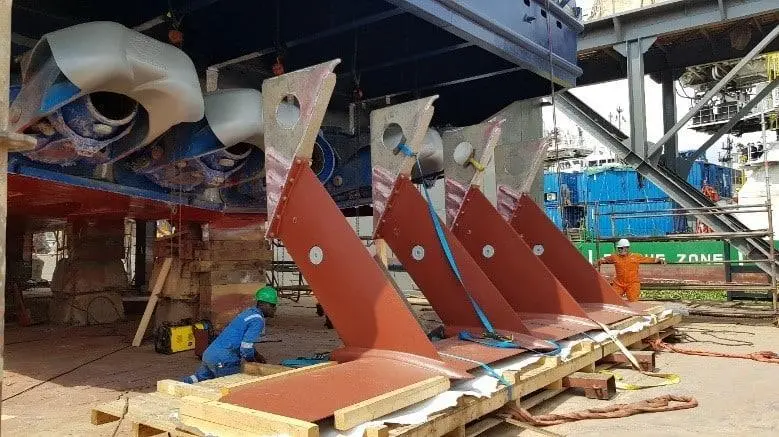
The project, carried out between TotalEnergies and Dutch developer Hull Vane, was carried out on a Fast Support Vessel (FSV) over several months.
The FSV Ava J McCall, 59 metres in length, transports goods and personnel to oil fields offshore Nigeria, and typically operates at 15-25 knots.
Sea trials confirmed that at 16 knots, fuel use was 16% less, and at 21 knots, 9% less. Over a year, that equates to 250,000 litres of diesel, says Hull Vane.
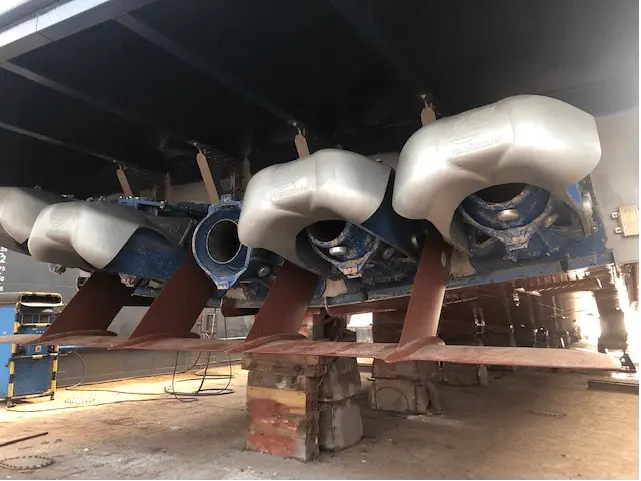
The technology is essentially a flap, called a Hull Vane, installed underneath the waterjets on the transom, without increasing the draft, beam or length of the vessel.
Acting like a submerged wing, the Hull Vane reduces the overall pressure resistance of ships that can range in size from 10m to 108m.
“The flow of water under a vessel’s stern isn’t always horizontal but angled upwards.” says Hull Vane. “Our Hull Vane has a profile shaped like a horizontal wing, which generates lift perpendicular to this flow. The horizontal component of this lift provides forward thrust that is transmitted through the Hull Vane’s struts.
“We designed and engineered the wing’s hydrodynamic profile so that the thrust it generates is greater than the drag it creates. In other words, the net result is reduced resistance for your vessel as a whole.”
The wing-shaped profile creates an accelerated flow of water over the upper surface, which produces a low-pressure region behind the vessel. This interacts with the vessel’s wake to suppress its stern wave much like a bulbous bow suppresses a vessel’s bow wave.
“There’s a direct correlation between a vessel’s wake, or wave pattern, and the power required for propulsion. Suppressing the stern wave therefore reduces fuel consumption.”
“This can be installed on all semi-displacement applications including offshore wind,” said Arjen Barendse, sales manager Commercial Ships with Hull Vane.
“For us, this customer feedback is a milestone, which underwrites the efficiency numbers and benefits we are able to achieve with a completely maintenance-free, 100% reliable mechanical solution as a patented underwater wing.
“But more important it is the start of major companies demanding sub-contractors reduce emissions as much as possible when tendering a new project with specific details. We will release a similar message from another major energy supplier soon.
“For Offshore Wind we are also very active mainly on CTVs, OSVs and USVs. Most CTV passengers are ‘land’ people working at sea. A side but very important effect for CTVs is that we improve the comfort on board by reducing pitching and slamming (uo to 20%) so that the vertical accelerations (sea sickness) will be reduced.
“Hull Vane can be integrated from new build design, but also as a retrofit. Many vessels receive a mid-life update and it would be perfect to add a Hull Vane to decrease the fuel consumption and environmental footprint, independent of whatever propulsion type is chosen (electric, dual fuel, hybrid, shaft, IPS, waterjet, etc).”
Barendse says another target group is the RoRo and passenger ferries, which have to run all year and have to comply with ETS, CII regulations. He estimates that on a RoRo vessel of 150 metres, 7-10% fuel savings could be achieved – making the return on investment less than a year.