![MaritimeJournal[Seawork]](https://www.maritimejournal.com/wp-content/uploads/2026/09/MaritimeJournalSeawork.svg)





On a mission to validate electric sea travel
A Swedish team has made history by successfully crossing the Baltic Sea in the Candela C-8 hydrofoiling electric boat to help validate the technology.
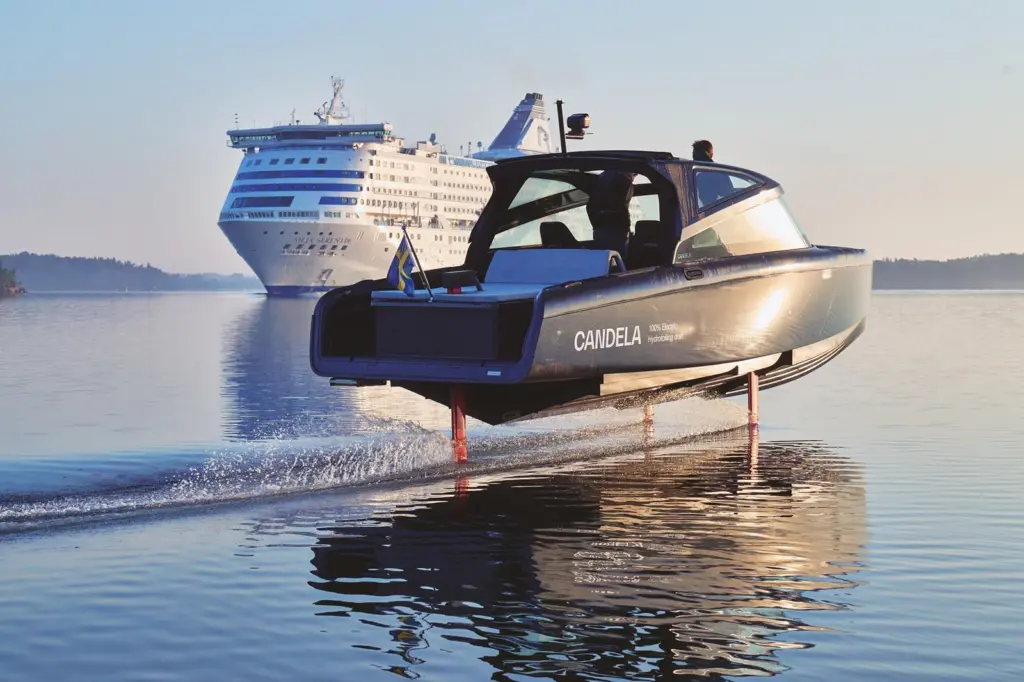
This marks the first time an electric boat has completed the journey between Sweden and Finland, significantly reducing emissions and costs compared to fossil-fuel-powered vessels.
“The aim was to demonstrate that zero-emission sea travel is not only possible today but also more cost-effective than traditional boats,” said Gustav Hasselskog, CEO of Candela.
“We can easily electrify coastal public transport at very low costs, not just in Sweden but across the world. It just requires political will to make the switch.”
Proving viability
The journey, made in mid-September, took the Candela C-8 from Stockholm to Mariehamn in the Åland Islands, covering 150 nautical miles.
The boat, equipped with a Polestar battery and powered by Candela’s hydrofoil technology, consumes 80% less energy than conventional ships, ensuring longer range and faster speeds.
“We’re talking about 95% lower operating costs. This is a revolution that makes waterborne transport competitive with land transport in terms of costs, which we will now demonstrate in public transport in Stockholm, said Hasselskog.
Candela is now gearing up to launch the electric ferry Candela P-12, which will soon serve Stockholm, helping prove the viability of electric boats in public transport.
The 30-passenger hydrofoil ferry will begin operating the Ekerö-Stockholm City Hall route, where it is expected to halve travel times thanks to not producing wake, which means it is permitted to travel quickly in the inner city.
Candela has recently announced a deal to electrify the water transport network in Saudi Arabia’s giant NEOM project, as well as ferries sold to cities ranging from Berlin to New Zealand.
Related Articles
 OTHER NEWS
 ACCESSORIES & EQUIPMENT
 SPECIAL REPORTS