![MaritimeJournal[Seawork]](https://www.maritimejournal.com/wp-content/uploads/2026/09/MaritimeJournalSeawork.svg)



Sweden launches three classes of high-speed rescue boats
The Swedish Sea Rescue Society (SSRS) is introducing three new classes of purpose-built rescue vessels designed by Birger Kullmann Design, strengthening its operations along Sweden’s coastline and archipelagos with entirely new technical solutions.
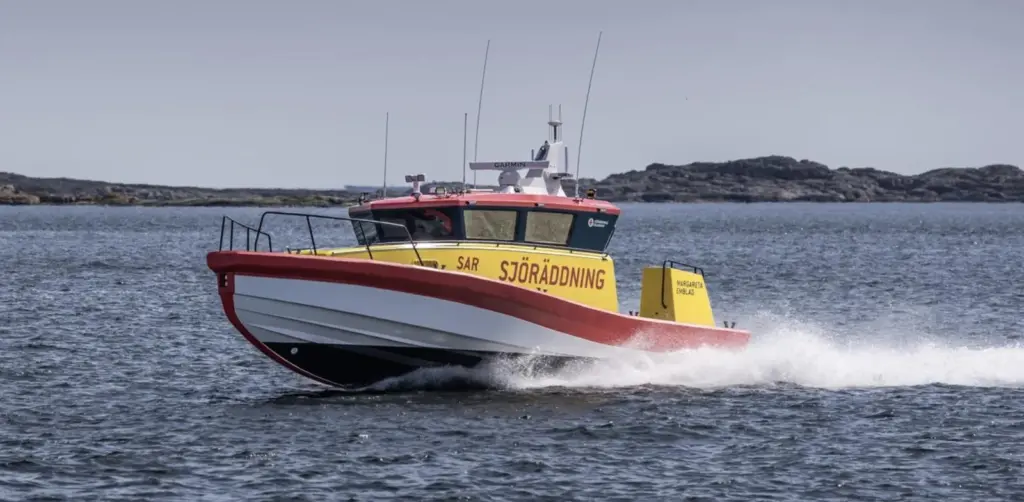
The programme encompasses three hull classes — the K9-SAR, K12-SAR and K15-SAR, with designations referring to each vessel’s length. The first K12 entered the water last year, the 9-metre K9 has just been launched, and the larger K15 – donated by King Carl XVI Gustaf – is now entering production.
The K9’s propulsion system centres on a single Volvo Penta D6 diesel engine paired with a Kongsberg Kamewa waterjet unit, a combination well suited to the shallow, obstacle-strewn waters of the Swedish archipelago where a conventional propeller shaft would be vulnerable. Waterjet propulsion also offers rapid acceleration and improved manoeuvrability in the close-quarters conditions typical of inshore rescue work.
Crew protection has been a core design consideration across the programme. Both the K9 and K12 are equipped with suspension seating from Ullman Dynamics, engineered to absorb the repeated shock loads generated during high-speed operations in rough seas, forces that can cause cumulative musculoskeletal injury to crew members over time.
The 9-metre K9 carries three Ullman Biscaya Jockey Seats, while the 12-metre K12 features four Ullman Daytona Crew Seats finished with mesh upholstery to aid ventilation during extended callouts.
The three-class programme reflects a comprehensive rethinking of SSRS rescue vessel design, with each hull size tailored to different operational demands. The K9 suits fast inshore response, the K12 offers greater range and enclosed crew protection, and the forthcoming K15 will extend the society’s capability into more exposed offshore waters.
By treating crew welfare — through suspension seating, ergonomic layout and appropriate propulsion — as an operational priority rather than an afterthought, the new vessels represent a significant step forward for Sweden’s volunteer rescue fleet.
Related Articles
 OTHER NEWS
 ACCESSORIES & EQUIPMENT
 SPECIAL REPORTS