![MaritimeJournal[Seawork]](https://www.maritimejournal.com/wp-content/uploads/2026/09/MaritimeJournalSeawork.svg)



Viking Line unveils future electric ferry vision
Viking Line has revealed a concept for its largest electric passenger-car ferry to date, a vision to decarbonise the Helsinki to Tallinn route in future.
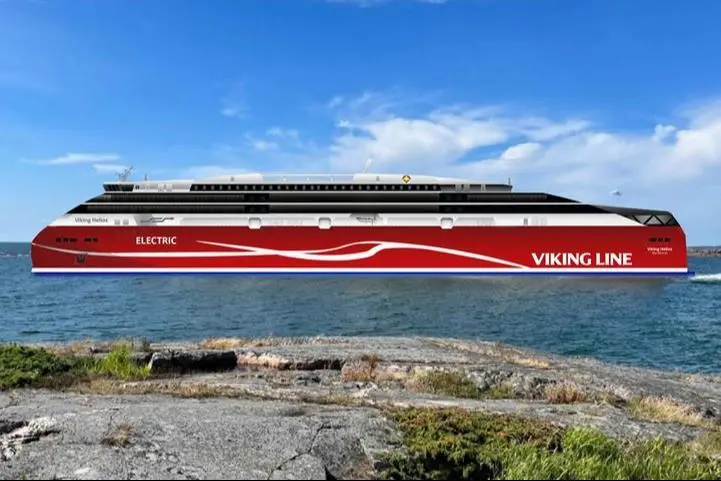
Named Helios, the fully battery-powered vessel aims to show how vessel electrification and emission-free maritime transport across the Gulf of Finland could be realised as early as the beginning of the 2030s.
“Helios heralds a new era in maritime transport, just like the first sail, steam and motor ships did in their time,” said Viking Line CEO Jan Hanses.
“The concept proves that large-scale emission-free maritime transport is no longer a utopia.”
Tailor-made
With battery capacity estimated at 85 to 100 megawatt hours, Helios will carry up to 2,000 passengers between destinations in just over two hours.
The electric ferry will be specifically tailored for the 80 km Helsinki to Tallinn route. Its innovative design omits a funnel and will feature a freight capacity of 2 kilometres.
Helios is the result of collaboration with Rauma shipyard and part of the FIN-EST Green Corridor initiative supported by the cities and ports of Helsinki and Tallinn.
“It is great that both cities and their ports have committed to creating a green maritime corridor. Electric shipping is not created solely by ship investments. It also requires efficient, reliable charging infrastructure in ports,” said Mr Hanses.
For this reason, the home port for the new electric vessels will be Jätkäsaari, where the Port of Helsinki has a development and expansion programme underway until 2032.
Because charging will need to take place in port with a requirement of over 30 MWh per stop, the need for reliable portside charging infrastructure is paramount.
Viking Line aims to order two electric ferries to double year-round capacity as demand rises. According to the Port of Helsinki’s forecasts, passenger traffic between the city’s West Harbour and Tallinn will increase from 5.5 million passengers in 2024 to 11.6 million by 2040.
Going forward,Viking Line said that battery power and vessel electrification will be key to meeting EU environmental targets as fossil fuel-based marine transport faces tighter regulations.
Related Articles
 OTHER NEWS
 ACCESSORIES & EQUIPMENT
 SPECIAL REPORTS