![MaritimeJournal[Seawork]](https://www.maritimejournal.com/wp-content/uploads/2026/09/MaritimeJournalSeawork.svg)






Wilson Sons prioritises sustainable tugboats
Wilson Sons is accelerating vessel build innovation to expand its sustainable tug capabilities and drive port decarbonisation across Brazil.
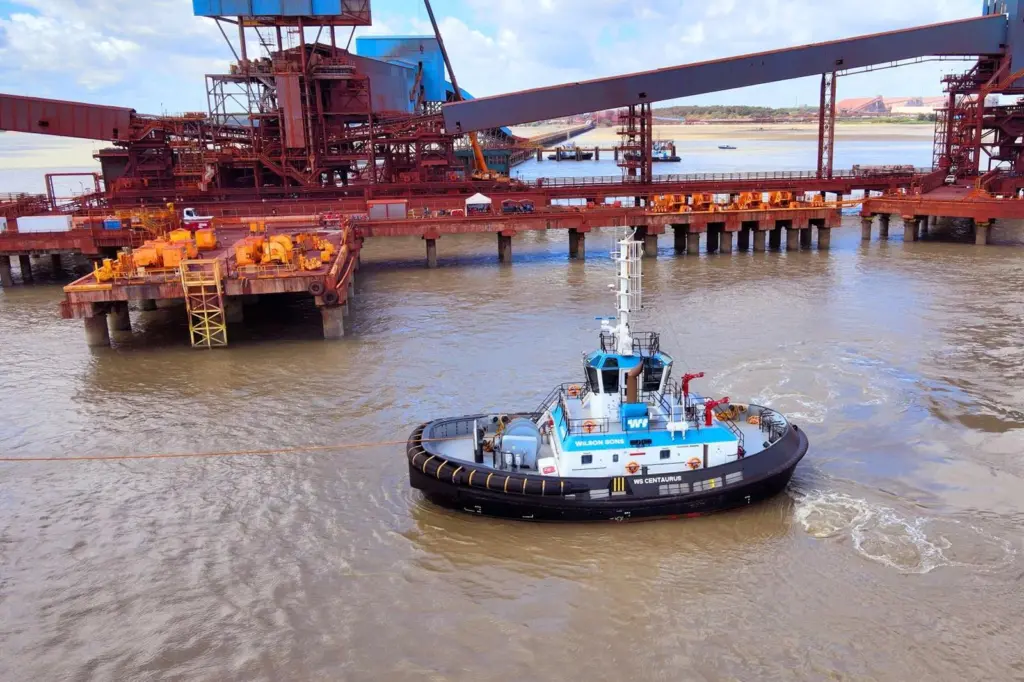
The company is rolling out advanced technologies in its towage division and container terminals to support major steps forward in vessel electrification and cleaner port operations.
“We reaffirm Wilson Sons’ commitment to sustainability by strengthening our strategy of applying the best environmental, social, and governance (ESG) practices to our businesses,” said Arnaldo Calbucci, CEO, Wilson Sons.
Green strategy
A central pillar of Wilson Sons’ strategy is the development of more efficient and sustainable tugboats.
Between 2022 and 2024, the company delivered six next-generation tugs from its Guarujá shipyard, each designed with an innovative hull that reduces greenhouse gas emissions and cuts fossil-fuel consumption by an estimated 14%.
With a fleet of more than 80 tugs operating along the Brazilian coast, these improvements are significantly enhance air quality in key port hubs.
In 2025, Wilson Sons began a new vessel build programme for three ultra-powerful sustainable tugboats, further strengthening its leadership in low-emission maritime support services.
Beyond tug technology, Wilson Sons is advancing port decarbonisation through operational optimisation and vessel electrification initiatives.
These include shore power use for tugs, prioritising renewable energy, fleet-tracking to minimise fuel burn and encouraging a major shift to electric cargo-handling equipment at its Rio Grande and Salvador container terminals.
The Rio Grande terminal now sources 100% renewable electricity, reinforcing the company’s pathway to cleaner logistics.
In recognition of its broad ESG progress, Wilson Sons earned the 2025 Diamond Sustainability Seal from Brazil’s Ministry of Ports and Airports during a ceremony at COP30.
The Sustainability Seal is a recognition and an incentive for companies with good ESG practices that have adhered to the Sustainability Pact established by Ordinance no. 58/2025.
It aims to help to reduce greenhouse gas emissions and to implement social and environmental programs aligned with the global Sustainable Development Goals (SDGs) of the 2030 Agenda.
Related Articles
 OTHER NEWS
 ACCESSORIES & EQUIPMENT
 SPECIAL REPORTS