![MaritimeJournal[Seawork]](https://www.maritimejournal.com/wp-content/uploads/2026/09/MaritimeJournalSeawork.svg)




Windcat and Damen launch first European Elevation series CSOV
Windcat Amsterdam has arrived in Europe, the first Elevation-series CSOV in the region and a new type of offshore vessel built for wind farm construction and maintenance.
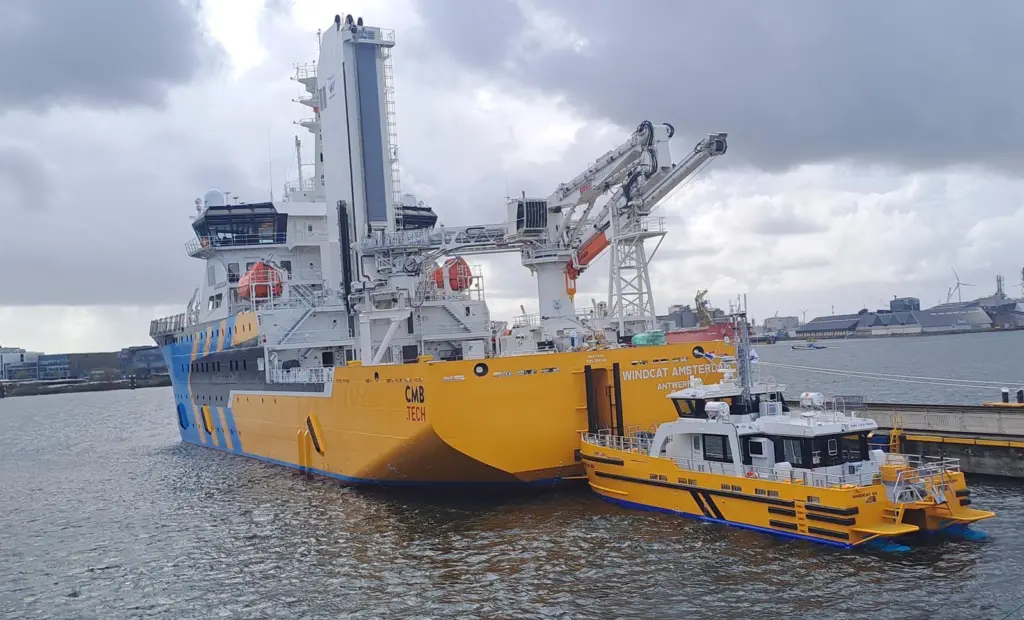
Guests including Maritime Journal attended the launch of the Windcat Workboats vessel in the Dutch capital this week, with a full tour of the 89.39m x 19.7m elevation vessel, which has a helipad, warehouse and 90 cabins for a total of 120 persons.
The vessel has been developed through a collaboration between Damen Shipyards Group and Windcat, and was built at Damen’s Ha Long yard in Vietnam – from where it set sail two and a half months ago, making incredible time given she had to go around Africa.
While primarily setting itself up as a company building offshore wind support vessels, Windcat Amsterdam will actually head to Aberdeen to work in the oil and gas industry.
The vessel, one of six intended to be built, is configured to remain offshore for extended periods of up to 30 days. It functions as a floating base, reducing the need for frequent transfers to shore and enabling continuous operations at offshore sites. This type of vessel is increasingly used in the offshore wind sector, where projects are moving further from shore and require more complex logistics and longer on-site presence.
As is becoming customary, Windcat Amsterdam is ‘hydrogen ready’, although cannot actually run on hydrogen yet because there are no approvals in place, which Windcat managing director Willem van der Wel says the company is working on. The company currently has two CTVs that run on 70% hydrogen with approvals in place, he says.
The dual-fuel hydrogen engine is intended to enable the auxiliary generator set to operate on hydrogen, and although the hydrogen genset, storage and fuel supply systems have been specified in the design, their installation is contingent on the regulatory approvals so at entry into service, the vessel will run on ABC diesel engines for retrofitting at a later stage once approved.
“Introducing our first CSOV to Europe is a proud moment for Windcat and for all partners involved,” he said. “Windcat Amsterdam sets a new standard in our fleet and in the industry and underscores our commitment to supporting Europe’s energy transition with reliable and future-proof vessels.”
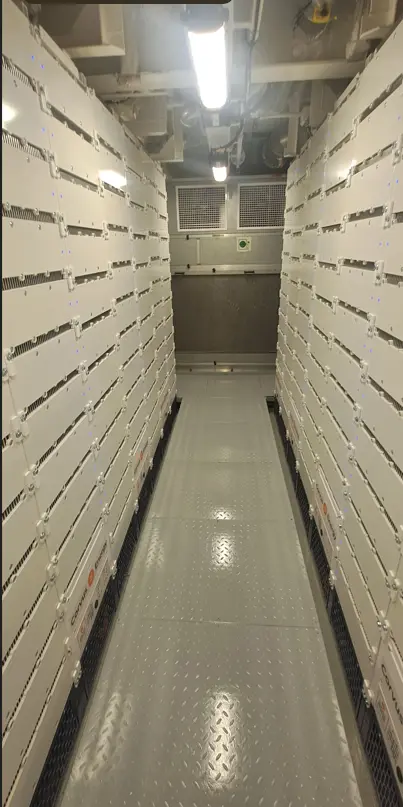
As well as the hydrogen set-up, the vessel has a battery room, with the onboard energy system designed to operate as an integrated network, managing power distribution across propulsion, hotel load and operational equipment. The vessel is fitted with four identical azimuth thrusters capable of 360-degree rotation, enabling dynamic positioning and precise manoeuvring alongside offshore structures.
The design also includes motion-compensated access systems intended to maintain operability in variable sea conditions. A 3D motion-compensated gangway allows personnel transfer between the vessel and offshore installations, with a vertical operating range designed to accommodate wave motion. It also has a 10-tonne 3D motion-compensated crane, enabling cargo transfers in conditions that would typically limit operations. These systems are aimed at reducing weather-related downtime, a key factor in offshore project efficiency.
Windcat itself has operated in the offshore wind sector for more than two decades, primarily providing crew transfer services. The company manages a fleet of more than 60 CTVs and has been expanding into larger offshore support vessels such as CSOVs in response to evolving project requirements. It is now part of CMB.TECH, the Belgium-based maritime group with a diversified fleet spanning dry bulk, tankers, container shipping and offshore vessels. CMB.TECH has also invested in alternative fuel development, including hydrogen and ammonia.
The introduction of Windcat Amsterdam comes at a time when European offshore wind projects are scaling up in size and distance from shore, increasing demand for vessels capable of supporting longer-duration operations. CSOVs are expected to play a central role in this shift, combining accommodation, logistics and technical support functions in a single platform.
Coming soon: A closer look inside Windcat Amsterdam.
Related Articles
 OTHER NEWS
 ACCESSORIES & EQUIPMENT
 SPECIAL REPORTS