![MaritimeJournal[Seawork]](https://www.maritimejournal.com/wp-content/uploads/2026/09/MaritimeJournalSeawork.svg)



World’s largest electric ferry boards semi-sub before voyage to South America
Australian shipbuilder Incat Crowther has reached a major milestone with what it describes as the world’s largest battery-electric ship.
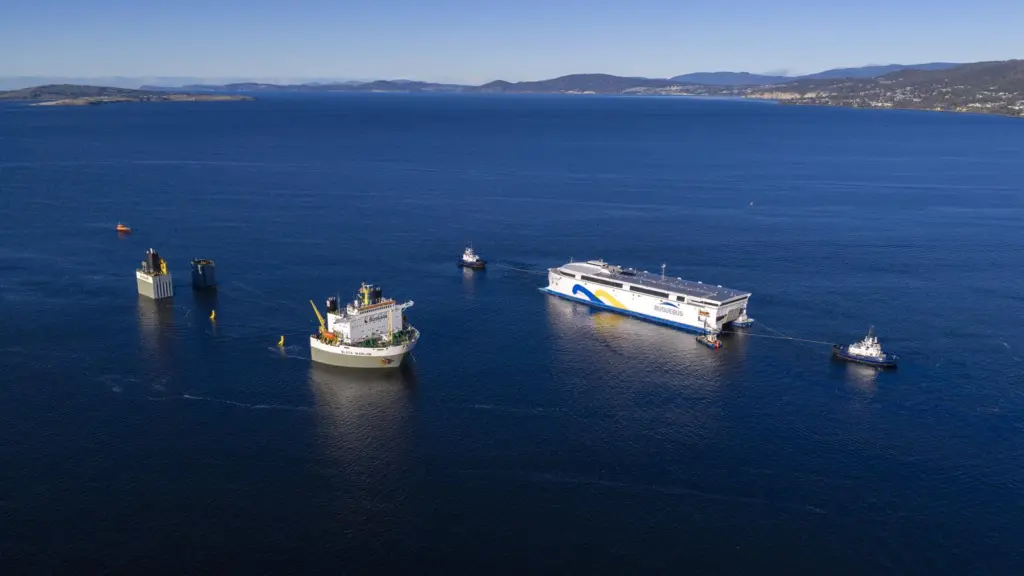
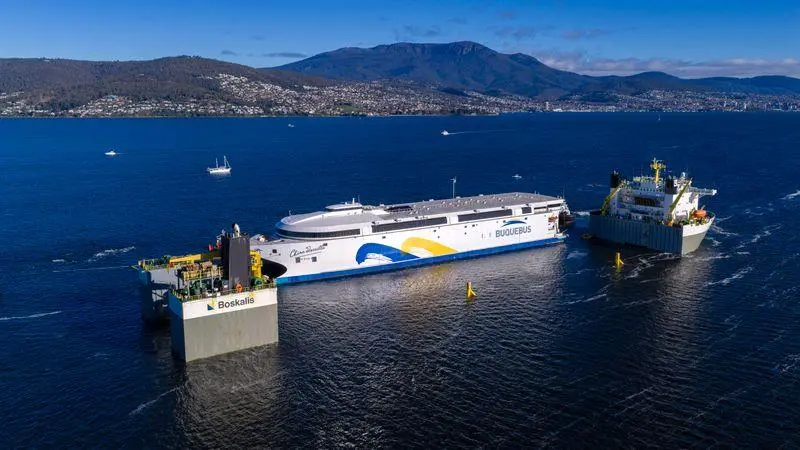
The company has completed one of the most complex maritime operations ever undertaken in Tasmania, loading Hull 096 aboard the semi-submersible heavy-lift vessel Black Marlin ahead of its 40-day voyage to South America.
The operation on the River Derwent saw Black Marlin ballast down beneath the waterline before Hull 096 was manoeuvred into position over its submerged cargo deck. The heavy-lift vessel is now being refloated, gradually lifting the ferry clear of the water before final sea fastening ahead of its ocean journey.
Black Marlin is one of the world’s best-known semi-submersible heavy-lift vessels, owned by Boskalis. At 217.8 metres long, it is designed to transport extremely large floating structures, including drilling rigs, FPSOs, naval vessels, floating docks, offshore platforms, and now the 130-metre battery-electric ferry for delivery from Tasmania to South America.
The loading marks the latest milestone in a project that has attracted international attention and represents years of planning, engineering and construction at Incat’s Hobart shipyard in Australia.
Incat chairman Robert Clifford described the moment as significant not only for the company but for the wider maritime industry.
“This is an extraordinary moment, not just for Incat, but for the future of sustainable maritime transport,” he said.
“For years we’ve watched this vessel evolve from an idea into reality, and today we’ve reached another incredible milestone in the most significant project in Incat’s history.”
Mr Clifford said Hull 096 had challenged conventional thinking throughout its development and showcased the expertise of the hundreds of people involved in its design and construction.
He added that the vessel had generated worldwide interest because it demonstrated that large, high-speed battery-electric ferries are now commercially viable.
Electric ferries are becoming an increasingly common sight on waterways across Europe, Asia and North America. Advances in battery technology, combined with stricter emissions targets and government support, have driven rapid growth in the sector, particularly on short and medium-distance routes.
Once preparations aboard Black Marlin are complete, the heavy-lift ship will depart Hobart for South America.
There, Hull 096 will be offloaded for final commissioning before entering service with ferry operator Buquebus on one of the world’s busiest passenger ferry routes, connecting Argentina and Uruguay across the Río de la Plata.
Related Articles
 OTHER NEWS
 ACCESSORIES & EQUIPMENT
 SPECIAL REPORTS