




Design for Surface Effect Ship (SES) WFSV
Norwegian company Umoe Mandal has developed designs for a wind farm service vessel based on the surface effect ship (SES) principle.
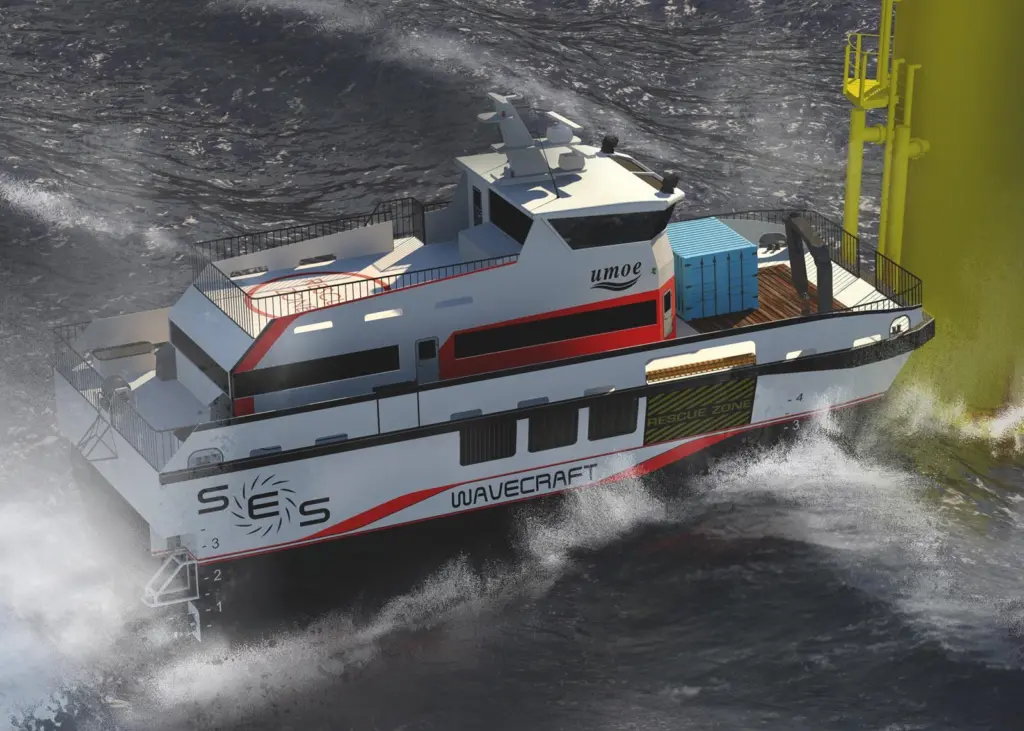
Umoe Mandal has long experience of developing surface effect vessels from their range of very high speed military craft built for the Swedish Navy. They claim that a wind farm vessel based on the SES principle would be capable of higher speeds than conventional catamarans and would also be able to provide access in higher sea states because of the air cushion stabilisation.
The Wave Craft Express design developed by Umoe would have a length of 26m and a beam of 10m and in plan view would be virtually rectangular in shape. When raised on its air cushion the draft would be just 0.7m. Construction of the rigid hull and superstructure would be in advanced composites.
The air cushion is created in a space below the hull that is enclosed by the rigid side wall of the catamaran hulls. At the bow there is a flexible skirt fitted with ‘bow fingers’ angled towards the rear at the bottom that creates a seal for the air chamber and which can adapt to oncoming waves. At the stern there is what Umoe calls a ‘lobe bag’ that creates a moveable seal there with the enclosed air able to filter out at the bottom.
The Wave Craft Express will be powered by a pair of diesel engines coupled to water jet propulsion. Umoe is confident from past experience that the water jets will operate effectively despite the close presence of the enclosed air cushion to the jet intakes. Separate engines will power the lift fans installed in the superstructure.
Umoe claim that a top speed of 45 knots will be possible, which is a much higher speed than current wind farm support vessels. During transfer operation at the turbines they claim that the air cushion will help to stabilise the craft and they are confident that transfers can take place in conditions with a 2.5m significant wave height. The vessel will be able to cope with even higher waves in heavy swell conditions.
The cargo capacity will be 4 tonnes and there will be accommodation for 12 passengers. The design can be customised to meet the specific needs of clients. With a range of 700 plus miles, the need for refuelling will be reduced.
Umoe claims that the high transit speed of this concept will allow operators to take advantage of smaller weather windows than conventional catamarans which could be a significant factor as construction work move further offshore. This development project is supported by The Research Council of Norway.
Further information: www.um.no
By Dag Pike
Related Articles
 OFFSHORE RENEWABLES
 OTHER NEWS
 MARINE CIVILS NEWS