




IMO is committing fuel fraud in the name of compliance – opinion
IMO regulations are not just failing to cut emissions, they are actively incentivising operators to game the system, says Rob Mortimer, founder of Fuelre4m, who will be presenting at Seawork in June this year.

When staying compliant and finding loopholes is more profitable than genuinely reducing consumption, regulations have failed, he says, and right now, that is exactly where we are.
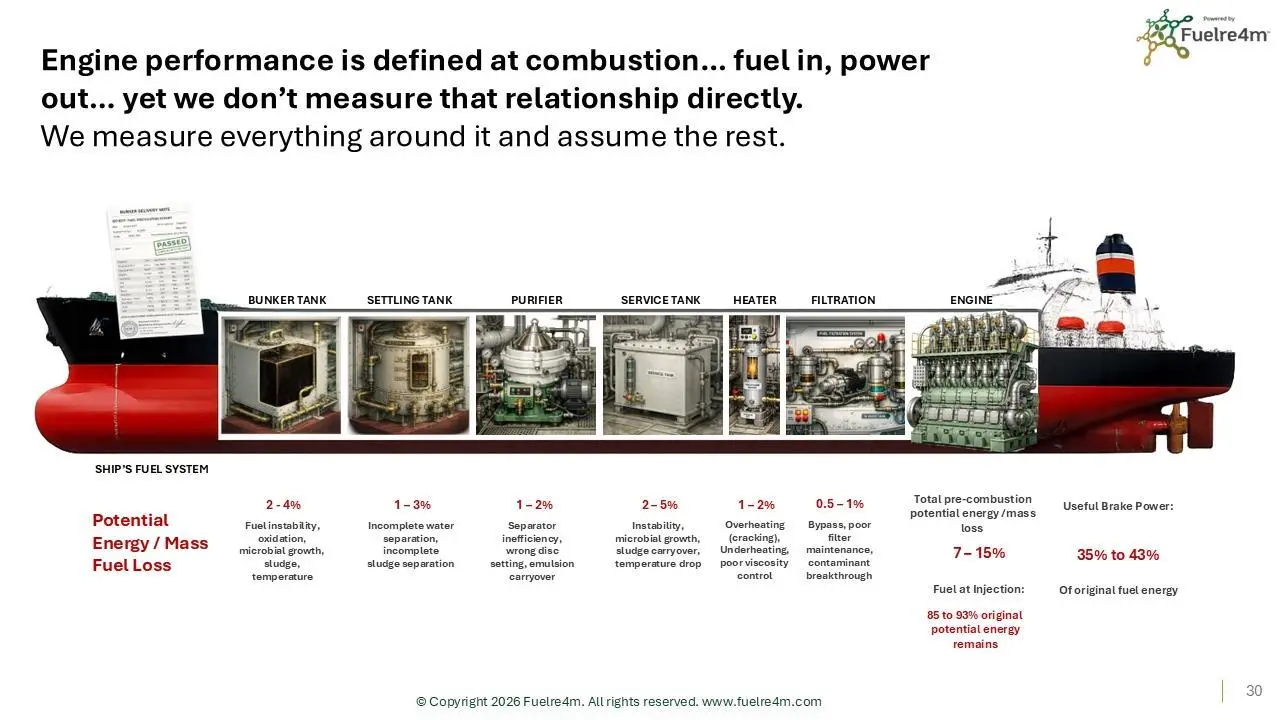
“Fuel has always been accounted for after the fact in maritime operations, on the assumption that a tonne of diesel is a tonne of diesel – uniform in quality, predictable in output,” Mortimer says. “It is not. There is a wide specification window within which fuel can legally be sold, and that window tells operators nothing about how much energy they will actually extract from it.
“The specification exists to protect the engine. It says nothing about how efficiently that fuel will combust, how much power it will deliver to the shaft, or how much of its calorific value will simply be wasted as heat and unburnt emissions.”
Into the gap between potential energy and realised power the IMO has implemented an enormous regulatory apparatus, he says.
“The IMO regulations are encouraging operators to commit fuel fraud. Nobody is accounting for every drop of fuel being used to make sure it’s converting as efficiently as possible to energy. Instead we are trading emissions rather than cutting them.
“When did the IMO turn from being regulatory compliance to now being in charge of one of the biggest budgets we’ve ever seen? It’s crazy. The people that are suffering in the end are the businesses that are now having to lose more of their margin. I won’t say profit because some are being forced out of business by having to do all this compliance.
“People want to save money but they also want to stay compliant, and they can see that if they find the right loopholes it’s more profitable than trying to reduce consumption and emissions. We’re driving in the wrong direction.”
The irony is that since the focus was on reducing fossil fuel consumption, it has increased year on year, he says.
Emissions trading schemes allow larger operators to aggregate credits across fleets and generate more emissions on paper while appearing compliant. The push towards dual-fuel vessels forces operators to hedge on which secondary fuel will be viable, knowing many will never significantly use it. Biodiesel and HVO are marketed as clean alternatives, yet an end-to-end analysis of their production, transport and combustion performance rarely supports the claim.
Meanwhile, engine manufacturers and fuel companies are lobbying the IMO most heavily, and stand to benefit most from a regulatory direction that mandates new engine types, complex dual-fuel infrastructure, and expensive technology transitions.
Another irony is that the IMO’s own targets –ambitious, well intentioned, but largely unmet – could plausibly be reached without any of this.
Pre-combustion fuel optimisation
Fuelre4m’s technology is essentially a fuel-conditioning reformer. In December 2024, the company ran bollard pull tests on two tugboats in the UAE, Mortimer says. The first, a 2015-built vessel that had consistently pulled 70–71 tonnes throughout its working life, was retested under baseline conditions and pulled the same. The fuel was then dosed with Fuelre4m’s product, and 12 hours later, the same tug pulled 82 tonnes.
A second, smaller tug rated at around 55 tonnes moved 60–61 tonnes. On a twin-engine vessel, one side was dosed and the other left untreated: the dosed side achieved the same power output at a measurably lower RPM. The conclusion is not that the additive is ‘saving fuel’ in the conventional sense, but unlocking more of the potential energy already present in the fuel that was previously being wasted.
The science behind this is straightforward, Mortimer says.
Diesel is not a homogenous substance. When injected into a combustion chamber, the fuel arrives as droplets of varying size. Large droplets can only begin burning from their outer surface; by the time the molecules at the core start to combust, the piston has moved past the optimal moment for energy transfer, leaving waste heat, unburnt particulates and emissions.
Fuelre4m’s reformer mechanically alters the surface tension behaviour of fuel molecules. When shaken, treated fuel breaks into fine, stable droplets that do not re-coalesce, unlike untreated fuel, which reverts to larger droplets. The result is a finer, more uniform atomisation on injection, a greater surface area of fuel exposed to oxygen, and a more complete, earlier primary combustion.
The company estimates this improves fuel combustibility by 7.5-11%, which translates to 15-20% more power to the shaft, which means a 1% improvement in combustion efficiency yields approximately 2.5% more shaft output.
“If performance is not anchored to fuel and power, it cannot be recovered, only interpreted. If your performance is judged in the weather, it will always be in the weather,” he says.
The approach works across fuel types. The product has been tested on biodiesel blends and shows greater proportional savings than on standard diesel, precisely because biodiesel’s combustion characteristics are less consistent.
Methanol, which has an even wider specification window than diesel, presents the same challenge: two batches with identical stated energy density can deliver markedly different shaft output. The industry is preparing to invest heavily in methanol-capable engines while largely ignoring the question of whether the methanol itself will combust reliably. Fuelre4m argues that pre-combustion conditioning should be applied to every fuel type to ensure that test-bed performance translates to real-world operation.
There is a practical implication that the industry has not yet fully absorbed, Rob Mortimer believes. All post-combustion efficiency gains – hull cleaning, propeller upgrades, voyage optimisation, trim management – are calculated against a fixed baseline of shaft power. If pre-combustion optimisation raises that baseline by 15%, every post-combustion measure becomes proportionally more effective. Investing in fuel quality before combustion amplifies everything done afterwards.
For smaller vessels and workboats in particular, the arithmetic is compelling. Pre-combustion optimisation requires no capital expenditure on new engines, no dual-fuel infrastructure, no speculation on which alternative fuel standard will survive the decade. It requires measurement – a fuel flow meter in, a flow meter out, and a torque meter on the shaft – and a willingness to act on what the data actually show rather than adjusting the numbers to fit received theory.
The maritime industry is not short of ambition when it comes to decarbonisation. What it is short of is honesty about where the energy is actually going, and who benefits from the current direction of travel.
A regulatory framework that rewards visible compliance over measurable reduction is not a path to lower emissions, it is a business model for those positioned to exploit it. Pre-combustion optimisation will not attract the same investment flows or generate the same engine sales, but it would actually achieve what all the compliance regulations are failing to do.
Rob Mortimer is founder of Fuelre4m, a fuel conditioning technology company operating in the maritime and industrial sectors. He will be presenting at this year’s Seawork exhibition and conference in Southampton, June 9-11.