



A devastating fire at Glasgow Central Station in March this year has brought the dangers of lithium-ion batteries into the spotlight again. With witnesses saying they saw the smoke billowing from a drawer behind the counter at an adjacent vape shop, it seems fairly obvious that it was a lithium-ion battery that sparked the fire, with vapes being powered by these batteries.
Joining IIMS in 2014 without a technical background, Mike Schwarz leveraged senior UK media and membership leadership experience to drive digital transformation, chairing the MCA’s Certifying Authority group, championing global surveying standards, and serving on industry bodies.
This is his insight into the quiet danger lurking on all vessels.
I do not plan to address here the specific issues of lithium-ion (li-ion) battery fires on electric-powered boats or ships, nor will I discuss the electric vehicles that have caught fire in high-profile incidents at sea on car carriers. That’s a topic for another day!
I also don’t intend to scare anyone: there are millions of li-ion powered devices in the world and the vast majority perform their function without drama or malfunction. But there is growing evidence to show that li-ion batteries, for all their advantages, present some significant challenges when things go wrong, especially in the maritime sector.

There is no evidence to suggest that a li-ion battery blaze is more likely to happen than a conventional fire, but the reality is that when one does happen, the results are usually rapid and explosive and often lead to a total loss.
The inferno represents immediate danger to crew, passengers and the vessel itself, as well as neighbouring boats and even harbour infrastructure. Unlike a fire in an electric vehicle on the road, where the driver can pull over and escape, that luxury is not afforded to those at sea.
In recent years, the number of fires aboard vessels has risen dramatically. Li-ion batteries are commonplace these days and the plethora of high-end water toys and electric devices are causing catastrophic fires on boats: this could be overheating while charging or damage in storage.
Lithium is a highly reactive alkaline metal and the chemistry behind the batteries is complex. This makes it ideal for storing large amounts of energy in battery form but also makes it potentially explosive when something goes wrong.
It’s all about the construction of the cells. When in use, electrons flow between the cathode and the anode through a perforated separator. If this membrane breaks down, either through poor manufacture, old age or mishandling, a short circuit can occur.
Then the cell quickly heats up, the electrolyte expands and a toxic, flammable gas is vented, sometimes explosively. In bigger batteries with multiple cells, the heat starts to damage neighbouring cells, which then also malfunction. This process is called thermal runaway and once triggered, it is almost impossible to stop. When the cell is breached, highly reactive lithium simply adds fuel to the fire.
Thermal runaway is a dangerous, self-sustaining chain reaction in li-ion batteries where internal heat exceeds heat dissipation, leading to excessive temperatures. It causes rapid, uncontrollable temperature rises, releasing toxic and flammable gases - known as off gassing - and often results in fires or explosions. The toxic fumes are a rarified mix of substances, and if inhaled could kill.
Fire suppression systems and extinguishers are not yet effective enough to guarantee putting out a li-ion fire once it has taken hold, and worryingly, there is an ongoing risk that the device could reignite hours, days or even weeks after the event.
Case study 1
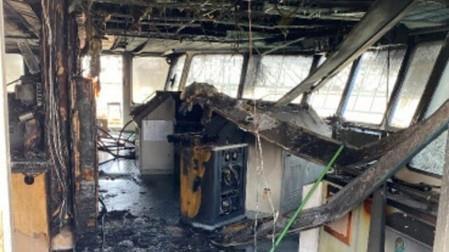
The National Transportation Safety Board investigated a blaze on the bridge of the crude tanker S-Trust on 13 November. The damage to navigation and communication equipment on the vessel was estimated at $3 million.
Investigators found the remains of three batteries (one nickel-metal hydride and two lithium-ion) on the communications table. The single nickel-metal hydride battery (all of its six cells) was intact; one of the lithium-ion batteries (both cells) was found intact in the remains of the charger. Investigators only found components of the second lithium-ion battery (a two-cell battery).
Case study 2
Fire Service issues reminder on dangers of lithium-ion batteries following Gayton Marina boat fire

Early on the morning of 5 August 2025, a li-ion battery fire occurred at Gayton Marina in Northamptonshire on a day boat that had been left on charge overnight. It was the first known event of its kind on the UK canal network. The explosion literally shook the marina, the boats moored in it and rocked the wider canal community; yet this story did not even make national news headlines.
Just moments before the local fire brigade were ready to start tackling the flames, the boat exploded with such force that anyone on board would not have survived the blast. The results of any subsequent internal investigation, if there was one, remain unknown.
Area Manager Neil Sadler, of Northamptonshire Fire and Rescue Service, said: “Lithium-ion batteries come in all shapes and sizes and are used in everyday items we all own, so we want to remind people of the hazards they can sometimes pose.
“If they overheat or are punctured, crushed or overcharged, then they can release a flammable vapour which can ignite, burn or in some cases explode.
“We want to ensure people follow the appropriate safety advice to mitigate any risks that lithium-ion batteries can pose in products we use every day, such as mobile phones, electric cars, charging devices and tools.
“The main advice is for people not to put these batteries in the bin. Make sure you take them to your local household recycling centre so that staff there can dispose of them safely.”
Protection is key and there are some simple yet essential things that can be done.
In most cases, regulators remain behind the curve as far as li-ion battery technology is concerned. However, there are industry guidelines emerging as more becomes known. The US Coast Guard Safety Alert 14-25, for example, covers hazards that are linked to li-ion batteries and urges proper inspection regimes and crew training.
There are also practical, common sense steps. Make sure that li-ion batteries are certified to UL, CE or IEC standards. At all costs, avoid cheaper products, such as chargers, and stick to the manufacturer’s specifications.
Mixing battery types must be avoided. Compatibility between batteries, devices and chargers must be verified to avoid electrical mismatches that could cause overheating or failure. For shipboard use, all procurement should be documented in inventory logs to ensure traceability and accountability.
Essential tips
- Any li-ion battery propulsion installation should have been installed by a competent person. Are you able to check this is the case? And does it meet the ISO 23625:2025 Small craft - Lithium-ion batteries standard published last year?
- Devices should never be left on charge overnight unattended. Even when charging in the daytime, have line of sight to your device on charge.
- Check batteries regularly. Look for any signs of swelling, corrosion or weeping. Isolate it in a secure place if it looks odd.
- Never accept a charger offered by someone else because you have left yours behind. You cannot vouch for its authenticity.
- Buy replacement batteries or chargers from trusted suppliers, and always choose a genuine, branded product.
- Never cover chargers and make sure charging is done in a well-ventilated area.
- Always charge in cool, open areas and avoid charging in direct sunlight or heat.
- Never charge a li-ion battery device in a place where you would need an escape route in the event of a fire - the speed and rapid spread of any fire could block your way out.
- If you see white vapour that may look like smoke coming from a battery then get out, stay out and call the fire service immediately.