





Powering the Fehmarnbelt
The 18 km long Fehmarnbelt tunnel about to be built between Germany and Denmark with its electrified rail operation and a fully lit road tunnel will require the security of an uninterrupted power supply. As a consequence, the world’s longest road and rail tunnel will have its own, major substation at Rødbyhavn.
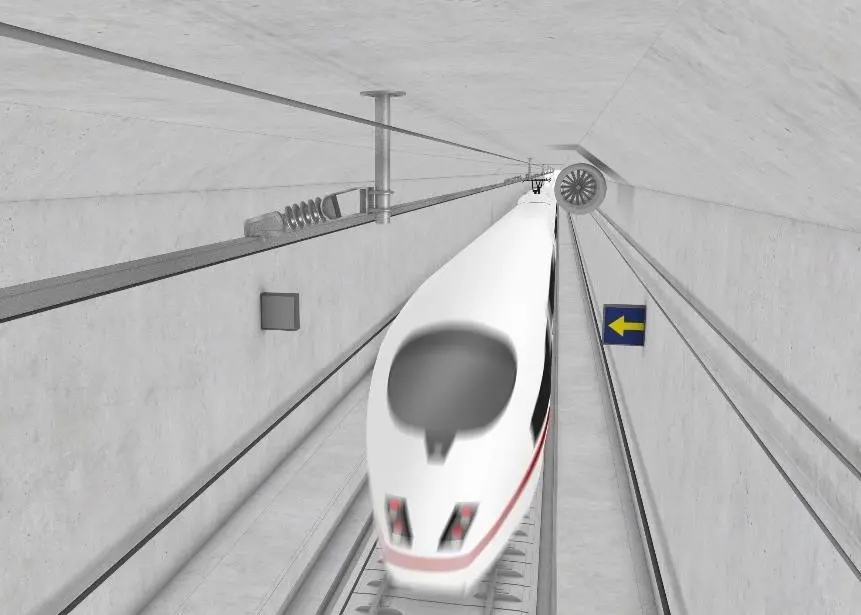
The substation will supply power equivalent to a total annual electricity consumption of 60 gigawatt-hours (GWh) to the Fehmarnbelt tunnel. This corresponds roughly to the consumption of a large provincial town with 10,000 households – or Maribo and Sakskøbing combined. The total power is approximately 120 MW. In terms of area, it will occupy 20,000 square metres, equivalent to nearly three football pitches of the same size as Parken in Copenhagen.
The facility brings exciting but proven technology and construction methods, which are being introduced into Denmark for the first time. These include climate-proofing, so that the substation is not in danger of being flooded by storm surge on the low-lying island of Lolland. This will be achieved with a cofferdam driven into the ground, which will form a watertight, four metre high barrier around the substation.
Furthermore, there is the need to ensure that the huge, high-voltage facility does not interfere with the surroundings in sparsely populated areas. For example, by affecting the train on the way to and from the tunnel. If it is not shielded effectively against electronic ‘noise’ in the form of electromagnetic radiation, it may, at worst, mean that the power is turned off, or mobile phones crash. The problem will be addressed by applying new technology in the form of power electronics, which are already used in a number of countries with electrified railways.
“This method for building substations has not been seen before in Denmark. We are introducing a comprehensive security system in relation to both climate change and electromagnetic noise, which is based on proven technology that is in use today in many parts of the world,” said Johnny Restrup-Sørensen, contract director at Femern A/S.
The electric trains will use most of the power from the substation. According to estimates, up to 120 trains, both passenger and freight, will pass through the tunnel each day – this is where the power electronics need to prevent interference.
The plan is that the trains will run on Danish power through the tunnel and along a short stretch of land on Fehmarn, where they will switch over to the German electricity system. The Germans will be able to engage a temporary supply if the power were to go down in the tunnel.
Femern A/S has pre-qualified three consortia to bid to build the substation: the Danish Bravida Danmark A/S, the Danish-French Siemens A/S and Cegelec Mobility, and Elektrobudowa SA from Poland.
By Jake Frith
Related Articles
 MERGERS & ACQUISITIONS
 MARINE CIVILS NEWS
 ENVIRONMENT