


Rostock expansion targets bigger ships
The German Baltic seaport Rostock is investing heavily again this year in major terminal and quayside expansion to meet the benefits offered by approach channel deepening set to begin next year, writes Tom Todd.
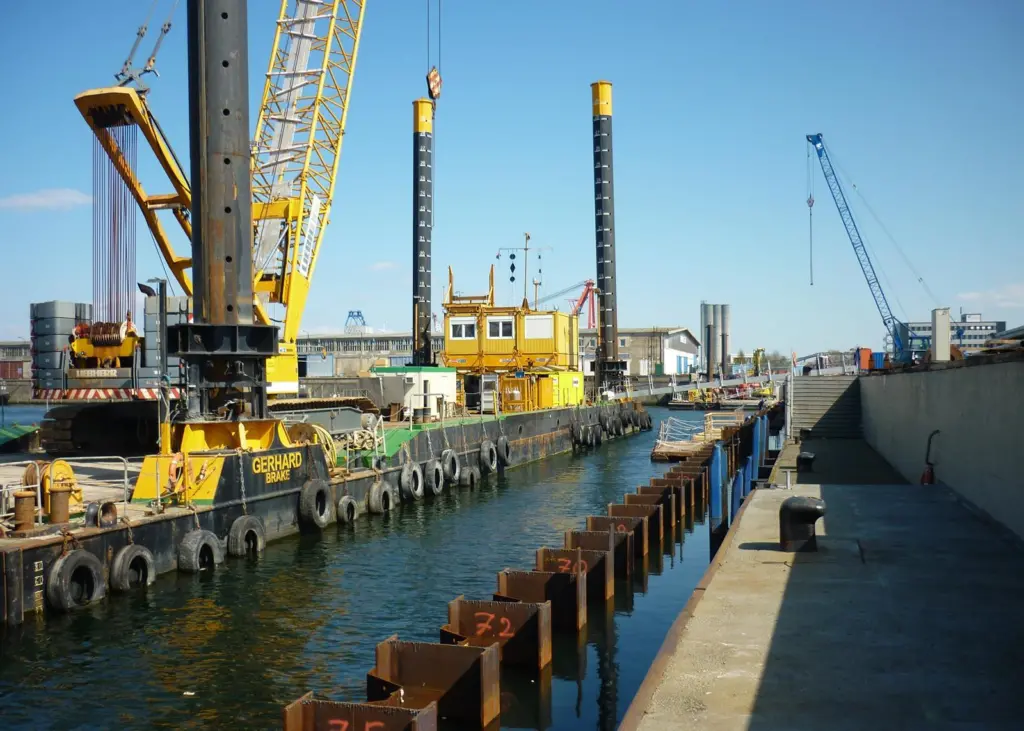
Some €30 million are being ploughed into infrastructure and superstructure renovation and improvement this year in the port’s main Überseehafen. It’s just the latest in a series of big investments in advance of approach channel deepening.
Last year investment by Rostock Port GmbH was even higher at €40 million – a ten year record, according to Jens Scharner, one of the company’s two managing directors. In the five years up to 2023 about €250 million are being invested, added fellow MD Gernot Tesch.
Many of Rostock’s main harbor basins as well as much of its superstructure – like warehouses, offices and handling cranes – date back to a time long before German reunification in 1990 when Rostock was the main port of the GDR. The Überseehafen in fact turned 60 in April.
EXPENSIVE PROCESS
Replacement and renovation is an ongoing and expensive process designed to provide deepened main harbours and modern terminals able to handle the bigger ships and increased cargo volumes which Rostock Port believes a deepened approach channel will bring.
It is hoped that in turn will cement the significance of a port which some people once believed was destined for backwater status in the shadow of Hamburg and Bremen/Bremerhaven after German reunification in 1990. It has in fact become the biggest German universal port on the Baltic – one handling 27.2 million tons a year and offering a unique north-south-east, Scandinavia-East Europe traffic flow advantage to boot.
The deepening of the 15kms navigable channel into Rostock’s Überseehafen from 14.5m to 16.5m will mean the dredging of an estimated 5.6 million m3. It is expected to take two and a half years to complete and cost in excess of €100 million. In charge of deepening, last undertaken in 1999, will be the German Government’s Waterways and Shipping Administration (WSV).
As that work approaches, port projects are being completed well in time to benefit.
Being finished in May was the two-year renewal and expansion of the 270m bulk handling Berth 23 in the Überseehafen. The port said the facility, more than 50 years old, had reached the end of its useful life. Rostock Port spokesman Jörg Litschka told Maritime Journal the €17 million renewal project was begun in 2018 to cope with expected bigger bulkers. It was the first major engineering project in Rostock to anticipate approach channel deepening, he said.
Most of the work on Berth 23 was finished last year. But surface load improvement from two to five tons, track work and dredging from11.5m to 14.5m was being completed this year. Rostock Port Construction Project Head Dirk Warning told Maritime Journal 130,000m3 were being dredged.
Berth 23 work has been handled by a consortium grouping Ed. Züblin Rostock and TAGU Tiefbau Unterweser, Oldenburg.
Looking even further ahead Jörg Litschka noted that although ships drawing maximum 13m could currently berth in the Überseehafen, work was underway to improve water depths generally for ships drawing up to 16m.
RORO IMPROVEMENTS
RoRo cargo berth expansion to cope with ever-bigger ships was also reported well advanced. The Berth 62 project for ships of maximum 220m was finished last year. The bigger Berth 63 for ships up to 250m was finished in spring.
Part of that €13.5 million project has been the construction of a new wall in front of the existing Berth 62 and 63 quay walls with scour protection and mooring points. Warning told MJ a consortium comprising Ed. Züblin in Rostock, Colcrete- von Essen Wasserbau in Eckermünde and Aug. Prien Bauunternehmung in Hamburg handled the work.
RoRo berth improvement was also the motivation for the €6.7million Berth 50 project begun in late 2018 and finished earlier this year. Two new RoRo ramps provide more handling. A new quay wall with scour protection and two mooring dolphins was created here also, in front of the existing wall. The facility is suitable for RoRo cargo ships of 189m length drawing 6.2m.
Warning said a consortium grouping Colcrete-von Essen in Rastede and Aug. Prien Bauunternehmung in Hamburg were responsible for the Berth 50 project.
Related Articles
 MARINE CONSTRUCTION
 EQUIPMENT
 MARINE CONSTRUCTION