![MaritimeJournal[Seawork]](https://www.maritimejournal.com/wp-content/uploads/2026/09/MaritimeJournalSeawork.svg)




Salvage operations keep SMIT busy
Salvage teams from Rotterdam and other SMIT Salvage locations worldwide have responded to a series of marine emergencies in recent months. Operations in the third quarter included the response to the plight of the chemical/oil tanker Peonia, aground off Cape Verde.
Peonia
was on a voyage from Argentina to Algeria when the grounding happened on 1 July. SMIT obtained a Lloyds Form and mobilised a salvage team of nine from the company’s Rotterdam headquarters. At that time one of SMIT’s senior salvage masters, accompanied by a naval architect, was returning to Rotterdam following the successful refloating of the casualty
Gulf Nomad
at Maputo, Mozambique. They were both diverted to Cape Verde, to lead the salvage effort.
It was obvious from the first that the prelude to a refloating would be the discharge of bunkers and cargo. There was flooding in the forepeak and in five ballast tanks to port and starboard.
Tugs were mobilised from West Africa and a lightering vessel was despatched from the Mediterranean. Meanwhile, the salvage master got to grips with an immediate problem, the casualty’s excessive movement in the big swells. There was a danger of severe additional bottom damage. With this in mind, the decision was taken to move quickly and attempt a refloating, rather than wait for the lightering vessel to arrive. Despite the significant difficulties, the ship was freed on 9 July and towed to a nearby location for a ship to ship transfer to the lightering tanker Alice. Following completion of the STS in Porto Grande Bay, the Peonia was redelivered on 23 July.
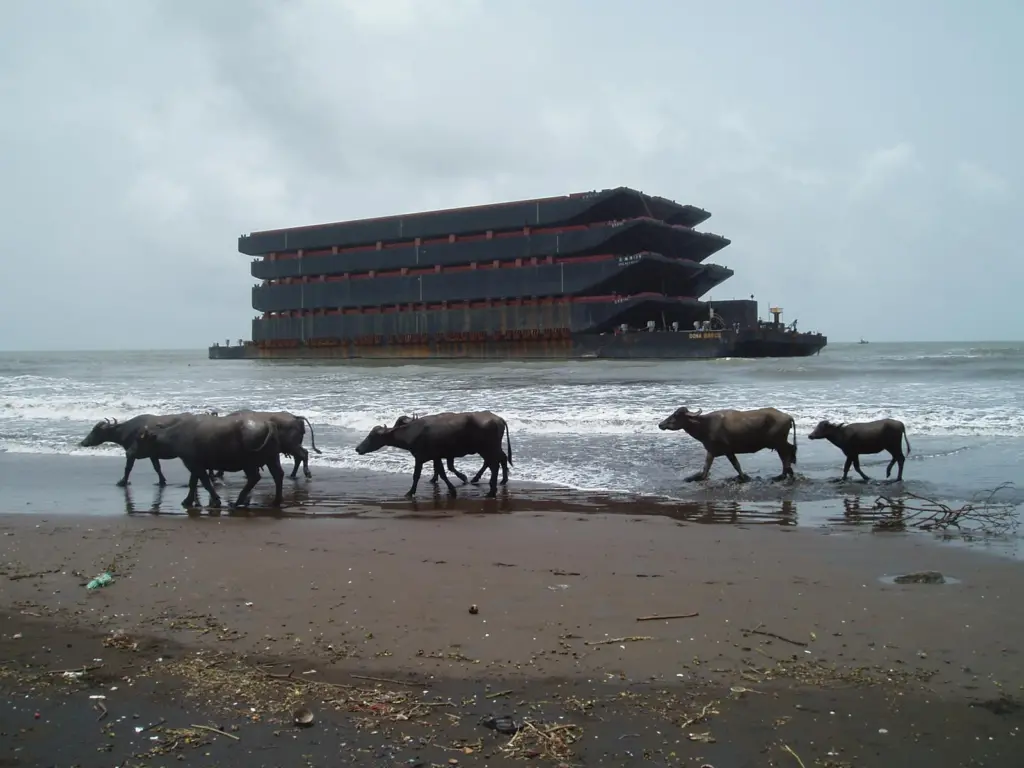
Another recent refloating involved the DINA Barge. This vessel, laden with 12 inland barges, was under tow from the Far East to Europe when the tow was lost in a storm. This large barge eventually grounded in the shallows at a location 90km south of Mumbai.
This operation was another LOF 2000 salvage. The contract was agreed on 12 August, with two tugs mobilised to the scene from Dubai. The main problem, in this case, was one of access. A solution was found in the use of Dyneema synthetic tow cable, as strong as steel but five times lighter. A 1,900m long Dyneema tow connection was rigged. This was the longest Dyneema connection ever employed by SMIT. DINA Barge was successfully refloated on 31 August. This operation was progressed rapidly, to utilise the last spring tide available until the end of the monsoon season. Failure to meet this deadline could have left DINA Barge on the beach for many months.
Recent operations include the pollution prevention assignment involving the wreck of the VLCC Haven, located off Genoa. Under a contract from the Municipality, a SMIT diving spread (including a saturation diving system) was mobilised and the team checked and certified as oil-free a total of 88 spaces within the wreck. This operation was launched in order to avoid the risk of persistent leakage, a threat to the extensive oyster and mussel beds in the area. A vacuum system was used to recover residues, with a hot tap system employed to enter some compartments.
Related Articles
 ACCESSORIES & EQUIPMENT
 ACCESSORIES & EQUIPMENT
 MARINE CONSTRUCTION