
SD Eileen, first of a small but special class of ‘girls’ – by Jack Gaston
One of the most recent deliveries to Serco Marine Services under their contract with Damen Shipyards is the small ASD tug SD Eileen.
This vessel is the first of a four tug series specially designed and built by Damen Shipyards as part of a 29 vessel ‘package’ required as part of Serco’s support contract with the Royal Navy at HM Naval Bases in Portsmouth, Devonport and the Clyde (Maritime Journal December 2009).
Included in the €146m construction contract are16 tugs and tug/workboats, some selected from the Damen standard range and others modified or purpose designed. SD Eileen and its sister ships fall into the latter category and have been built to a bespoke design formulated to meet the exacting needs of the client. To date 21 vessels have been delivered, with the remaining eight to be completed by the end of this year.
SD Eileen is the smallest azimuthing stern drive (ASD) tug ever designed by Damen. A great deal of equipment and many facilities have been packed into a very small vessel, intended primarily to carry out a wide range of harbour duties and coastal towing. In spite of its size this class of vessel has the capability to handle surface vessels and submarines, transport up to 12 passengers and deck cargo, transfer fresh water and provide fire fighting and water spray facilities to ammunition barges.
All of those exacting requirements have been met in a tug just 21.19m in length overall, with a maximum beam of 8.83, a depth (at sides) of 4.00m and a displacement of 267 tons. A shallow draft of 3.66m was a specific requirement. The tug complies with Lloyds Register rules for 100 A1 Tug Specified Coastal Service + LMC UMS and UK MCA Class IX.
The double chine hull form is similar to other Damen ASD designs and includes a short box keel, a docking skeg aft and a stern optimised for a good performance when running astern. A broad beam offers enhanced stability and the bulwark design and fendering gives adequate clearance and protection above and below the waterline. In keeping with all of the tugs supplied under this contract, the fendering material is made up of a grey moulded rubber to prevent leaving unsightly marks on grey naval vessels.
Integral tanks have the capacity to accommodate 21.4cu/m of fuel oil, 8.0cu/m of fresh water, 10.9cu/m of ballast water, 1.3cu/m of bilge water, 1.0cu/m of lubricating oil, 1.3cu/m of propulsion unit oil, 1.0cu/m of dirty oil and 1.7cu/m of sewage.
Two Caterpillar 3508B TA/C diesel main engines, generating a total of 2,000bhp (1,492bkW) at 1,600rpm, power the propulsion system. Each main engine is coupled to a Rolls-Royce US 155CP fully azimuthing propulsion unit designed to afford precise control of thrust in any direction. Noise and vibration is reduced by means of flexible engine mounting and drive shaft couplings. A HRP 67 bow thruster, rated at 67kW (90hp), is fitted as a further aid to manoeuvrability.
The main engines are fitted with ‘box coolers’ and a forced ventilation system supplies 40,000cu/m of air per minute. Hydraulic pumps mounted on each main engine provide power for the deck machinery and bow thruster. Exhaust gases from the main and auxiliary engines pass through silencers below deck and discharged via unobtrusive uptakes on either side of the wheelhouse.
Electrical power is supplied by two Caterpillar C4.4 T powered auxiliary generator sets, each rated at 68kv at 440 volts, 60Hz. Two electrically powered, high capacity Sterling SIHI AKHK 5101 pumps of 22cu/m/hr are used for bilge and ballast water. A pair of smaller, Sterling SIHI AOHA 3101 pumps of 4.5cu/m/hr are used for fuel.
The deck layout aboard SD Eileen is spacious, with adequate room to work, in spite of the comprehensive array of equipment fitted. The afterdeck has been kept as clear of obstructions as possible to enable equipment to be carried and can accept small containers.
Towing winches are installed fore and aft to enable quick and effective towing connections to be made when working alongside small ships and barges. Both winches are hydraulically powered and supplied by Kraaijeveld. The winch mounted on the foredeck incorporates a cable lifter for the vessel’s single anchor and a towing drum with a line pull of 10 tons and a maximum brake load of 75 tons. An almost identical winch, without the cable lifter, is fitted immediately aft of the deckhouse in a particularly neat installation. Both winches are used in conjunction with substantial, stainless steel lined, towing fairleads and high performance manmade fibre ropes. A Mampaey quick release tow hook with a safe working load of 45.8 tons is also fitted aft for secondary use.
The outfit of equipment on the after deck is completed with the provision of a Heila HLM 20-3S hydraulically powered marine crane with a maximum lifting capacity of 1.7 tons at a maximum outreach of 10.56m. A three section telescopic jib is incorporated along with a MW 14 hydraulically powered winch and wire, with a lifting capacity of 1.1 tons.
One of the most remarkable aspects of the SD Eileen is the almost ’Tardis’ like effect of the deckhouse and accommodation, which seems much larger on the inside than out. The deckhouse has virtually the same ‘foot print’ as the wheelhouse above it and embodies just the main watertight entrance door and various storage facilities at deck level.
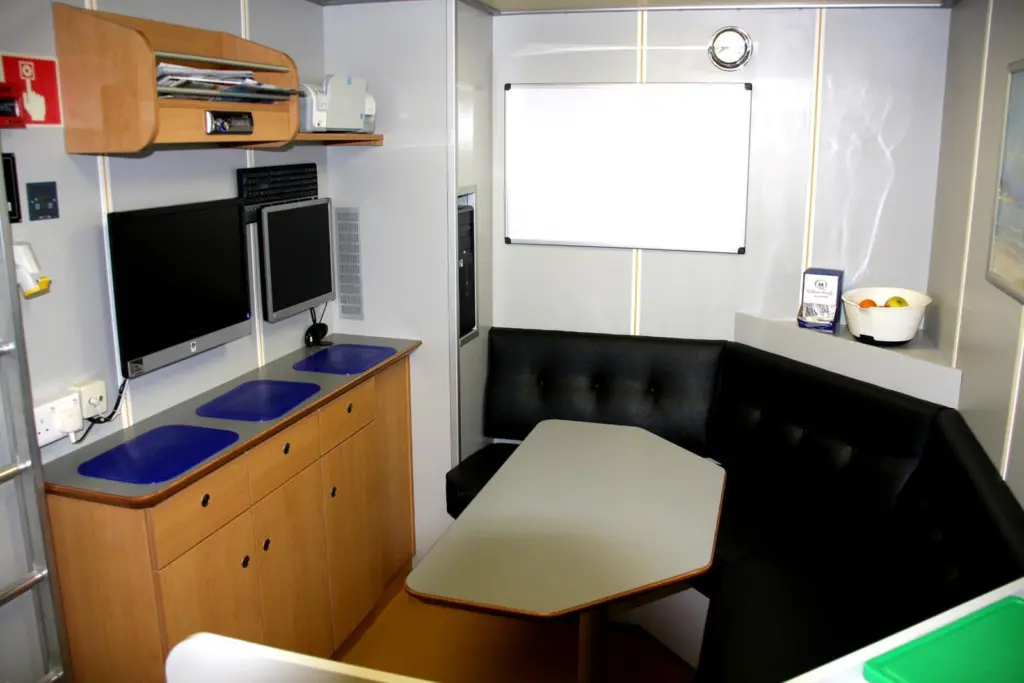
An access stairway leads from the access door at main deck level into the relatively spacious accommodation, designed to take a maximum of 15 persons including 12 passengers. The accommodation includes a single berth Captain’s cabin, two double berth crew cabins, a galley, sanitary facilities and a mess/day room for six persons. The accommodation is neat and well equipped, and finished with modern linings and insulating materials to reduce the effects of noise and vibration to a minimum.
The wheelhouse can be accessed internally or externally and once again is remarkably spacious. All round visibility is very good from the single control position close to the forward windows. A ‘split’ control console configuration has been chosen, enabling the ‘Captain’s’ chair to be positioned in the most convenient location. All of the main propulsion and winch controls, and communications/navigational instruments, are within easy reach. Switches and instrumentation for all essential systems are located on the sides of the console or overhead. The outfit of communications and navigational equipment includes two JRC JMA 5210-4 radar sets, a Kotter Cassens & Plath magnetic compass, a JRC JLR GPS compass, a JRC J-NAV 500 GPS, and an Alphatron ‘Alphasea’ autopilot. Also installed is a SEIWA Explorer chart plotter, a JRC NCR-333 Navtex and VHF radios from Sailor.
All four tugs of this new series are being built and completely fitted out by the Damen Shipyard in Gdynia, Poland. The ‘first of class’ vessel SD Eileen was delivered to the Netherlands at the end of March and carried out further trials and familiarisation for the Serco Marine personnel before being handed over in April. During trials, a bollard pull of 23.7 tons was achieved towing ahead and 21.5 tons towing astern. As expected, SD Eileen is extremely manoeuvrable and during speed trials produced a maximum speed of 11.5knots ahead and 10.6 knots astern.
The long established practice in the UK naval dockyards of giving the smaller tugs ‘girls’ names has been continued by Serco Marine Services. SD Eileen is now in service and will be followed by SD Suzanne this month, SD Christina in July and SD Deborah in October.
Damen will research the possibility of adding a commercial variant of the ASD 2009 to its product range. Such a vessel is likely to be less complex, have more power, and propulsion units with fixed pitch propellers.
By Jack Gaston