

Sea routes aren’t always C02 saviours
It’s not always the case that getting transport off the roads and onto the sea reduces carbon emissions, says Professor Alf Baird of the Transport Research Institute (TRI), Edinburgh Napier University.
He said, “It has become a truism that longer sea routes means less CO2, but while the bigger, longer operations do actually give a net benefit, when you look at some island ferry routes using smaller vessels, such as going from Aberdeen to Orkney, the reality is that taking the longer road route for the largest slice of the journey followed by a very short sea crossing over the Pentland Firth is more efficient and creates less carbon than taking a longer route by sea. In fact, even flying by air is less polluting.”
The recent study carried out by TRI on the Scottish Island routes showed the land transport options followed by a very short ferry crossing came out some 10 times more CO2 efficient, despite heavy public subsidies pushing people to go by ferry on the much longer Aberdeen route.
Professor Baird explained that this is because the modest sized ferries typically used on the Scottish Island trades have a single freight and car deck plus one or two decks for passengers. However, the small 450 lane metre ferries serving the Aberdeen-Orkney route actually have the same engine power (about 20 Mw) as the largest 4,500 lane metre DFDS ships running between Tilbury or Immingham to Gothenburg, and use the same heavier polluting Heavy Fuel Oil, not the lighter, cleaner Marine Diesel Oil that lower powered boats use.
A lot of the problem lies in the hydrodynamics and the bow shape, said Prof Baird. “From a naval architect’s point of view, this is a major part of the fuel to mile equation. The ship’s length doesn’t matter anywhere near as much, indeed longer vessels offer greater efficiency. The problem with small island ferries like those serving Aberdeen is they need a very high power in order to achieve over 20 knots, yet are only specified with a single freight deck, and a short length so that they fit into Aberdeen harbour, so essentially much of the subsidy is going up the funnel in fuel and this means that, for smaller ferries, land transport by truck or car is far more efficient per kilometre than sea transport.”
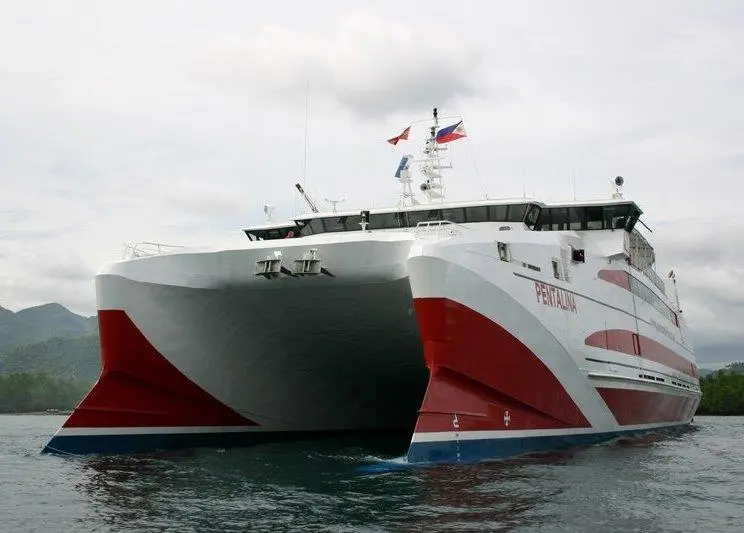
By contrast the MV Pentalina, operated by Pentland Ferries, which runs the short route from Caithness to Orkney, is a medium speed catamaran with an extremely fine hull form, reducing resistance and lowering the power requirement.
This vessel operates on a shorter and much higher frequency service than the longer Aberdeen routes and, when the numbers are crunched, both CO2 and outright cost savings are obvious despite the combined longer road travel and shorter sea run. Also, the medium speed catamaran’s capital cost is only around a quarter of its longer route competitors.
Related Articles
 ACCESSORIES & EQUIPMENT
 ENVIRONMENT
 MARINE CONSTRUCTION