




Simple spud leg system is cheap solution to tricky access issue
Accessing the underside of a rail bridge over fast flowing water for a recent rail upgrade required some out of the box thinking.
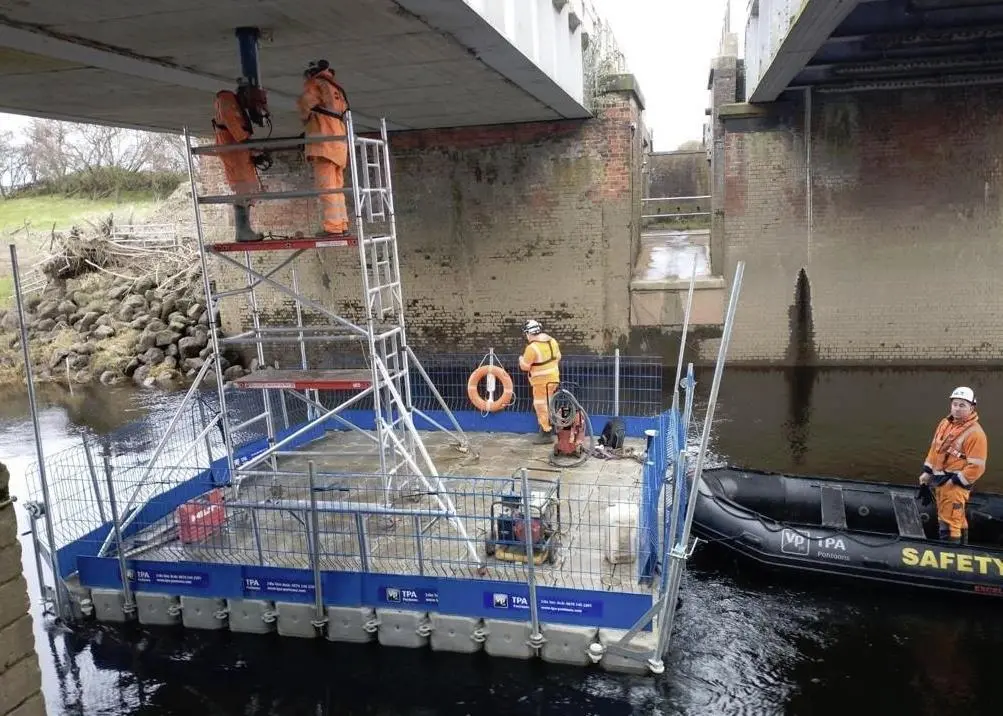
TPA Temporary Access Solutions, a specialist hire company providing access solutions for land, rail and water was contracted to supply their VersaDock modular pontoons to Network Rail’s Trans Pennine (east) route upgrade in the UK.
As part of the modernisations, engineers needed access to the underside of a rail bridge to fit electronic monitoring sensors. Situated above a strong flowing river, fixing any platform in place here was going to prove challenging.
TPA Pontoons have a long working history with Versadock, which describes itself as ‘market leaders in modular pontoons and drive on docks’. The solution to this anchorage issue was to produce a Spud Leg bracket. This bracket bolted to each corner of the raft allows a leg to be raised and lowered using a winch system to give pinpoint accuracy and secure holding. Although the concept of a Spud Leg is not a new one, no such fitting existed for a modular pontoon of this nature, Versadock claims. Versadock were quick to design a viable bracket and within a few weeks, prototypes were produced. These were tested at Versadock’s facility in Berthon Lymington Marina, UK before being deployed by TPA Pontoons in a real world environment.
James Myatt, Business Development Manager for TPA Pontoons said: “Chris and his team at Versadock have really helped us with this bracket and our customers will reap the benefits of more complicated installation sites being completed quickly and efficiently.”
“TPA really are experts at what they do and when they called, we were only too happy to help develop something for them,” said Chris Davison of Versadock.
TPA Pontoons provided a 6m scaffold tower, a safety boat, two operators and the 6m x 6m pontoon raft. The four leg anchoring system performed admirably, holding the raft securely in place while the engineers carried out the bridge works. The ease of deployment and recovery of the anchor legs means that the raft can be easily moved and re-positioned as the engineers dictate. The upgrades to the bridge will take up to three weeks to complete and the raft with access tower will be in place throughout.
By Jake Frith
Related Articles
 ACCESSORIES & EQUIPMENT
 MARINE CIVILS
 MARINE CIVILS