![MaritimeJournal[Seawork]](https://www.maritimejournal.com/wp-content/uploads/2026/09/MaritimeJournalSeawork.svg)






A next-gen research vessel for ocean sciences
A groundbreaking research vessel looks set to transform ocean sciences using advanced vessel propulsion and sustainable vessel build technologies.
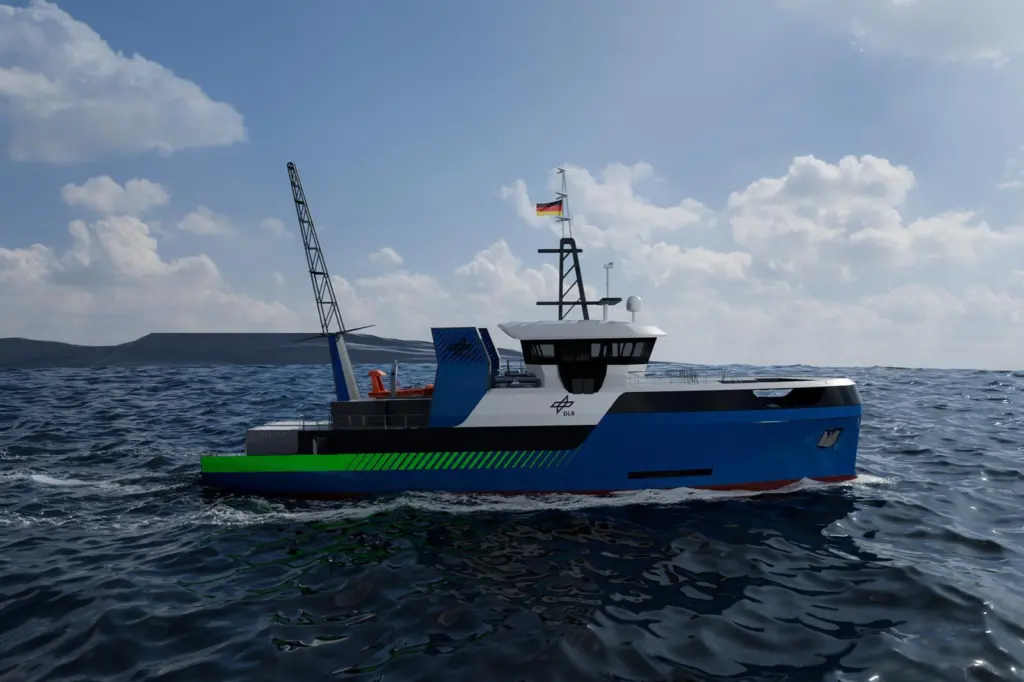
German Aerospace Center (DLR) has commissioned Lloyd Werft Bremerhaven to construct a 48-metre research vessel designed as a floating laboratory for testing next-generation maritime energy systems.
The €36 million vessel will support real-world experiments in the North Sea and Baltic Sea, offering a unique platform for collaborative studies on climate-compatible propulsion and alternative fuels.
“This flagship project highlights the importance of maritime research in Germany and actively contributes to shaping the maritime energy transition. Both the Lloyd Werft workforce and the entire Rönner Group share this commitment,” said Friedrich Norden, managing director of Lloyd Werft Bremerhaven.
”This contract also demonstrates that Lloyd Werft is not only a strong project contributor in ship repair and conversion but also a key player in the construction of specialised vessels and complex custom-built structures.”
Advanced technology
The vessel build will integrate Steerprop’s new Contra-Rotating Propeller (CRP) azimuth propulsion units, its first commercial order for this next-generation technology.
Each Ice Class 1A-rated unit delivers 750 kW and features pressure lubrication, boosting mechanical efficiency to 98.5% and reducing fuel consumption. These propulsion advances will enable precise testing of hydrogen-based, battery-powered, and hybrid systems in authentic marine conditions.
Beyond propulsion trials, the research vessel will feature a digital twin for advanced simulations, a specially designed test engine room and instrumentation to measure load, torque and thrust.
Scheduled for completion in summer 2027, it will accommodate up to 20 researchers per voyage, driving innovation in ocean sciences and providing vital data to accelerate the maritime energy transition.
Related Articles
 OTHER NEWS
 MARINE CIVILS
 MARINE CIVILS