![MaritimeJournal[Seawork]](https://www.maritimejournal.com/wp-content/uploads/2026/09/MaritimeJournalSeawork.svg)





Deep-sea submersible in new study to predict volcanic activity
A new study has revealed a method for predicting volcanic eruptions beneath the ocean floor using heat data from hydrothermal vents as an early warning signal of tectonic unrest.
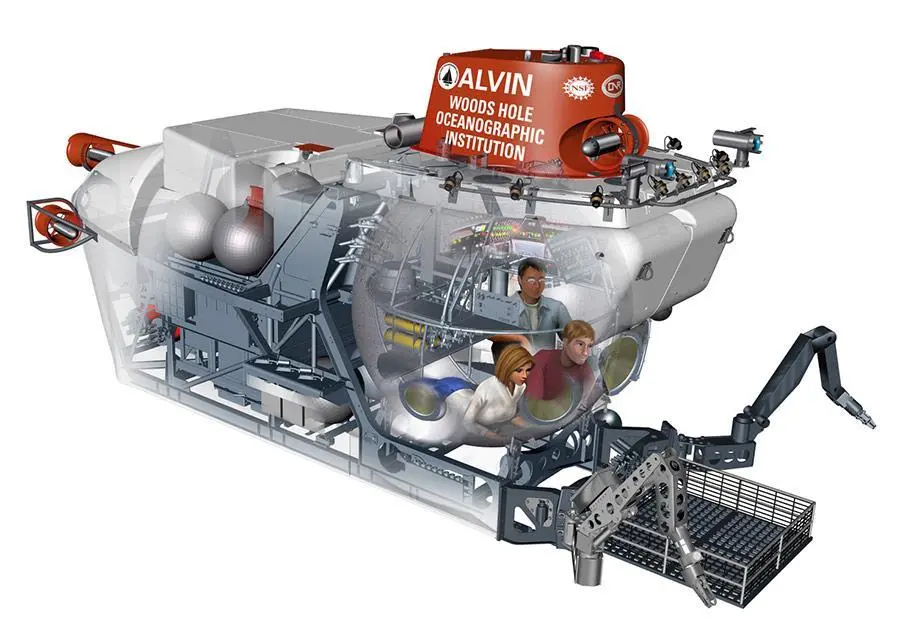
The deep-sea submersible Alvin, which is owned by the US Navy and operated by the private education institution Woods Hold Oceanographic Institution (WHOI), based in Massachusetts, was able to prove that predictions of a 2025 eruption were correct having been made based on the new technique.
The research was published in the Proceedings of the National Academy of Sciences (PNAS) under the heading Hydrothermal vent temperatures track magmatic inflation and forecast eruptions at the East Pacific Rise, 9°50’N.
It describes a monitoring tool that translates minute temperature changes in vent fluids into insights about magma movement miles beneath the sea floor.
For the first time, scientists have shown that hydrothermal vents can act as natural sensors of deep tectonic processes, offering the ability to forecast sea floor eruptions weeks or even months in advance.
Led by Thibaut Barreyre of the French National Centre for Scientific Research (CNRS) and the University of Brest, with collaborators from the WHOI, Lehigh University, and Scripps Institution of Oceanography, the study draws on a 35-year record of temperature data from five hydrothermal vents along the East Pacific Rise – a highly active segment of the global mid-ocean ridge system.
Using long-term autonomous instruments, the team detected a slow but consistent rise in vent temperatures from about 350°C to nearly 390°C before two confirmed eruptions in 1991–1992 and 2005–2006.
The same warming trend was observed again in recent years, leading scientists to forecast another eruption in early 2025. That prediction proved correct when a sea floor volcanic event was confirmed in April by a WHOI-led expedition using Alvin, which can carry one pilot and two observers and dive down to 6,500 metres for up to 10 hours.
“Our results show that vent temperature changes mirror the build-up of magmatic pressure beneath the crust,” said Barreyre. “These measurements give us a new way to listen to the planet’s internal dynamics in real time.”
According to WHOI scientist emeritus Dan Fornari, the approach bridges a long-standing observational gap between the sea floor and the deep Earth.
“Hydrothermal vents are not just biological oases – they’re technological gateways to understanding how our planet works,” he said.
The findings promise to revolutionise how scientists monitor volcanic and tectonic activity along Earth’s vast undersea ridges. As next-generation sensors and autonomous observatories expand across the sea floor, researchers envision a global network capable of detecting Earth’s tectonic ‘heartbeat’ as it happens.
The study was supported by the U.S. National Science Foundation, the French National Research Agency, CNRS, and the European Research Council.

Related Articles
 OFFSHORE RENEWABLES
 OTHER NEWS
 OTHER NEWS