



Exail launches 16m USV with 30-day endurance
Exail has unveiled a new transoceanic Uncrewed Surface Vessel (USV) with multi-robot deployment capabilities for subsea operations.
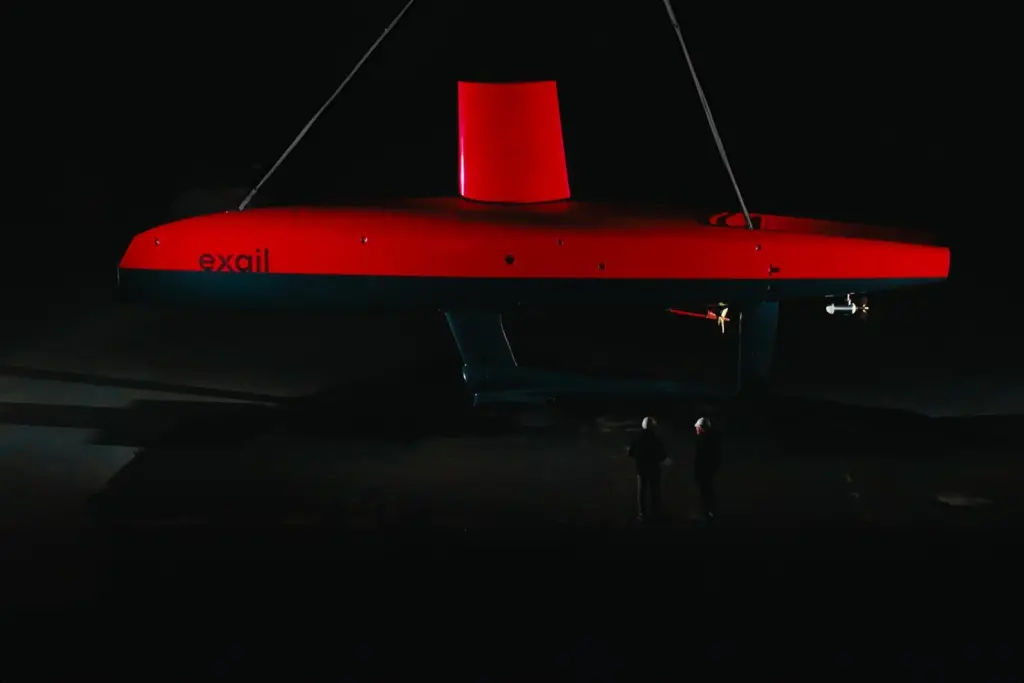
Launched at Oceanology International at London’s ExCel exhibition centre this week, the DriX O-16 gives the option of complete autonomy up to 2,500 nm, or can be remotely controlled.
Its naval architecture, Exail says, can withstand the most severe ocean conditions.
Like its 8m predecessor, It has operational endurance of 30 days and can deploy multiple payloads and subsea assets.
The electric-diesel vessel has a fibre-optic gyroscope for rotational measurement, which Exail says is a core element of the technology.
“With this next-generation transoceanic low-carbon USV, we are pushing back the limits of ocean exploration, empowering collaborative autonomy between surface and subsea drones, while minimizing human exposure at sea,” said Olivier Cervantes, VP Maritime Autonomy Solutions at Exail.
“The introduction of our new DriX O-16 truly marks a significant stride in autonomous maritime operations, as multi-robot missions are definitely where we see the maritime industry and our own developments leaning in the coming years.”
Versatile platform
The new USV leverages the successful track record of the already existing DriX USV, launched back in 2017 and that accumulates more than 150,000 hours of operations at sea in more than 19 countries.
DriX O-16 has hybrid propulsion, redundant architecture, advanced communication systems and AI-powered obstacle detection and avoidance capabilities. It also allows launch and recovery of a range of subsea assets such as Remotely Operated Towed Vehicles, inspection-class Remotely Operated Vehicles and Autonomous Underwater Vehicles.
Its gondola, located below the surface, can further host a wide range of payloads such as deep-water Multibeam Echosounders, Sub-Bottom Profilers or aoustic subsea positioning and communication systems.
This makes the new DriX O-16 especially suited for full ocean depth scientific and hydrographic surveys, geophysical and UXO surveys, as well as subsea infrastructures inspection and surveys that might require the deployment of multiple robots.
Related Articles
 INSURANCE, LEGAL & FINANCE
 MARINE CIVILS
 OTHER NEWS