



Survey boat back in service after grounding repairs
The 22.5m government hydrographic survey boat Oland has resumed service in north Germany following repairs to damage caused when it ran aground on the island of Sylt, reports Tom Todd.
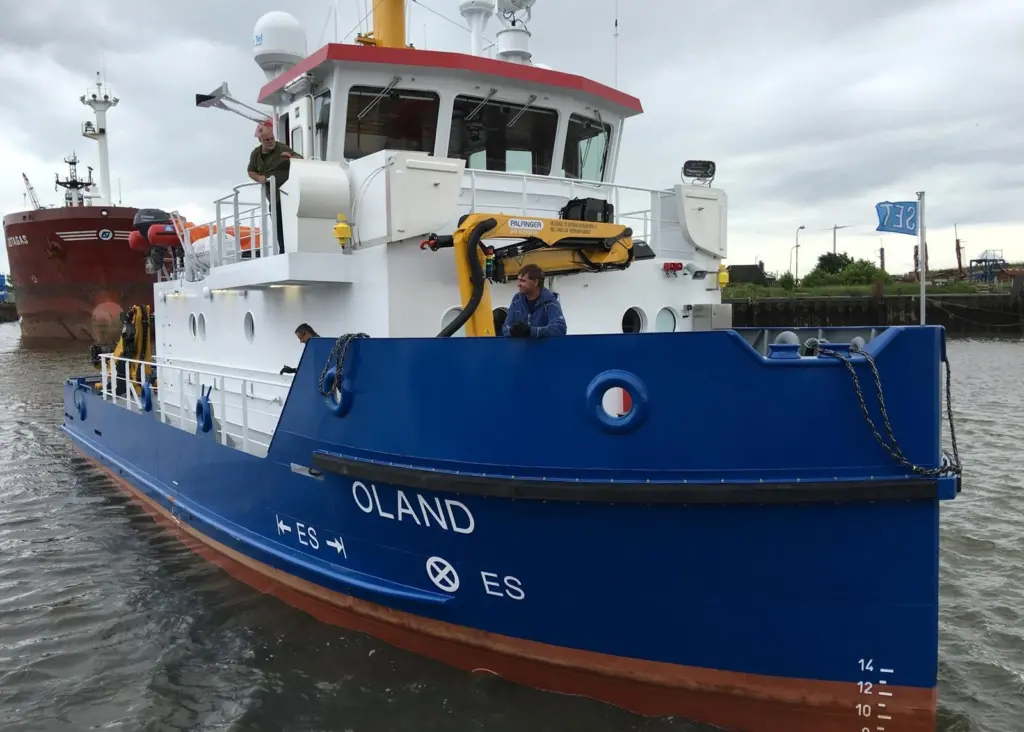
The four-year-old boat spent 22 hours on a sandbank on the holiday island after scraping a submerged groyne and taking on water during measuring operations. To prevent sinking, the crew settled Oland on the sand – something the flat-bottomed boat, drawing just 0.9m and designed for shallow flats, does regularly.
During low tide temporary steel plates were welded over hull gashes. The work was completed in time to allow the boat to get off under its own power without help from a standby sea rescue unit. It was drydocked at the Husumer Dock and Reparatur shipyard on the mainland.
Oland operates for the LKNSH, the government agency responsible for coastal defence, national parks and marine protection in the shallow waters off Schleswig-Holstein in north Germany.
LKNSH spokesman Rainer Lüdtke told Maritime Journal the boat was bottom-holed twice – once in the area of the bow thruster plant and again in the bow engine room.
During drydocking in Hüsum, extensive new plating was installed under DNV-GL supervision, he said. He also reported some electrical damage to bilge pump and bow thruster motors and sensors and added an isolating transformer was replaced. Other motors were cleaned and re-coiled and the repaired areas repainted. “The ship looks like new again”, Lüdtke told MJ. The cost of the work was not revealed.
Oland, built at the SET Shipyard in Tangermünde in 2016 for €3.8 million, is one of three almost identical multi-purpose workboats with the LKNSH. The others are Hooge and Trischen and all have been built since 1916
Listed specifications for the 140gt steel monohull boat include two D9 MH main engines from Volvo Penta, each of 221kW, driving two fixed Promar propellers providing 10 knots and a bollard pull of 5.5 tons. Two auxiliaries are listed – a D7 from Volvo Penta and an air-cooled unit from Hatz – and Oland also has a 35kW, electric-drive Hydrosta-designed bow thruster type BR Sider of 35kW.
The double rudder plant is from van der Velden and there are also two Palfinger 1.5 ton cranes mounted in the bow and stern.
Related Articles
 ACCESSORIES & EQUIPMENT
 ELECTRICAL SYSTEMS
 VESSELS