

The supply chain, life-blood for offshore wind
The supply chain is quite simply the life-blood of the offshore wind industry.
But it is much more than ensuring the hardware turns up just in time. It includes the myriad support services which need management and coordination, crossing geographical and regulatory borders, requiring a rich and complex mix of diverse skills and disciplines.
In this second of a three part series, Peter Barker, Maritime Journal’s marine renewable energy correspondent, talks exclusively to Adrian Fox, supply chain manager at The Crown Estate (TCE) in London. He provides an overview of the current state of this crucial part of the jigsaw, along with his vision of the future as TCE, together with the industry, prepare the road for the challenges of the UK’s Round 3 offshore wind programme.
Jobs for generations
With the industry set to focus its attention on Round 3 in coming years, Mr Fox is keen to point out the importance for the UK through involvement in the supply chain. “In terms of the UK, obviously part of the prize for the programme is that we can create supply chain capability within the UK, and some of the issues coming from the cost reduction work suggest the most competitive way service implements will be delivered is through a local supply chain.” He describes ‘local’ as Europe as much as the UK, and makes the point that as offshore turbines become ever bigger, the existing arrangement of manufacturing in the centre of an industrial zone and then transporting by road and rail becomes unsustainable. Despite the pre-eminence of countries such as Korea and China in heavy engineering, he questions the cost-effectiveness of shipping over long distances, when resurgence in the UK can deliver the components directly to where they will be assembled and taken offshore.
Referring to companies such as DONG, Gamesa and Siemens’ commitment to manufacturing in the UK, Mr Fox states that for these companies, local employment was as much on the agenda as reducing costs, pointing out the aspiration of the Offshore Wind Developers Forum for 50% of content to be UK sourced. He makes the comparison with suppliers to the automotive industry, listing windfarm components such as access platforms, secondary steel, bearings and lubricants that could be fed into the supply chain from UK based companies.
Purchasing decisions usually rest with original equipment manufacturers but Mr Fox is optimistic about prospects: “They are very active in two ways, one in terms of understanding where their existing supply chain could come to the UK rather than sourcing from say Germany and Spain, and secondly by encouraging the UK supply chain through telling them about their requirements including size, quantity and quality but they have to be cost effective with their existing sources.”
It is tough though, as he says 500 of some components can be airlifted from anywhere in the world and that will be the challenge.
The frenzy of activity that accompanies construction phases of offshore wind is important, but the longer term prize, albeit somewhat less intense, is the O&M requirement over the windfarm’s lifespan, an aspect Mr Fox was keen to highlight: “You have to maintain the windfarm, and clearly, to do so for 25 years is a much bigger prize in terms of longevity than the two year hiatus of actually building it. The real long-term ‘jobs for generations’ is with O&M and not only the maintenance aspect, but where for example Siemens may hold an inventory of stock at a base locally in the UK rather than flying it in from Germany”.
An important part of the equation is cabling, described as “a weak area in the supply chain” by Mr Fox, who added, “Irrespective of whether you have an integrated or a radial grid, export cable production is critical and there isn’t enough, particularly when you look at global supply, so it is not just have we got enough manufacturers in Europe but are there enough manufacturers globally”.
While recognising that cable can be loaded on a carousel and shipped around the world, the cost equation has to be right, pointing to the advantages of supply originating in Europe where the current focus of demand in centred.
Ships and boats also
The conversation turns to the eclectic mix of vessels involved in the industry (considered part of the supply chain) and Mr Fox’s previous experience in oil and gas industry is in strong evidence. He clearly recognises the opportunities from exploiting the synergies of the two closely connected industries, stating, “There are plenty of vessels out there that can install wind turbines but they need to be crewed with really experienced people who have been out there, who understand the weather out there, because as we try and build out faster we will be up against more challenging conditions as you push the boundaries with higher waves, higher winds, stronger currents. There is no substitute for expertise and experience and obviously the offshore oil and gas industry is the one that has been out there for a number of years. You can build boats to a spec, bend the steel, weld the steel, you float it out but creating the human capital is essential. Europe looks to the UK for that expertise, other parts of Europe don’t have the high degree of oil and gas expertise the UK has. The Norwegians do it, but other countries don’t.”
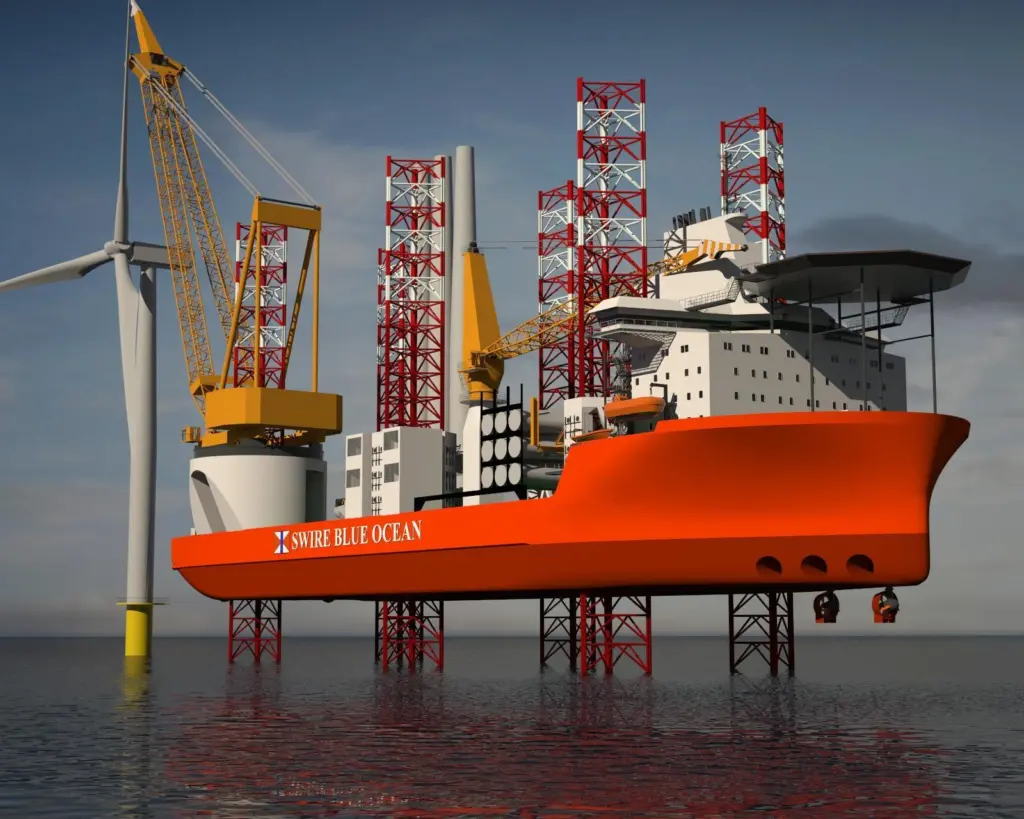
Asked about the proliferation of orders for installation vessels and the various free-floating DP vessel concepts emerging, Mr Fox considers that as the scale of demand increases, in both quantities and sizes of components, the part that is not quite right is adapting to the demand of installing jacket foundations, which he considers will overtake monopiles. He feels the volumetric requirements of jacket foundations will have to be factored in to vessel designs, including the free-floating vessel option. He added, “We do need these solutions to come forward and be tested and tried and demonstrate they can be done safely. Doing it all in one [complete turbine installation] may even be safer, reducing the number of exposure hours but they also have to cost less than the alternative way they currently do it.”
He agreed with the principle, highlighted by Vattenfall during the opening of the Thanet offshore windfarm, that as much assembly as possible should be completed ashore. “Doing as much as you can under factory conditions ashore, people see the advantage of that lean construction approach offshore, it makes even more sense to spend the minimum time out there, do what you need and come back ashore.”
Of particular interest is the state of the small support vessel market, typically those up to 20m, operating under the twelve passenger rules, a sector currently booming in both quantity and quality. Mr Fox stated that the Carbon Trust’s Offshore Wind Accelerator programme is looking at a number of areas, including the issue of access to turbines far offshore. Accommodation vessels are currently popular with contractors having to deal with the logistics of organising significant numbers of workers offshore during construction phases. The smaller crewboats however remain the workhorse of the industry, ferrying personnel between the shore, accommodation vessels and the turbines themselves.
As projects move further offshore, Mr Fox acknowledges the industry will have to pay particular attention to how they meet the challenges of both increased distances from a safe haven and the more hostile environment that will accompany this change from the current day (or night) boat arrangement, and he sees opportunities for the industry in this area. “They have got to think about the ergonomics of working offshore because if you consider the day basis working, you go out, do your job and you come back. But as we move further offshore, we are going to have a different work pattern with people working maybe two weeks on and two weeks off. If that is the case, you have got to give them entertainment and education, you have to give them a good night’s sleep, they have got to be looked after out there. You need something more than just moving them backwards and forwards, and that is where these opportunities lie in reality, somewhere where they can download daily logs through satellite links, there is huge opportunity there for really clever thinking and really motivating the workforce to work further offshore.”
He sees the adoption of vessels such as Offshore Ship Designers’ offshore wind maintenance vessel concept, a 187m DP2 vessel featuring a floodable deck, accessible from the stern for smaller attendant craft, as the way forward for both construction and the long-term phases of deepwater windfarms. He points out however, that arriving at the solution here is not the same as with the oil and gas industry, where fixed accommodation platforms are located next to the working well platform. With offshore wind, the portfolio of fixed assets is spread over a large geographical area, requiring flexibility of options.
Mr Fox again draws on his previous experiences with the question of using helicopters to transfer personnel. “Are helicopters the right way to transfer people? I think the big question to ask is, are we prepared to accept the fatality rate the oil and gas industry occasionally experiences, not because helicopters are inherently unsafe, but because of the multiple trips aspect. With the best will in the world machinery fails. Are boats an inherently safer option even though they take longer? Also, there are things you can do in a boat you just can’t do in a helicopter.”
He acknowledges that cost will be a factor and feels that some operators will try it out, particularly if they can get coverage from nearby oil and gas installations, once again pointing out the potential synergies between the two industries.
Commenting on the current trend of contracting offshore oil and gas industry vessels for offshore wind projects, Mr Fox acknowledges that if there is demand in their principal market they will return there because it is better paid. Interestingly, he makes the point however that other sectors, including defence contractors, automotive and aerospace, are struggling because of cutbacks and that these people could move into renewable energy and make that their new home.
Mr Fox sees the recent entry of France into the industry as having potential for the UK. “Alstom producing a brand new turbine will bring down costs on our doorstep through more competition in the market place.” He feels they (the French industry) will not just build one factory, including potentially setting up shop in the UK if it serves their geographical requirements. He also sees the potential for UK jobs within the French market given they have very little offshore experience with no offshore oil and gas assets.
Summing up, Mr Fox does consider the supply chain is still immature and fragmented, and while recognising the importance of RenewableUK as the industry’s umbrella trade association, he highlights a lack of the coming together as groups of the separate subdivisions, such as the installation people, the cable people and the turbine people, to talk about best practise.
He demonstrated that the work of TCE goes beyond just licencing the seabed for others to develop. TCE involvement also includes identifying the challenges, including technical, financial and social, and helping the industry stay ahead of the game, helping the supply chain element in particular. He paints a positive picture of future prospects. For instance, he commented on the state of the installation vessel market, with over 20 newbuilds currently in the pipeline. “The only reason those guys build boats is because they can see there are a lot of turbine manufacturers. They won’t build boats if there are no turbines coming. They are saying what’s the point in me spending a hundred million pounds or more on a vessel.” He clearly considers they do see the point.
Next month in the final interview in this series we look at what TCE is doing to address the all important health and safety aspects of offshore wind energy.
Related Articles
 OFFSHORE RENEWABLES
 OTHER NEWS
 MARINE CIVILS NEWS