![MaritimeJournal[Seawork]](https://www.maritimejournal.com/wp-content/uploads/2026/09/MaritimeJournalSeawork.svg)




Truckloads of buoys for Sheringham Shoal
This month sees the start of the installation phase for MT Hojgaard of the Sheringham Shoal offshore wind farm but, as John Caskey of Hydrosphere told MJ, ‘Nothing much can happen until the site marking buoys are placed in position’.
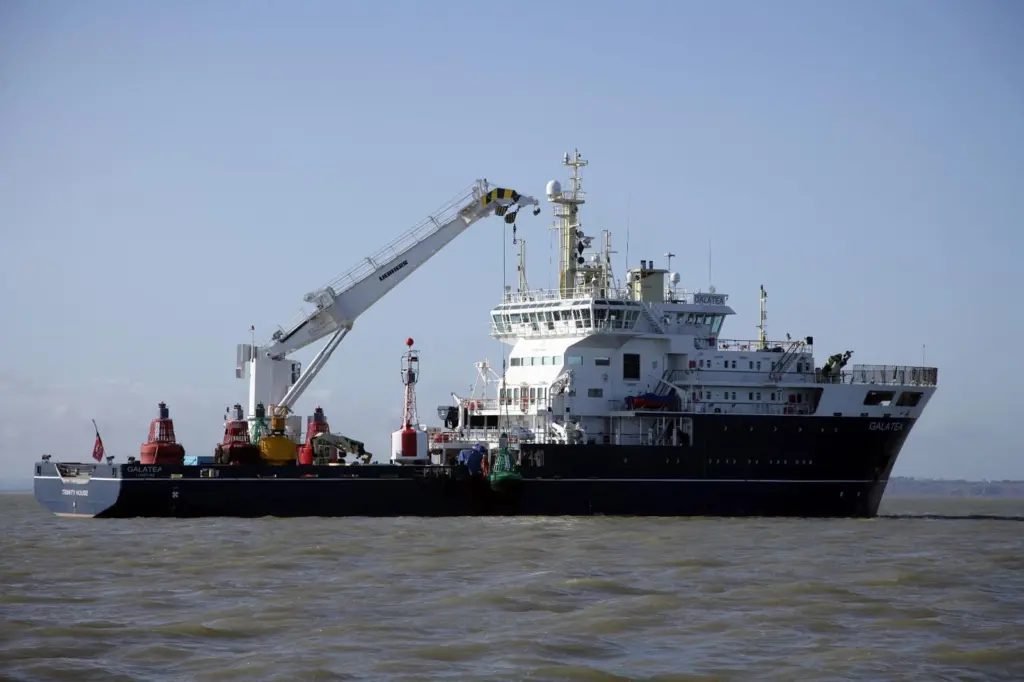
The buoys themselves, four configured as Cardinal Marks for the edges of the farm and four yellow Special Marks, located on the corners of the farm’s diamond shape, are really quite something to move around, and getting all the components to Trinity House’s Harwich buoy facility took no less that seven articulated trucks.
Mr Caskey further explained that this is partly because the buoys are physically very large and partly because they came from several factories. ‘All components are of the best quality available, he said. ‘Our chains are manufactured by Carlier in northern France, one of the sole remaining manufacturers in Europe. The buoys themselves are the Mobilis Jet 9000 QI, High Visibility model, giving a 4.5m focal height, which translates into a top to toe measurement of around 10m, with a 3m diameter.
Deployment of the buoys will be carried out using Trinity House’s vessel Galatea, which is one of the few vessels that can safely handle the load and has excellent positioning capabilities. Galatea is 84m in length with a broad deck space and a crane capacity of 30 tons
‘It’s not just the size, either, continued Mr Caskey, ‘There’s the health and safety aspect. If you think about it, we will have 8 two and a half ton buoys, 7 sinkers weighing between three and four tons each, plus around 32 tons of 38mm chain. You can imagine what can happen if things start breaking loose on deck.’
Hydrosphere utilise Trinity House’s experience and professionalism to get the buoys to site safely as well as putting them down in exactly the right spot.
The buoys themselves are constructed in a modular fashion around a central galvanised steel core. This design results in easier maintenance and lower replacement costs. Hydrosphere are keeping a stock of spares ‘just in case they get hit by on-site workboats or other passing ships ’, added Mr Caskey, although he doesn’t predict any trouble due to failures. All the parts have been sourced with durability in mind. The lights are the well proven Vega VLB36 units with a visible range of 5 miles. The batteries are long life gel, the two 50 watt solar panels have an expected life of 20 years and even the buoy colour fastness is expected to last 15 years.
Related Articles
 VESSELS
 MARINE CONSTRUCTION
 VESSELS