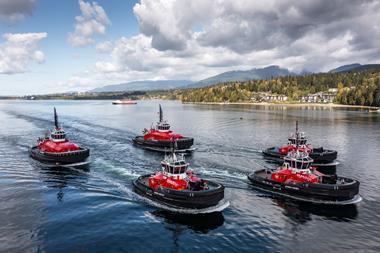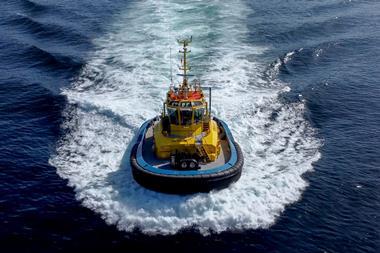



The tug fleet operated by the Turkish Maritime Organization to provide escort and emergency response services in the Bosphorus has been increased in size with the addition of two further vessels.
Faced with rapidly increasing shipping traffic
and
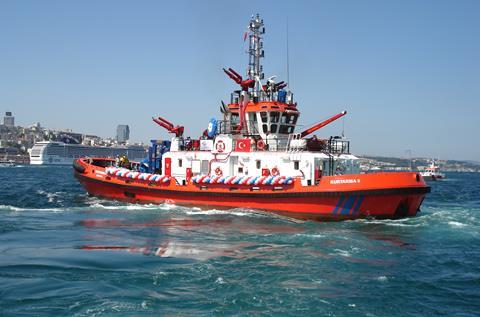
a rising number of ship collisions in the 1990s, the Turkish authorities made the decision to order two more Voith tractor tugs from the Istanbul Naval Shipyard. Both vessels were recently put into service. Named Kurtarma 5and
6, an important feature of the new tugs is a powerful fire fighting system meeting the Internationally recognised FiFi 2 stand
ard, higher than normally installed in tugs of this type.The new tugs are identical high performance Voith Water Tractors, designated the ‘Escort Class’ by Voith Turbo Marine, with an overall length of 37.6m, a beam of 12m
and
a draught of 5.80m. They are propelled by two diesel main engines each generating 2,650kW (a total of approximately 7,200 bhp) to drive two Voith Schneider type 32 R5/265-2 cycloidal propellers. This gives the tugs a bollard pull of 65 tonsand
a considerably greater line pull in the indirect (escort) towing mode.All six tugs operated by the Turkish Maritime Organization in the Bosporus have Kurtarma names, with a serial number,
and
have similar Voith Schneider propulsion systems. The FiFi 2 fire fighting system aboard Kurtarma 5and
6 includes four remotely operated monitors, two at boat deck leveland
two above the wheelhouse roof, with a total capacity of 7,200 cu/m of water per hour.The earlier vessels, Kurtama 1 to 4, are equipped for fire fighting at the lower FiFi 1 st
and
ardand
have two monitors with a correspondingly lower fire fighting capacity of 3,600 cu/m/hour.The Bosphorus is a busy
and
potentially dangerous waterway with over 200 maritime accidents recorded over the past 20 years. Turkey is obliged by international agreements to ensure unhindered sea traffic in the Bosphorus. This is not an easy task in view of the oneand
a half million people crossing the strait from the European to the Asian shore on ferries, tourist boatsand
other craft every day. This is in addition to numerous container shipsand
‘supertankers’ transporting 150 million tons of oiland
other hazardous goods through the 30 km strait between the Black Seaand
the Mediterranean every year. Since the Turkish Maritime Organization first introduced Kurtarma 1and
2 in 2000 the tugs have provided an importantand
reliable service.