




Vessel Launch: Versatile new research vessel delivered to UMBSM
‘RV Actinia’, a new research vessel for Scotland’s University Marine Biological Station, Millport (UMBSM) has been completed by Seaway Marine of Macduff.
UMBSM, the national facility for marine biology fieldwork, is located on the eastern shore of the Isle of Cumbrae in the Firth of Clyde. It is ideally situated for marine biological teaching and research, being sheltered and within easy reach of a diversity of marine habitats, such as rocky, sandy and muddy shores, salt marshes, a large estuary, and deep water with soft mud, gravel and rocky bottoms.
UMBSM is formally an institution of the University of London, with a special relationship with the University of Glasgow, which is involved in its management. The Station provides marine biological teaching support for both of these ‘parent’ universities. However, the Station also has a substantial national role in providing facilities and logistical support for field teaching by universities and schools throughout the UK. Current research programmes include work on marine fisheries, biodiversity, marine fouling and marine microbiology.
Throughout its history the Station has supplied specimens of marine organisms to teachers and researchers, and, as other institutions have ceased to do so, this service has become increasingly important nationally. Material is regularly dispatched to some 60 laboratories and universities throughout the UK.
UMBSM operates two research vessels, both of which vessels are made available for contract research or survey charters to other organisations. The arrival of the catamaran RV Actinia as a replacement for RV Aplysia, an 11m GRP workboat built in 1977, completes the thorough modernization of UMBSM’s research vessel capabilities, a process begun in 2003 with the launch of the 22m RV Aora, built at Macduff Shipyards and designed by Macduff Ship Design.
Macduff Ship Design, working closely with UMBSM staff to determine the varied requirements of a vessel to be used for teaching and research, were again chosen to develop the optimum specification, produce the designs and oversee the construction of RV Actinia.
The 10.85m displacement catamaran hull, wheelhouse and whaleback were moulded by Gemini Workboats in Colchester in Essex UK and transported to Seaway Marine’s boatbuilding facility in Macduff. Close liaison between between Seaway Marine, Macduff Ship Design and UMBSM throughout the build has resulted in a vessel not only equipped and finished to a high standard, but uniquely tailored to the varied tasks RV Actinia will be required to perform during its career as a research and teaching vessel at UMBSM.
Based on an extended G10 Gemini GRP hull, RV Actinia is 10.85m LOA, 5.2m in the beam and has a draft of 1.6m. An anti-pitch hydrofoil joining the two hulls at their forward ends adds to the strength of the overall structure, as well as providing a more comfortable ride in poor weather. Together with the inherent stability of the Gemini catamaran design, the high freeboard and deep gunwales augmented by aluminium rails provide a very safe working platform for the crew and visiting students alike.
The wheelhouse roof is extended aft to provide shelter in inclement weather. The vessel will accommodate 14 people, including a crew of two, and has been built to the MCA Small Commercial Vessel & Pilot Boat Code of Practice. Actinia is powered by tin six cylinder normally aspirated 120kW Doosan LI-136 engines through twin Dong-I DMT70/90 3.12:1 reduction gearboxes. Both engines drive 110A 24v alternators. In the port sponson, a Mastervolt Whisper 8 Ultra generator provides 10kW of 240v AC electrical power, for domestic use in the wheelhouse, as well as being able to power scientific and survey electrical apparatus. The starboard engine drives a 45kW hydraulic pump for the deck machinery. In addition to the deckwash and bilge pumps driven directly from each engine, a 24v electrical pump supplies fresh seawater to the deck for the maintenance of collected marine specimens in portable tanks.
The wheelhouse is well proportioned, light and spacious for this size of vessel, with two bunks located at the forward end of the port sponson, accessed from inside the wheelhouse. Cooking and washing facilities are built in to the port console, along with bench seating and a table. The helm, engine controls and navigational instruments are on the starboard side. Remote controls for the winches and the hydraulic controls and instruments are positioned in a console aft of the helmsman’s seat. The toilet and washing facilities are located in the starboard sponson, and are accessed from the deck beneath the shelter of the wheelhouse roof.
Among Actinia’s duties will be a range of fishing methods including beam and otter trawling, and creeling, for the purposes of research, collection of specimens and the demonstration of gear operation to visiting classes of students. The teaching role poses particular problems for deck layout and the safe operation of gear, since groups of up to 12 students in addition to the crew of two may be present during the deployment and recovery of gear. The location of the 2.7 ton core pull split trawl winches underneath the aft towing gantry and the use of flush fitting deck hatches and covers for the built-in lashing points keeps the extensive deck area clear of hazards. The quarters and transom are protected from damage by stainless steel sheathing bonded to the hull and extending from the gunwale to below the waterline.
Rapp Ecosse designed, manufactured and installed the extensive package of hydraulic deck machinery, which includes a hydrographic winch, capstan, gilson winch, crane, and hauler in addition to the trawl winches.
The hydrographic slip-ring winch carries 500m of armoured 6mm co-axial towcable, and is used to deploy UMBSM’s oceanographic equipment such as the water column CTD profiler, carousel water sampler, and the sidescan sonar. The winch is located on the starboard side of the gantry, and has a local and a wheelhouse remote control.
The capstan and gilson winch will assist in the landing of gear and equipment, as will the Guerra crane, mounted on the port side of the gantry. The crane is fitted with a 19 inch power block and a 250kg winch with 300m of 8mm wire. In addition to net handling and general lifting, the crane and its winch will be used to deploy sediment sampling apparatus, such as grabs and corers.
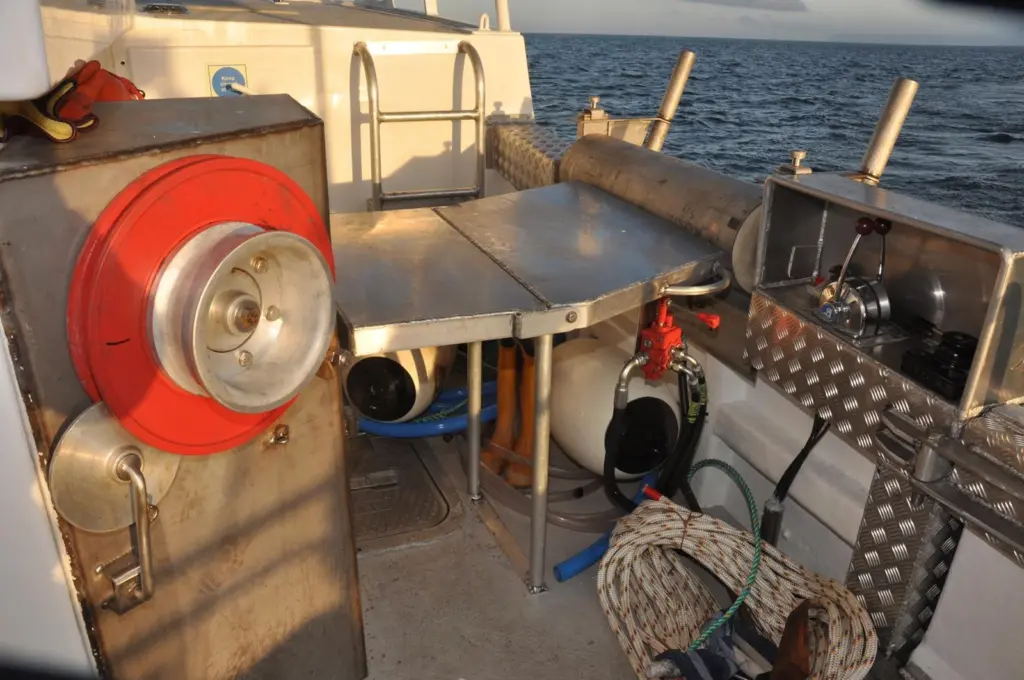
Actinia is rigged for creeling, with a Rapp Ecosse 0.5 tonne hauler, a large diameter stainless steel roller and clearing table on the starboard side of the offset wheelhouse, and a shooting door in the transom. Stainless steel sheathing protects the hull from the gunwale to below the waterline at the hauling station, and the external engine and autopilot controls are conveniently to hand in a protective gunwale mounted console.
In order to allow for the deployment of special purpose sonar transducers, for example for multibeam sonar or swathe bathymetry surveys, a successful feature has been copied from the larger RV Aora. A strongpoint and pivot is located on the port gunwale just aft of the wheelhouse to allow a stayed pole to be swung down, using the crane. The pole projects below the keel in use, but when retracted presents the transducer at a convenient position for adjustments to be made. Adaptors can be fitted to the flange at the end of the pole to suit the transducer required.
The wheelhouse has a dedicated baffled cable transit box to allow the connection of deck controls and electronics to subsea gear and tranducers. The table and work surfaces in the wheelhouse are fitted with flush cargo rails to secure temporarily installed electronic and survey equipment. Power (240v) and NMEA navigational information, from the comprehensive electronic package supplied and fitted by Oban-based Electrotech Marine Electronics Ltd, is also available at each equipment-securing area. The NMEA data from the DGPS navigator, autopilot, heading sensor, radar and dual frequency sounder, all from Furuno, are multiplexed to provide a single NMEA data stream, and buffered to give five independent outputs available to any temporarily installed survey equipment as well as the permanently mounted PC-based Microplot chart plotter.
UMBSM has been involved recently with ornithological and cetacean studies with respect to impact assessents for renewable marine power developments, both in the execution of surveys and the training of observers on the annual Marine Mammals course. To this end, an enclosed seating position for an observer has been incorporated on top of the wheelhouse.
The sheltered waters and varied sites around Cumbrae and further afield on the west coast of Scotland provide ideal conditions for underwater observation, sampling and experimentation. Many research projects and educational activities at UMBSM are supported by scientific diving. The Station has a diving team comprising the Diving Officer, Chief Diver and two full-time diving technicians. Like Aora, Actinia is capable of supporting diving operations, with ample deck space, removable bench seating and a door in the starboard gunwale for easy access.
The research vessel crews and the staff at UMBSM are all looking forward to the coming year as RV Actinia takes on its research and teaching duties for the first time in 2010. This new vessel represents a significant investment by the University of London, the University of Glasgow, the Higher Education Funding Council for England and the Scottish Higher Education Funding Council in the teaching of marine science in the UK. The one and a half thousand students who attend field studies courses at UMBSM each year will surely benefit.
Related Articles
 ELECTRICAL SYSTEMS
 VESSELS
 INDUSTRY NEWS