




Vessel Launch:‘Lady Iona’ provides comfortable crew transfer
Originally designed as a sightseeing vessel, the Europa Class catamaran Lady Iona was bought by Gordon Grant Marine from Mooney Boats Ltd in Ireland in late 2009.
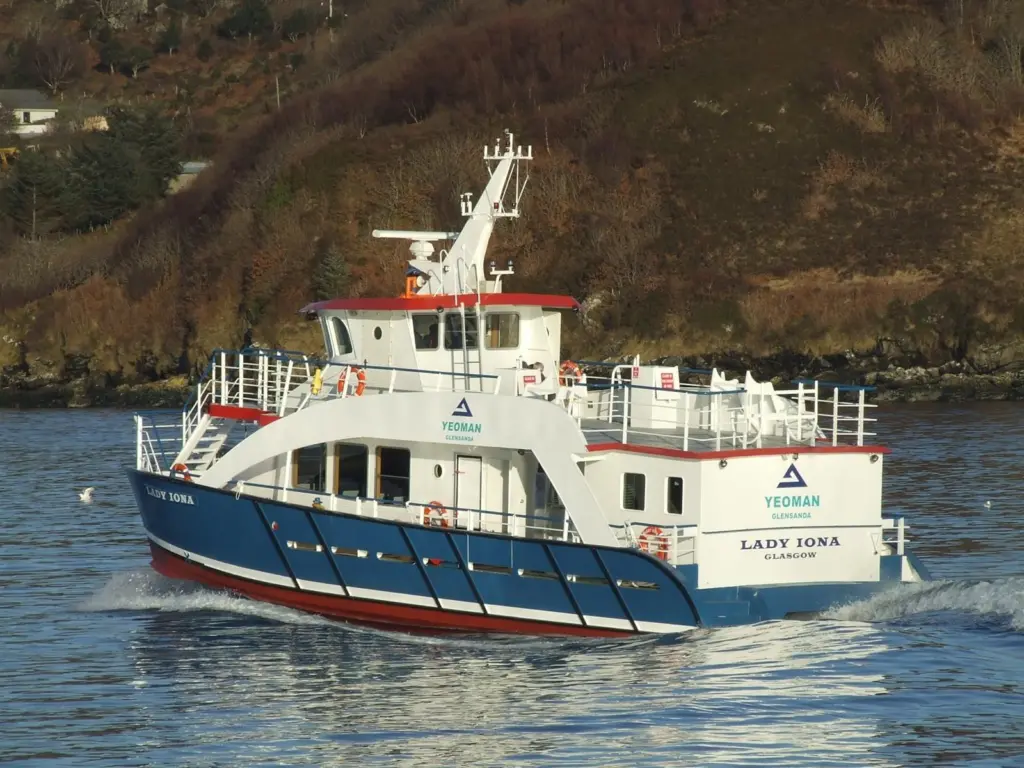
Being one of very few aluminium passenger ships of its size which could meet the European Passenger Ship Class B regulations, Gordon Grant Marine Ltd completed the deal in a very short time.
At 17.8m length overall and a beam of 6.6m the vessel is manoeuvrable and economical and, after some modifications carried out by Mooney Boats, is able to carry 86 passengers in a heated saloon fully fitted out with comfortable airline seating, audio visual displays and panoramic windows.
Naval architects Marine Design International were initially set the specification that the vessel must provide improved comfort and reduce the commuting time for the workers of Aggregate Industries, Glensanda Quarry. This required the addition of a new aft deckhouse and upgrading of the engines to twin Scania DI16 42Ms rated 748hp at 2,100rpm and driving correspondingly larger five blade propellers from Clements Engineering through TwinDisc MG 5114A gearboxes equipped with electric shift solenoid
Other modifications were made, driven by the operating crew to make working the vessel as safe and efficient as possible. Additional bow access stairs were added from the wheelhouse deck to the foredeck and twin port and starboard joystick helm controls added for docking and close proximity manoeuvring. Engine room ventilation was raised to the upper deck to keep noise levels to a minimum in the saloon and provide improved natural air circulation, saving weight and power over forced systems.
Wheelhouse electronics include Furuno Fr-1505 MK3 type approved radar working with a Furuno RP-180 plotter, Furuno Fe-700/50kHz IMO type approved echosounder, Furuno GP-150 GPS Navigator, and Furuno FA150 Class A AIS. Also on board is an IT Holland Type 11-B MC2 transmitting heading device, a type approved Walker Marine electromagnetic log system, two Simrad R135 MKII rudder indicators, a Sailor RT5022 DSC (Class A) VHF, Furuno NX-700-B Navtex receiver, a GME MT401FF float-free EPIRB, a SevenStar S.701 SART, and three Icom IC-GM1600E hand held GMDSS. Echomax has supplied a 230 radar reflector and there is a Phontech intercom system between the engine room and the bridge. Fitments include a CCTV system, public address system, televisions and a DVD player.
The vessel has also been brought under Bureau Veritas Classification to aid its flag transfer to the UK and passenger certification. There is no doubt that classification of small vessels is an involved process and much of the equipment is not generally supplied ‘type approved’. Certification is hard to manage and the level of calculation is higher than for even a well designed un-classed vessel.
There are, however, the benefits that all equipment is traceable, its quality and performance is closely scrutinised and the overall design and build is ensured to be as good as possible. There is also significant benefit for the new owners, giving piece of mind that the vessel they are operating is designed and built to an approved standard and the equipment fitted is up to the job, essential in the vessel’s role where unplanned downtime is not acceptable.
On trials the Lady Iona achieved 25 knots with full tanks and 22 knots with a further five tons of payload. Maximum operating speed will be 20 knots, which will be comfortably achieved in all conditions. Seakeeping and performance requirements have been met partially by the catamaran foil technology as described in the February 2010 issue of MJ, a technology which is being continually refined while proving highly effective on vessels of this type.
Lady Iona recently left the Mooney Boats Ltd yard at Killybegs in Ireland and completed the delivery voyage to Loch Linnhe in Scotland in just under 10 hours. The delivery went without problems and Lady Iona is currently undergoing going final preparation, crew familiarisation and drills.
Related Articles
 ELECTRICAL SYSTEMS
 VESSELS
 INDUSTRY NEWS