


Allseas launches ‘Grand Tour’ for offshore giants
The world’s largest offshore structures will be able to board Allseas’ new vessel when it’s delivered – expanding heavy-lift and towing capacity for offshore industry.
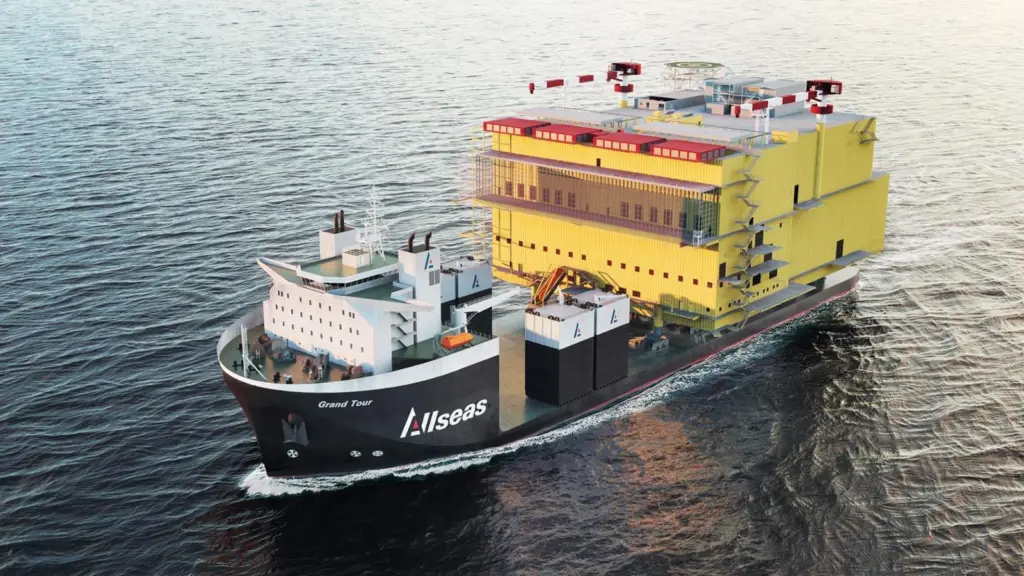
Switzerland-based Allseas may be well known for its pipelaying activities but its latest news – the order of a semi-submersible heavy transport vessel – is much more than just another arrival in the ‘dry tow’ market.
China’s Guangzhou Shipyard International has been entrusted with the order for the Grand Tour vessel, scheduled for delivery in Q1 2028. With a load capacity of 40,000 tonnes it will be capable of carrying the world’s largest offshore structures.
For the loading of floating cargoes, the 180m long vessel will feature an advanced ballasting system capable of pumping 24,000m3 per hour – equivalent to 10 Olympic-sized swimming pools
Grand Tour’s 24MW propulsion system will be able to transition to e-Methanol, ‘securing competitiveness in a changing energy market’ according to Allseas, while an air-lubrication system under the hull and podded propulsion will reduce drag, improve transit efficiency and cut fuel consumption.
The vessel will be capable of the usual submersible heavy-lift vessel (SSHLV) loading operations, including float-on/float-off, and its 57m beam will fit precisely into the bow slot of Allseas’ remarkable pipelaying and heavy transport vessel Pioneering Spirit, which makes the story more than just the arrival of another SSHLV.
Expanding markets
Increasing numbers of SSHLVs have entered the market in recent years, offering a dry-tow alternative to the more traditional wet-tow method, for example transporting damaged vessels and odd-shaped non-floating objects from one location to another (often offshore) otherwise loaded on non-propelled barges towed by tugs.
The dry-tow method is particularly suited for objects such as industrial plant, which would otherwise be lifted or skidded onto a barge, in consequence offering faster transit times and greater protection for the valuable cargo.
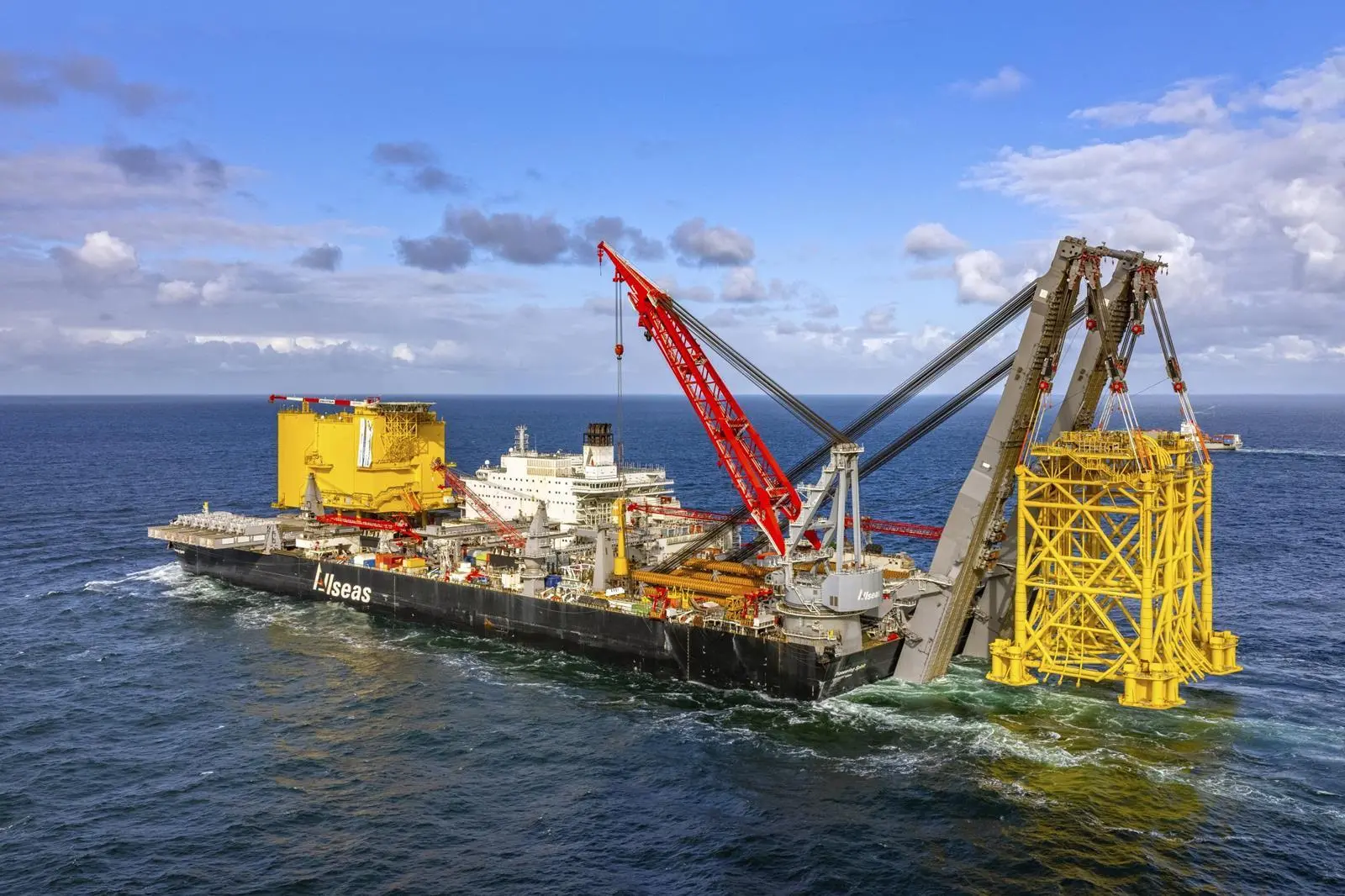
Two particular areas of growth will see the Grand Tour and Pioneering Spirit story coming together in an innovative way adding flexibility to the former and efficiency to the latter’s operations.
The global growth of renewable energy, in particular offshore wind, involving ever larger turbines and an increasing requirement for decommissioning (and new installation) of offshore O&G infrastructure, has seen huge demand for vessels that can install and remove ever larger structures.
Another change is that as offshore wind farms move further out to sea and into deeper waters, large high-voltage direct current (HVDC) converter stations are required, replacing the smaller, closer inshore AC-based sub-stations.
An example is TennetT’s BorWin5 HVDC converter station in the North Sea, involving the transport and installation of a 7,500 tonne jacket and 12,300 tonne topsides.
The second area of growth, requiring similar heavy-lift capabilities, is O&G platform decommissioning, typically involving two elements – the supporting jacket fixed to the seabed, and topsides.
Similar but separate abilities to perform installation and removal of offshore infrastructure are part of Pioneering Spirit’s raison d’être alongside its pipelaying capabilities.
Innovative features
Pioneering Spirit has a 59m wide slot between the two hulls and when decommissioning, its 12 thrusters manoeuvre the vessel into a position where the platform’s topsides are placed in the slot.
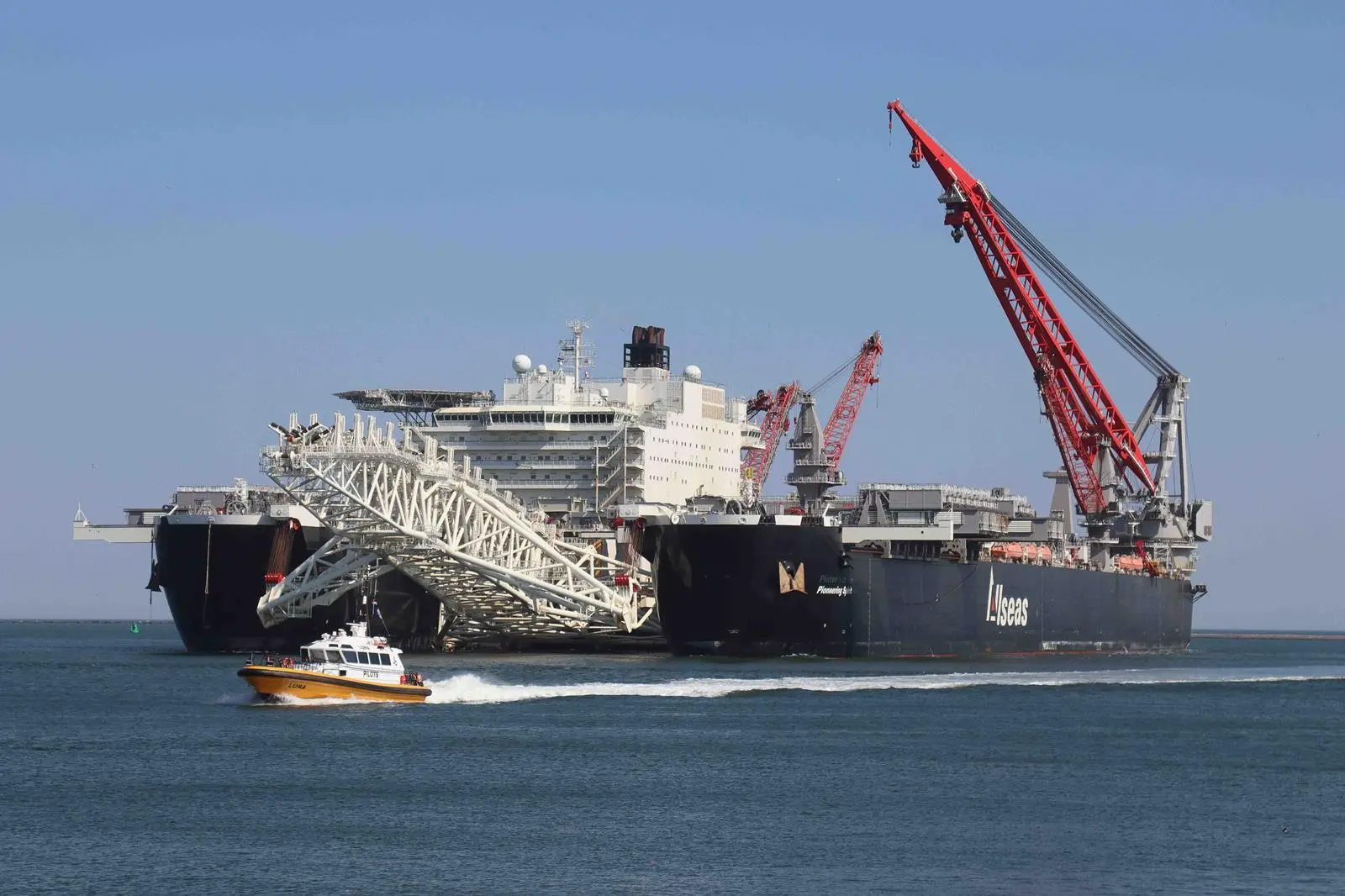
With the topsides disconnected from the jacket, motion-compensated single-lift technology on the ship raises the topsides clear of the jacket, the actual transition lift typically happening in seconds. The topsides then become cargo on board Pioneering Spirit.
Eight years after the vessel was built (in 2014), the final piece of the jigsaw was completed with installation of the jacket lift system.
Having loaded the topsides, the vessel manoeuvres its stern into position next to the jacket, which is now disconnected from the seabed. Two huge, linked arms are raised and connected to the jacket, which is raised ready for transport ashore and recycling, along with the topsides.
The same basic procedure in principle occurs in reverse when installing new jackets and/or topsides, including in the offshore wind sector, and it is here where Grand Tour is intended to fill a gap in the complete installation journey for the newer, outsized converter stations.
Talking to MJ, an Allseas spokesperson said: “Since the maiden Yme removal in 2016, Pioneering Spirit has set the benchmark for efficiency in platform installation and decommissioning, safely lifting and transporting more than 450,000 tonnes of offshore infrastructure, from small units to the record-breaking 31,000-tonne Brent Charlie topsides in 2024.
“Our unique motion-compensated, single-lift capability has transformed heavy lift, reducing offshore work, minimising risk and generating major time and cost savings. We have already proven this technology in the offshore wind sector, where scale and speed are critical.
“The addition of Grand Tour will enhance this capability, enabling seamless delivery of supersized converter stations from yard to site.
“Together, our vessels offer field developers and operators an unmatched solution to accelerate offshore wind expansion and realise the ambitions of the energy transition.”
Change of gear
During the early days of offshore wind, the North Sea was the focus of attention with components from foundations to offshore substations typically originating from within the region and close to their eventual destination.
At the time, the heaviest components were well within the capabilities of existing offshore construction vessels and crane ships with dedicated installation vessels later appearing, able to transport and install typically nine turbines in one loading. comprising foundations, transition pieces, towers, nacelles and turbine blades.
The industry’s progress is eye-watering: the first turbines in the Thames Estuary had capacities of 3MW and 3.6MW, but the largest turbines now in operation are 16MW in Fujian Province, China with Dongfang reportedly testing a 26MW turbine with 310m diameter blades.
It is partly the subsequent growth in size of the HVDC converter stations that has resulted in the order for Grand Tour, Allseas saying the concept ‘underscores our commitment to delivering projects smarter, strategically and with the future in mind’.
The global nature of the offshore wind market nowadays means greater distances between component fabrication sites and the actual wind farm location, particularly for HVDC converter stations, which in turn has led to a rethink on how these distances can be bridged.
Grand Tour will transport very large converter stations from fabrication yards in Asia and Europe to installation sites in the Dutch and German North Sea, where Pioneering Spirit takes over for single-lift installation.
The new vessel will play a key role in Allseas’ execution of TennetT’s 2GW offshore wind programme to deliver offshore wind power to European homes and businesses by 2032.
At the same time, Grand Tour’s conventional SSHL capabilities will enable Allseas to relocate its own fleet assets and enter new floating cargo markets – opening new long-term opportunities across sectors.
Related Articles
 OTHER NEWS
 MARINE CIVILS
 AUTONOMOUS VESSELS & TECHNOLOGY