



Collaboration in autonomy: the next steps
Enhanced vessel impact and movement data could boost industry leading vessel autonomy software. Jake Frith reports from Ocean Business 2025, Southampton, UK.
UK-based autonomous vessel control systems pioneer Marine AI has partnered Icelandic data-driven marine deep-tech company Hefring Marine in a force-multiplying collaboration.
By integrating Hefring Marine’s Intelligent Marine Assistance System (IMAS) with Marine AI’s GuardianAI vessel autonomy software stack, the partners are confident this will add another layer to maritime autonomy.
MJ caught up with Tom Rooney, general manager at Marine AI, along with Michael Given, Hefring Marine’s Sales manager, at Ocean Business to learn what the word salad above actually means for real-world autonomous vessel operators.
Key to the collaboration is the fact that Hefring Marine’s IMAS system employs sensors to obtain real-time data and then uses AI-driven technology and edge computing to provide actionable insights.
Hitherto, these insights have more usually been provided to a living, breathing skipper, but the carry-over to briefing an AI in the shape of Marine AI’s GuardianAI makes quite a bit of sense.
As Rooney puts it, the job of providing actionable insights is the same, whether those insights are provided to man or machine.
This makes even more sense when one realises that the GuardianAI system has been built on the hierarchy of decision-making that a real skipper would use.
Over the years, new streams of external data, such as radar targets, weather routing and thermal imaging camera data, have flowed into the stack and been integrated. So the system builds a passage plan that is adhered to, thus the vessel reacts to those ‘unless’ scenarios are effectively informed by a chain of command.
Just like a ‘real’ vessel (Rooney is quick to remind us that whether autonomous or human skippered they are all ‘real’ vessels), matters such as adhering to the COLREGS and so avoiding collisions with other vessels clearly loom higher than all else.
How the technology works

Taking the example of a hydrographic survey vessel, its objective likely will be to ‘mow the lawn’, adhering to a set of parameters to conduct a pre-programmed survey route.
While all is going according to plan, the vessel will be controlled by the survey engine software, with the overarching constant decision-making of GuardianAI making minor adjustments where required for slightly changing variables such as wind and tide, so that its swathes remain accurate.
Should an unforeseen event take place, such as a leisure vessel straying into the survey area, then a higher ranking part of the system takes over to take evasive action.
“What we ideally don’t want to do is stop the vessel in the water,” says Rooney. “That’s the worst-case scenario. In situations such as where a survey vessel has a sensitive and fragile towfish behind, the system will do just what a real skipper would. So it would take evasive action, by steering in the COLREGS-compliant direction in a large loop to clear the problem vessel, then resume collecting survey data where it left off. All while maintaining speed and hence not risking expensive towed equipment from hitting the seabed.
“To do this it will of course inform the survey engine of the manoeuvre so all survey data remains clean and uncompromised,” says Rooney. “So it’s done what a real skipper would do. It knows it must take evasive action, but equally it knows it is towing a million pounds worth of kit, so it takes the necessary evasive action in a manner that protects that kit.”
Marine AI acts as a central vessel operating software stack, so depends on bringing much of its data in from what it considers to be the industry leaders in discrete areas. It is always developing the system, and is currently working on automated VHF communications, so the AI skipper will talk and interact with other vessels whether they are driven by AIs or people.
Should any readers be concerned with the dystopian vision that AIs talking to AIs over the radio will result in the airways being populated by cacophonies of dolphin-esque AI clicks as they shed English for something quicker and more efficient, Rooney made things clear: “Our voice generation work for VHF communication is for the purposes of human oversight, often by third parties such as the coastguard or vessel traffic authorities, so it’s clear and optimised radio English and will stay that way.”
Guardian AI is already a modular autonomous vessel control system capable of IMO Level 4+ autonomy, allowing for high-fidelity situational awareness, tactical path routing and intelligent vessel control.
It has only become this by making the best partnerships. In terms of what Hefring brings to this autonomy party, it largely boils down to the value and fragility of equipment that autonomous vessels are likely to carry.
One of the benefits of marine autonomous vessels is that they can go longer, harder or faster than crewed vessels. Or that’s the theory. But talking to Rooney and Given, this ostensible benefit represents a double-edged sword: leaving the human crew on the dockside means the vessel might be able to, for example, go faster and obtain more data more quickly, but that human crew was the first line ‘sensor’, and a very accurate one when it came to noticing matters such as a slightly different sea state.
This is a key area where the Hefring IMAS comes in.
In the past, a skipper or crew might have started getting beaten about a bit and backed off or changed approach to protect the equipment, data quality or just themselves, and IMAS does exactly the same, only better.
“IMAS was initially designed to be a decision-making aid for human skippers,” says Given. “It can notice things like a slight change in accelerations or impacts before a human skipper can, so will advise on safe speeds for the conditions that take into account the maximum likely forces.
“In a very similar way to how IMAS informs a human skipper of a safe speed or passage plan for the safety and well-being of passengers or crew, IMAS can also inform an AI skipper of a safe speed or passage plan to protect the vessel’s hull integrity, the quality of its collected data or its expensive and fragile equipment.”
In this example, concerning the chain of command of the AIs aboard, the IMAS system sits quite high up as it is making fairly fundamental decisions such as the speed and direction of the vessel, which is appropriate for the situation at the time and also predicted events.
Tom Rooney emphasises the benefits of this integration: “The synergy between GuardianAI and IMAS will redefine how autonomous vessels interact with their environments. IMAS acts as the ‘human feel’ in an autonomous setting, allowing vessels to respond dynamically to real-time conditions. This partnership enables a holistic approach to autonomy, ensuring both crewed and uncrewed vessels can navigate safely and efficiently.”
While hydrograpic survey is an early adopter of autonomous vessel systems and one that felt appropriate to talk about at Ocean business, this collaboration and others like it could be set to enhance maritime operations across various sectors, including search and rescue, law enforcement, defence, offshore support, crew transfer, and the leisure industry.
Future plans
Hefring Marine and Marine AI will continue joint product development and system enhancements to expand the capabilities of autonomous vessel operations.
The scalable nature of this technology allows it to be implemented across a wide range of vessel types, from small uncrewed autonomous boats acting alone or in swarm configurations to large passenger ships.
This is not a technology that awaits far over the horizon.
It came as a surprise that according to Rooney, once the tech teams from Marine AI and Hefring Marine get working together, which is happening imminently, the lion’s share of the integration will take about a fortnight.
I guess that stands to reason considering Marine AI’s model is built upon selecting what it believes are industry leading third-party solutions and quickly and efficiently integrating them into its software stack.
We also spoke briefly about Marine AI’s location in Plymouth.
It is no accident that this industry-leading firm is based there as this deep-water port in the South West of England is home to the National Centre for Coastal Autonomy.
The NCCA is fast becoming a leader in coastal autonomy with a fleet of advanced autonomous vessels, sub-surface platforms, and scientific buoys.
These innovations, based in Plymouth, will create the UK’s first autonomous coastal observing system. Many companies are either being founded in or relocating to the city and it’s encouraging to see that the Icelandic company Hefring is so excited to have a tentacle in this crucible too.
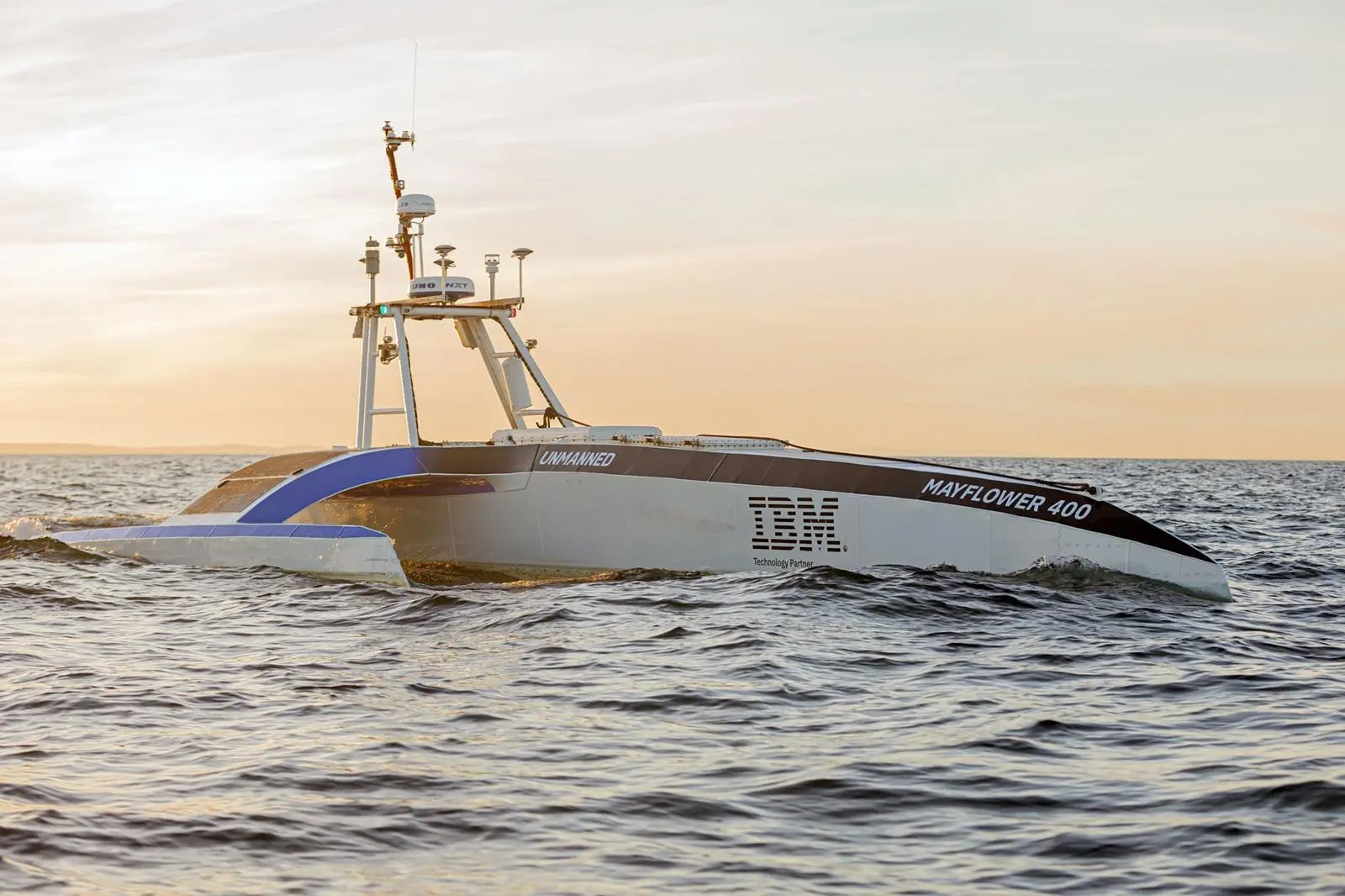
Fundamental to Plymouth’s development as a marine autonomy hub was the Mayflower Autonomous Ship project, the vessel setting sail on the world’s first autonomous Atlantic crossing in June 2022.
Marine AI, MSubs, IBM and ProMare provided the system that enabled the vessel’s remarkable journey.
Related Articles
 AUTONOMOUS VESSELS & TECHNOLOGY
 OTHER NEWS
 OTHER NEWS