



Demand and opportunity grow for wind farm CSOVs
Damen Shipyard’s recent orders for Construction Service Operation Vessels (CSOVs) from Taiwan and Belgium-based owners provides further evidence that this method of servicing offshore wind farms is no longer a concept but a reality.
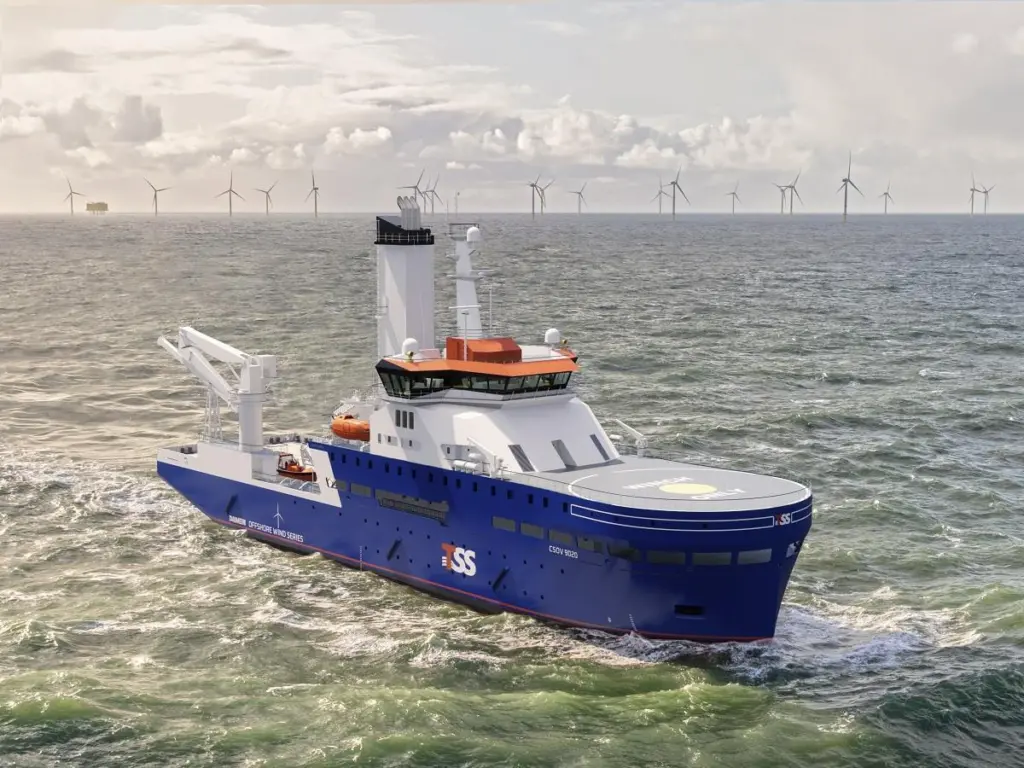
Orders for this relatively new type of vessel, along with Damen’s drive to develop electrically powered vessels, underlines the attractiveness of the model whereby technicians live offshore for periods of time rather than the earlier day-boat method of working when wind farms were within easy reach of shoreside facilities.
This was a natural progression as wind farms moved further offshore, with the extended ‘commuting’ times reducing the length of the working day along with a greater risk of weather disruptions.
Announcement of the order for Ta San Shang Marine (TSSM), a JV between Mitsui O.S.K. Lines of Japan (MOL) and Taiwan’s Ta Tong Marine Co Ltd came just a week before Damen unveiled a fully electric version of its 60m Service Operations Vessel (SOV) at the Offshore Energy Exhibition and Conference in Amsterdam.
The 85m vessel will have the usual features associated with SOVs, including DP and a walk-to-work access system. With accommodation for 60 technicians it will have half the capacity of other orders featured here, the specifications relative to the profile of the wind farm where it will operate, including size and location. It will become TSSM’s second SOV, joining TSS Pioneer, built in 2022 by Vard Vung Tau, Vietnam to service Taiwan’s Greater Changhua offshore wind farms.
Damen currently lists five SOVs/CSOVs in its portfolio: the 60m SOV 6017 Hybrid accommodates 40 persons; the SOV 7017 Electric version of 70m length accommodates 60 persons including crew; the SOV 7017 Hybrid accommodates 60 persons in a 70m vessel; the larger 84m SOV 8417 Hybrid houses 90 persons and finally, and relating to the orders reported here, the CSOV 9020 Hybrid of 88m length has accommodation for 120 persons.
CSOVs are typically larger than SOVs, with capacity for additional technicians and goods. As the construction/commissioning phase is relatively short they can move from one contract to another, providing greater flexibility for the owner.
TSSM’s CSOV 9020 is under construction in Vietnam and due for delivery in late 2025. MOL views the addition as consolidating TSSM’s position as a leading SOV player in Taiwan and a stepping stone for its business development in the Asia region.
The vessel will have ample personnel and storage capacity for contractors during both the construction and operational phases of wind farms, and will include diesel-battery hybrid power generation systems with full preparation for future use of green methanol.
Windcat expands
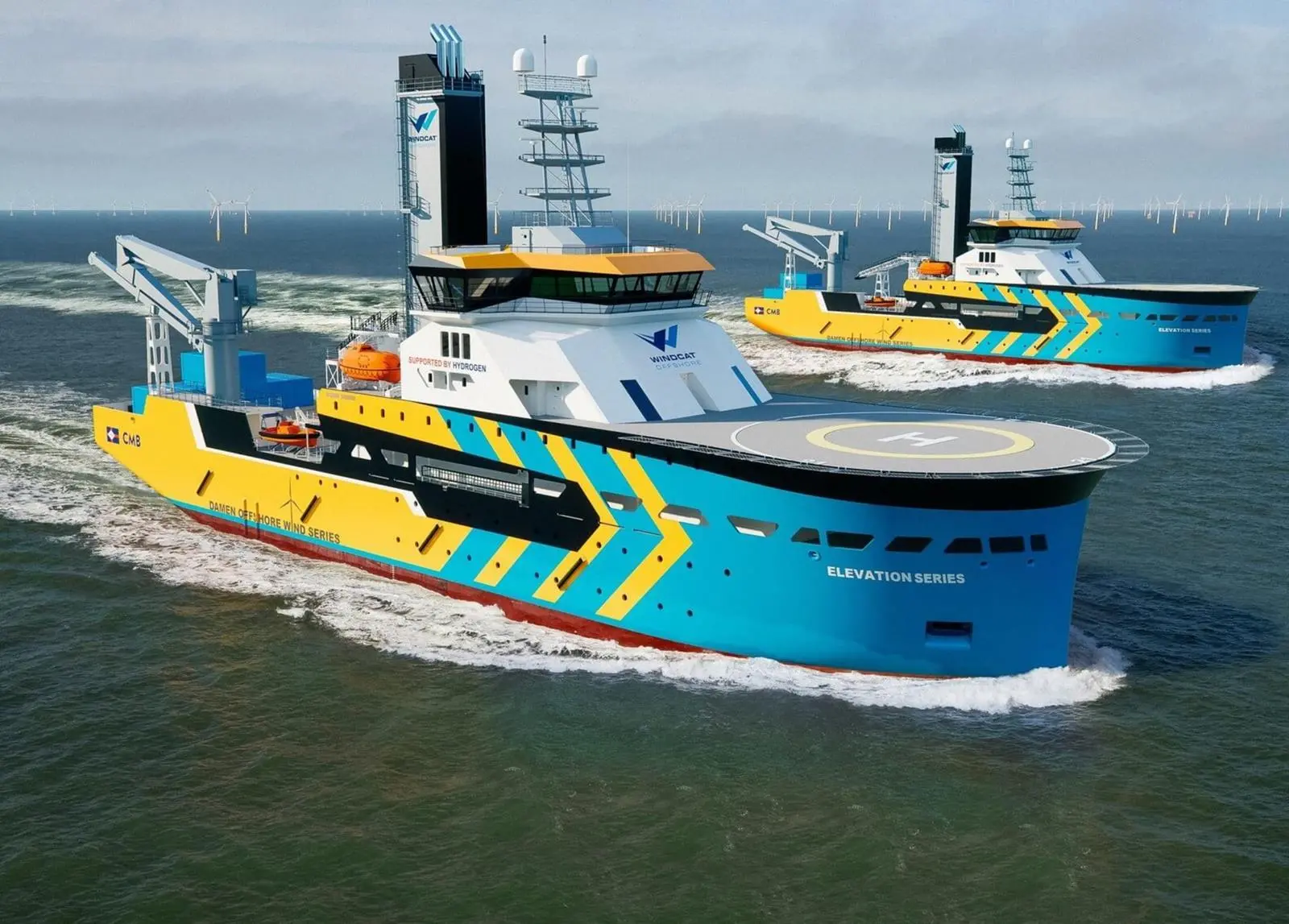
Belgium-based Windcat has been involved with the wind farm industry since 2003, and is an example of how the support vessel sector has grown in parallel alongside wind farms themselves. It has two business units – Windcat Workboats is a familiar name in Europe with more than 50 crew transfer vessels operating since the industry’s early days, and operates with JV partners FRS Windcat and TSM Windcat in Germany and France respectively.
In 2022 and building on its experience with the smaller vessels, Windcat Offshore was established as a sister company focussing on CSOV ownership and operation. With Windcat under the ownership of Belgium’s CMB since 2020, it will benefit from its experience managing larger vessels.
In November 2022, Damen received a significant order from Windcat for a series of hydrogen-powered “Elevation Series” CSOVs of 87m in length with accommodation for 120 persons. They are designed by Damen Shipyards in cooperation with Windcat and CMB. Tech.
Two were initially ordered with options for further vessels and with the appetite for this class apparent, news has followed that two further vessels have been ordered, increasing Windcat’s CSOV fleet to a total of five with an option for a sixth vessel.
They will include hybrid battery technology, and related to the all-electric 9020 version include an offshore charging capability. The first three, under construction in Vietnam, are due for delivery in 2025 with the two additional vessels expected in Q2 and Q3 2026.
CMB and Damen are both family-oriented companies.
“Both companies see there is a promising trajectory for the offshore wind industry and recognise the growing demand for vessels that align with clients’ needs for sustainable energy throughout the production and delivery processes,” says Damen.
Related Articles
 OTHER NEWS
 MARINE CIVILS
 AUTONOMOUS VESSELS & TECHNOLOGY