![MaritimeJournal[Seawork]](https://www.maritimejournal.com/wp-content/uploads/2026/09/MaritimeJournalSeawork.svg)






Electric drives could transform small craft inshore work
Electric propulsion, particularly for small commercial craft working in harbour settings, is still a big growth area. Jake Frith took a RIB with a 40kW motor for a spin at Ocean Business and chatted to RAD Propulsion’s Dan Hook.
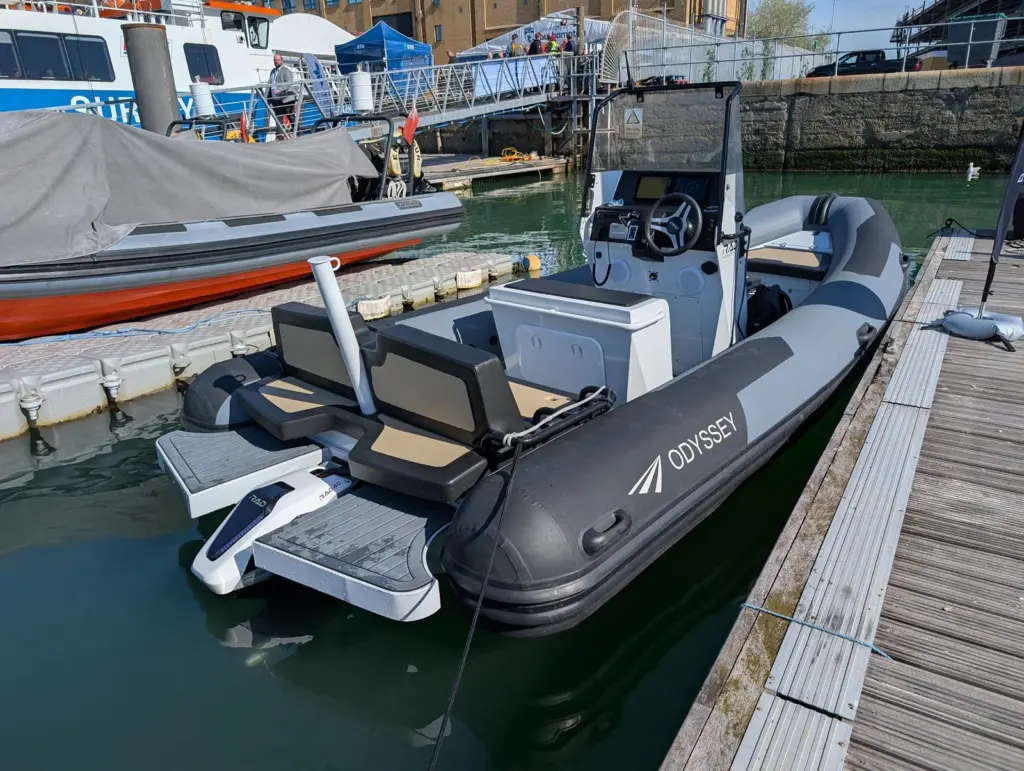
RAD Propulsion went into full production of its RAD40 last year, aided in part by successfully closing a £4.27m (€4.91m) funding round, the raise comfortably exceeding the company’s initial target of £2.5m.
Demand for these premium-priced drives has been worldwide: from an eco-tourism lodge in Botswana that has discovered these near silent motors allow its launches to get much closer to animals; to a cruise ship operator that has found its inflatable sightseeing tenders are quicker to dismantle and stow when equipped with modular electric drive components.
Demand has been diverse too: just the week after our trip two RS Pulse electric RIBs equipped with RAD40s would be acting as umpires for the world famous Oxford vs. Cambridge University Boat Race.
As I still mainly operate diesel and petrol boats, it’s always a surprise to step aboard a fully electric craft and experience the novel sensation of carrying on a conversation at normal levels while making acceptable progress across a harbour.
Hook vouches for the fact that “the silence isn’t why operators such as harbour authorities are investing in electric boats, but this is one of the main reasons the users of the boats on a day-to-day basis, even if they start out sceptical, are generally ultimately pleased when their authority makes the changeover to electric.
“These boats are often out for a few hours a day, with lots of slow speed and start/stop work, so the light controls (the RAD40 is completely fly by wire, so all inputs are fingertip light) and low noise levels make them highly popular.
“When you are out on a boat every day, small reductions in the general fatigue, such as that provided by no longer having to shout to be heard by other crew, all add up. While our engines are often purchased to meet decarbonisation targets, their users, just like many electric car drivers, often state that if all these targets got scrapped tomorrow they would keep their electric boats and never go back.”
Range and manoeuvrability

With range anxiety always being in mind with electric vehicles, I was surprised to learn that many harbour authorities recharge their RAD40 equipped launches every two to three days. At the 4-6 knots these boats patrol at, the range in these craft can be well over 100 miles.
Electric boats are still so new and developmental, there are still a number of different ways of solving the problems. Choice of motor and gearbox configuration is one area where many of the solutions diverge.
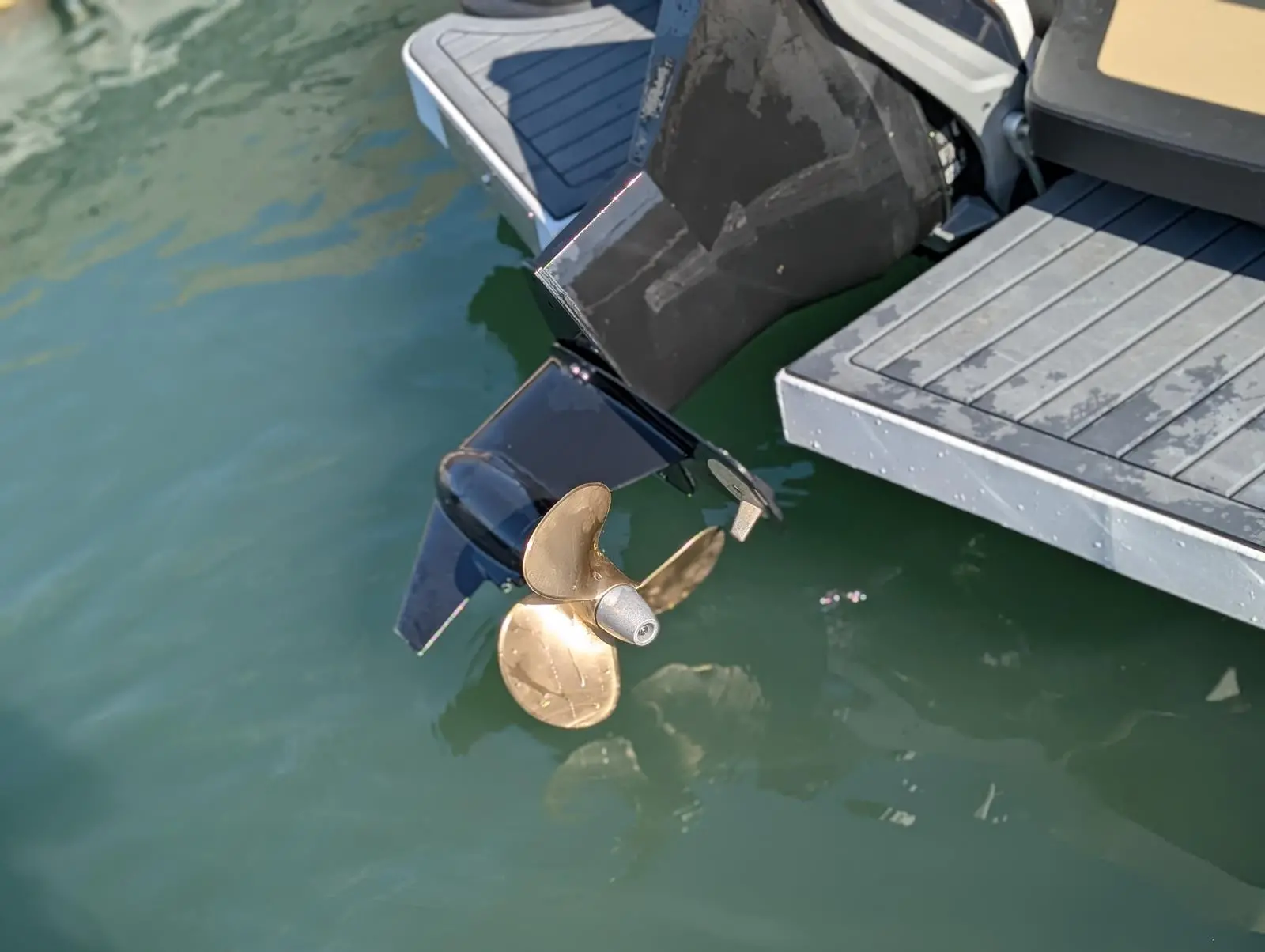
The RAD40 uses an axial flux motor. This is relatively wide and flat, is not the cheapest solution, but as far as Hook is concerned it is the best.
“For motors, diameter equals torque, thanks to simple principles of leverage,” he says. “Once you’ve decided the motor will be mounted above the water in a powerhead, so not a direct drive hub motor, you can, within reason, have it whatever shape you like.
“If you go for high torque at slow RPM, as we have with axial flux, you don’t have a great step down in gearing to take the motor speed down to the prop speed. With this, the gearbox in the leg can be a relatively small diameter, aiding hydrodynamics and so optimising speed and/or range.”
Unfortunately there are limits to this, as electric motors, particularly axial flux motors, shove out so much torque, the gearbox cannot be super narrow.
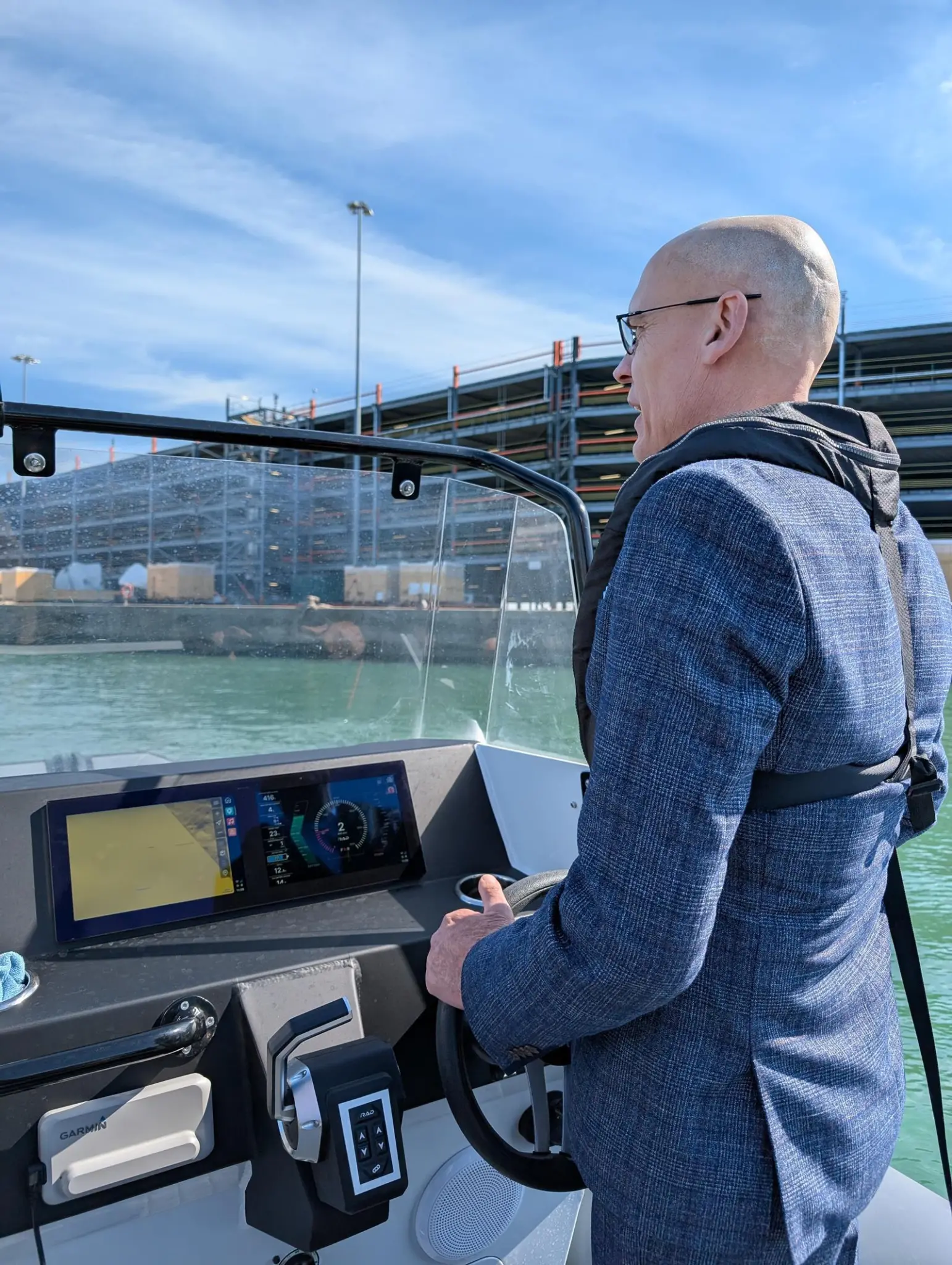
RAD says the 40kW is equivalent to a 60hp petrol outboard, and taking the wheel of this one at Ocean Business would incline me to agree.
Acceleration is instantaneous but quiet, and manoeuvrability is stunning. For those not used to a drive that can be turned a full 90 degrees either way from the straight ahead, it feels like something of a manoeuvring super power.
After enjoyably spinning the boat in its own length in forward gear, I slipped the control into reverse, giving it a little too much throttle before the way was adequately off the boat.
The V-hulled RIB suddenly got a very torquey rolling moment in the other direction. The fly by wire control system, called RADBus, limits power in reverse for this reason, but new operators need to be gentle on the controls. The system also limits the steering angle available at high speeds.
Electric benefits
Electrification allows other useful packaging wins. With no heavy internal combustion engine to keep a certain distance above the water, the motor tilts without any part of it entering the boat.
This immediately makes any boat feel about 50cm longer inside, and on small passenger craft this can mean an extra pair of seats. On all craft, the low level of the motor both tilted up and down means greater design options around swim platforms and stern boarding arrangements.
Most electric motors are waterproof and capable of working after full immersion. It’s a feature that’s not difficult to do on most motors as they don’t need to ‘breathe’ air, and their electrics are often close to the water so it’s a prudent thing to have.
The RAD40 is no exception, being tested to IP67 standards. While electric outboards are yet to make massive inroads into Search and Rescue, the ability to completely immerse the motor, restart and carry on straight away, has to be in their favour.
Batteries
Batteries is another area where solutions differ. The cheapest way to do it is most likely with off-the-shelf automotive battery packs, but these are configured to be wide and flat to sit at floor level in a car.
“For most boats a wide, flat automotive pack is not the preferred solution,” says Hook. “It’s hard to stow and if it is put under the console it can raise the helm position, potentially affecting the stability and feel of the boat.
“While our individual lithium-ion cells are the same as in some automotive packs, we’ve reconfigured these into deeper, more rectangular packs that nestle well into the V of most hulls. The batteries are available in 21kWh and 61kWh sizes, to fit a variety of boat configurations and requirements.”
Charging of the 61kWh is achievable in under an hour thanks to the 400 Volt architecture and CCS DC fast charging, but Hook reports that it suits many operators to just charge overnight on a mains plug.
In terms of future products, Hook let us into two areas of development. A circa 6kW solution will cater for small, slow moving harbour craft, while a circa 120kW solution will provide enough grunt for RIBs up to 8m in twin configuration.
In terms of catering for larger boats, Hook is fairly committed to RAD remaining a specialist in small vessel propulsion.
“For our customers we see around 150hp to be the sweet spot. It covers a lot of vessel types and speed ranges,” he says.
Related Articles
 OTHER NEWS
 ACCESSORIES & EQUIPMENT
 SPECIAL REPORTS