


Holland Shipyards delivers cable recovery vessel
Holland Shipyards Group has delivered a specialised cable recovery vessel for Dutch principals following conversion from a new general cargo vessel built in China.
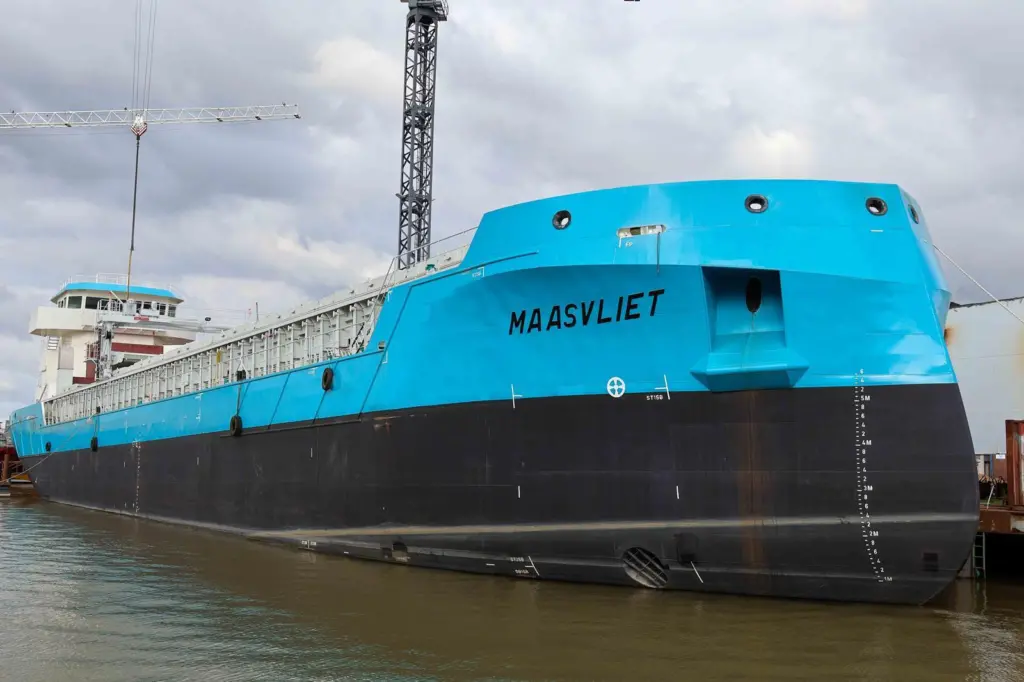
The ship in question is one of a series of vessels built by Yizheng Yangzi Shipbuilding in China for Instalho Scheepsbouw (part of Holland Shipyards Group) and shipped to Europe for Dutch interests.
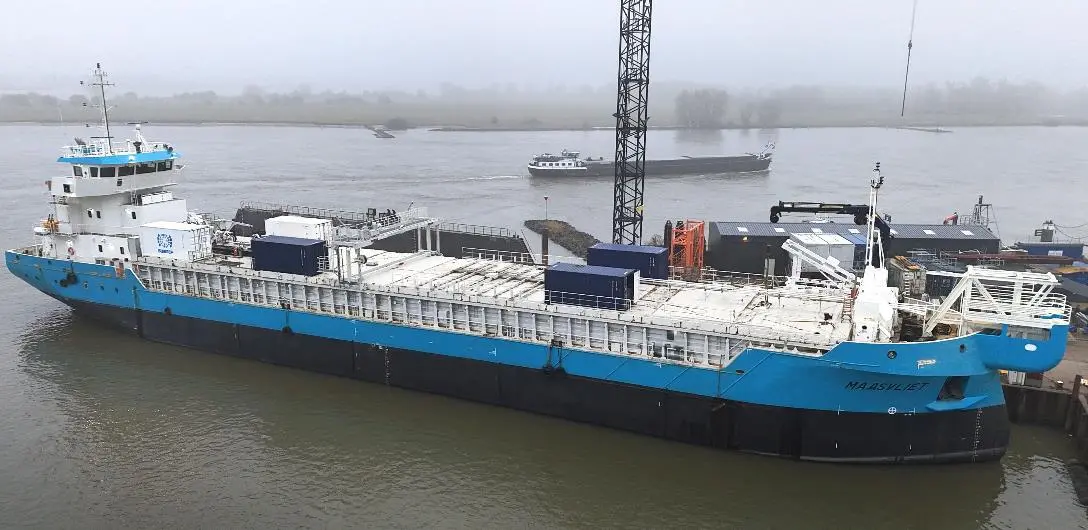
Originally built as standard general cargo vessels of around 2,800gt and 3,800dwt and with a modest length of 90.3m, one of the series, Maasvliet is now embarking on a different role as a cable recovery vessel for which Holland Shipyards Group was entrusted with its conversion.
Maasvliet has now emerged from the Hardinxveld-Giessendam yard following conversion into what it describes as a ‘highly specialised vessel’ to be managed by Netherlands-based Hartel Shipping & Chartering on behalf of long-term charterer Subsea Environmental Services, a US-based company engaged in the recovery and recycling of out-of-service submarine telecommunications cables and infrastructure that handles 95% of the global internet traffic.
Sustainability
The original cargo-carrying vessel design has allowed installation of dedicated cable tanks in the hold for the recovered cables, while an advanced cable management system, handling equipment and spacious working deck vessel will allow it to operate with precision in challenging conditions.
Maasvliet is addressing the challenges of sustainability with a diesel-electric drivetrain, allowing for it to be operated on sustainable fuels now and for alternative future developments.
The vessel is propelled by two 374kW electric motors with an installed power of 794kW, the frequency-controlled, diesel-electric arrangement regulating the speed of the propeller based on variables including load factor, water level and navigation route. Holland Shipyards says it results in fuel savings of up to 35% and ‘significantly fewer emissions’.
Backgrounds
Founded in 1981, Holland Shipyards is in many ways a traditional shipbuilder with a diverse portfolio including the ‘Eddy Tug’ series of tugs and inland ferries for operation in Amsterdam and further afield, Germany and Norway.
Its conversion activities are of particular interest, the company recognising that when markets slow down, leading to excess tonnage including in the tanker, container and offshore support sectors, owners face the prospect of laying up vessels, assets that potentially can be put to a different use in a different market.
As a result, offshore support vessels have been converted into accommodation vessels and container vessels have re-emerged from the yard as roros for the offshore wind sector. In one example, a newly-acquired general cargo vessel was converted into a trailing suction hopper dredger.
As for Maasvliet’s new charterer, Subsea Environmental Services, in just 10 years of operation it has recovered more than 50,000km of undersea cable, equating to 90,000mt for recycling – closing what it describes as the ‘cable life cycle loop’.
Subsea infrastructure remains out of sight of course, but with new and replacement cables being installed the environmental impact of the old data and electric inter-connectors has to be addressed.
Unlike the sophisticated large vessels involved in initial installation, this venture demonstrates that the problem of recovering old infrastructure can be accomplished with a relatively simple provision.
An indication of the global nature and scale of such activities is where in 2022, Subsea Environmental Services recovered the retired Atlantis 2 fibre optic cable that linked South America with Senegal in Africa.
Its publicity material illustrates an earlier similar general cargo vessel, built originally in the Netherlands in 2008 as Flinterbecca for Flinter Shipping BV, later converted into a cable recovery vessel operating for Subsea Environmental Services as Rebecca.