![MaritimeJournal[Seawork]](https://www.maritimejournal.com/wp-content/uploads/2026/09/MaritimeJournalSeawork.svg)


Kongsberg equipment for German ocean research vessel
Kongsberg will provide scientific sensors and scientific handling equipment for Germany’s new state-of-the-art ocean research vessel, the 135-metre Meteor IV.
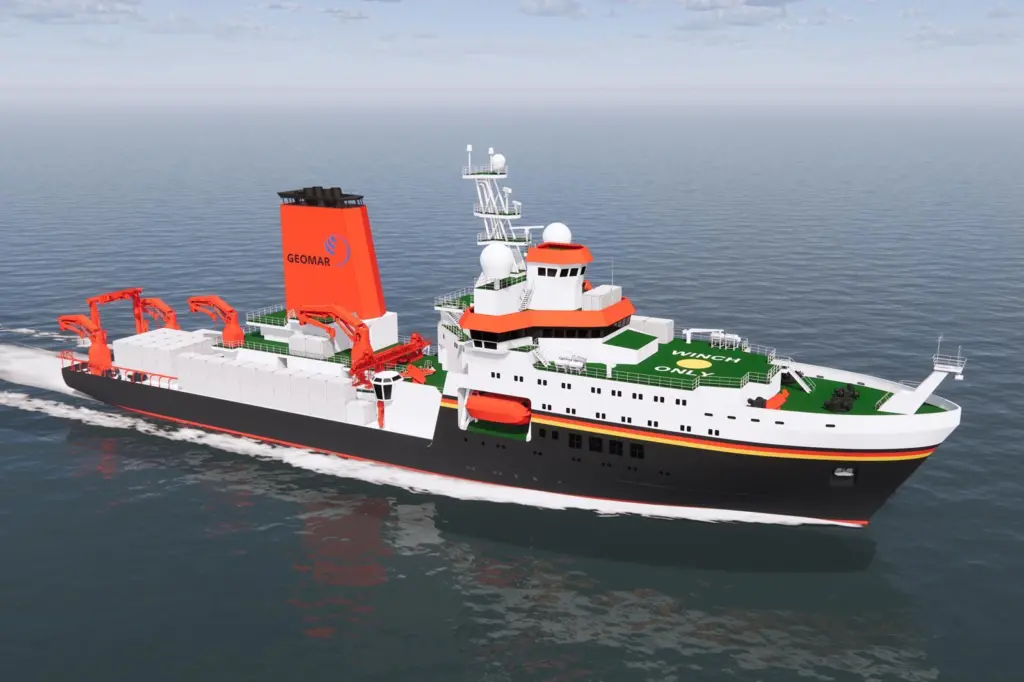
The 10,000 GT vessel will be built by MeyerFassmer Spezialschiffbau (MFSB) for the German Federal Ministry of Education and Research and will satisfy the need for next generation survey equipment.
“We need to build a better understanding of our changing climate and the effect it has on the marine environment to protect our oceans and future generations,” said Stene Førsund, executive vice president sales and marketing, Kongsberg Discovery.
“A top priority of marine scientists is to map the entire seafloor by 2030, an enormous task that will require instruments and equipment with extremely precise calibration.”
Scope of supply
Kongsberg Discovery will supply Meteor IV with the EM 124 and EM 712 multibeam echo sounders, used for seabed mapping at various depths.
It will also provide the Seapath 380 with Motion Gyro Compass (MGC) R3, which has sensors that use GNSS signals and inertial measurements. These combine with the EM series of echo sounders to create an exact picture of the seabed.
To monitor ecosystems and marine life, Meteor IV will use Kongsberg Discovery’s EK80, a high-precision scientific echo sounder with acoustic doppler current profiler capability, which may be used to measure the velocity of fish in a water column.
The EK80 measures speed and direction of currents in a water column, which helps researchers understand how organisms, nutrients and other biological and chemical constituents are transported through the ocean.
Kongsberg Maritime will also supply a complete integrated scientific handling system for Meteor IV, enabling safe and efficient operations with cables and ropes up to 12,000 metres in length.
The scientific winch system comprises two direct pull winches, two conventional twin drum traction winch systems and a third traction winch system, which includes Kongsberg Maritime’s field-proven cable traction control unit (CTCU) for superior performance with synthetic fibre rope.
The delivery also includes overboard handling units; a stern A-frame, two handling beams and a corer handling system, as well as cranes.
Kongsberg Maritime’s control system features the proprietary predictive active heave compensation (AHC) algorithm providing accurate winch system response matched to vessel motion, by aid of Kongsberg Discovery’s motion reference unit (MRU).
Meteor IVis designed for worldwide multifunctional and interdisciplinary research, with a focus on the Atlantic Ocean. The new vessel will make important contributions to national and international marine science, particularly in the areas of climate and environmental research.
The vessel, due for delivery in 2026, replaces existing research vessels Meteor and Poseidon.