![MaritimeJournal[Seawork]](https://www.maritimejournal.com/wp-content/uploads/2026/09/MaritimeJournalSeawork.svg)



OPINION: Can the growing SOV fleet meet demand?
The Service Operation Vessel (SOV) market is going through a period of rapid expansion driven by two main factors: a growing demand for wind-specific offshore support and more commercial opportunities in the traditional offshore energy market.

Analysts with Spinergie, the France-based start-up that specialises in optimising marine operations through advanced analytics, AI and real-time monitoring, explain how growing offshore wind demand and renewed opportunities in oil and gas make SOVs critical.
SOVs are primarily used in offshore wind as mobile bases for technicians, tools, and spare parts during the operations and maintenance (O&M) phase. Purpose-built and designed to accommodate up to 120 technicians at sea for up to 15 days, these vessels play a major part in maximizing offshore working time.
Unlike Crew Transfer Vessels (CTVs), which return to port daily, SOVs can operate farther offshore and in harsher conditions. As such they often include daughter craft and helidecks for personnel transfers when conditions are poor. That is not to say that SOVs replace CTVs, instead they complement them by offering greater endurance and comfort with broader operational windows.
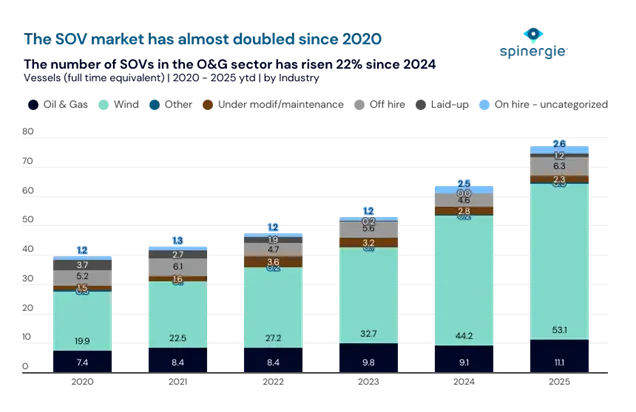
Beyond wind, SOVs are increasingly active in the oil and gas sector. Despite a stabilising wind market in 2025, oil and gas deployments are rising—up 8% year-over-year since 2019. In Q3 2025, 14 SOVs were active in oil and gas, a 35% increase from Q3 2024, signalling an evolution in the commercial scope of these vessels.
The global SOV fleet has grown by 30 units over the past three years. With their number expected to double in the coming years, Spinergie analysts Maëlig Gaborieau and Hugo Madeline share the current state of the SOV market and expectations for its continued evolution.
SOV during the offshore wind construction phase
SOVs undertaking key functions during the offshore wind farm construction phase take on the acronym CSOV. During inter array grid (IAG) termination and testing, they support the array cable pull-in by securing cable terminations inside the turbine tower. They also perform insulation resistance, continuity and high-voltage tests to verify electrical connections.
In the foundation completion phase, they support final inspections, bolting, welding and protective coating to prepare foundations for turbine installation.
Finally, for turbine commissioning, CSOVs assist with testing mechanical, electrical and control systems. This includes functional checks, system calibration and initial energization.
Each phase involves light crane operations to move tools, equipment, test devices and spare parts to the turbine. These tasks were traditionally handled by medium multi-purpose or construction vessels, but Spinergie analysis shows that CSOVs are now replacing many of these assets and gaining market share.
An increased role in O&M
SOVs are increasingly used in the O&M phase as offshore wind projects move into deeper waters with more difficult weather conditions. Their operational abilities and crew capacities are making them the preferred solution over CTVs in these kinds of projects.
O&M SOV activities include planned interventions such as scheduled turbine maintenance, inspections and minor repairs, as well as reactive operations like unplanned light maintenance following component failure or sensor alerts.
With onboard workshops, spare parts storage and motion-compensated gangways, SOVs enable technicians to address issues promptly without the need to return to port, maximizing turbine availability and reducing logistical delays.
The key advantage of SOVs lies in their operability windows
There is significant versatility in SOVs with their superior operability, one of their main plus points. This is especially clear when they are compared to CTVs.
CTVs typically operate within 60km from shore and are limited by sea state (generally up to a wave height of 1.8 m), but SOVs maintain access at much higher thresholds. This heightened operability enables safe transfers over more days per year, especially in harsher North Sea and Atlantic conditions.
A useful way to visualise SOV competitiveness is through a distance-to-shore × weather-severity matrix, which highlights their growing share of operational time compared with CTVs.
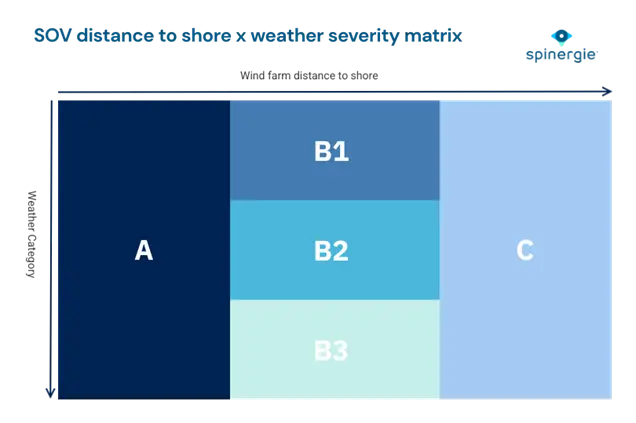
The matrix categorizes conditions into three distance buckets: Close (<30 km), Far (30–60 km), and Very Far (>60 km), and three weather conditions: Calm, Medium, and Harsh, defined with the number of harsh weather days observed per year.
Category A: Close to shore (<30km), almost exclusively CTVs are used, regardless of weather conditions on the wind farm.
Category B1, B2 & B3: SOVs begin to be used more at this distance (between 30 and 60km), and local weather conditions influence the observed split between CTV and SOV usage.
Category C: SOVs are heavily used at very long distances (>60km), mainly due to the long transit time required for a CTV to make a daily trip (>2 hours).
In Close–Calm scenarios, CTVs still dominate due to their lower cost and sufficient accessibility. However, as either distance or weather severity increases, SOVs rapidly gain share. For instance, very far and under harsh weather conditions, SOVs account for more than 40% of O&M observed time. This trend underscores how SOVs unlock O&M continuity for distant and exposed sites, where weather downtime would otherwise lead to unacceptable turbine unavailability.
Coping with rising demand
With demand rising in the offshore wind sector, and in O&G, how will the market cope?
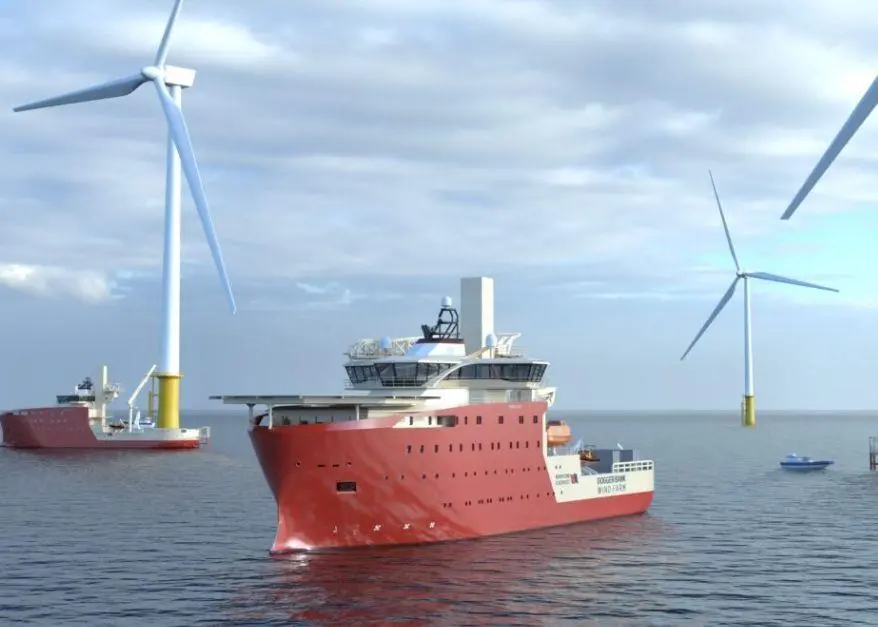
As of August 2025, the global SOV fleet includes 85 active vessels with another 48 expected over the next few years.
Of the expected deliveries, 32 are scheduled in 2025, following the 16 in 2024. This is a rapidly scaling fleet and is expected to reach at least 133 units, excluding a number of assets currently under option.
Our market analysis indicates that the offshore wind project pipeline might not be fully met. In an analysis of heavy-lift vessel availability we have identified a bottleneck around 2027, which may delay some offshore wind projects and reduce near-term SOV demand. In response, vessel owners are adapting their strategies.
To secure financing and optimise fleet deployment, more owners are locking in tri-partite agreements – binding contracts between the vessel owner, ship designer and offshore wind developer – for terms of five to 10 years.
Of course, demand patterns vary by region. In mature offshore wind markets like Europe, SOVs dominate O&M operations as projects move further from shore. In newer markets, commissioning and maintenance still rely on CTVs and re-purposed O&G vessels.
What to expect from the future
The SOV sector continues to evolve as new opportunities emerge. The market is seeing mid-sized SOVs entering the market to bridge the gap between CTVs and full-scale SOVs. Meanwhile, new designs aim to lower CAPEX while maintaining operational performance and onboard comfort.
The market is also seeing owners repositioning with a number of purpose-built CSOVs entering the O&G sector to meet the temporary demand surge while wind growth slows.
In the near term, the SOV market is set to remain supply-constrained rather than demand-limited. Fleet expansion is moving fast, but with utilization already exceeding 80%, and with cross-sector competition from oil and gas, vessel availability will be the key pressure point.
As owners lock in long-term agreements and adapt vessel designs, the next phase of the market will be defined less by whether demand exists, and more by how quickly purpose-built SOV capacity can keep pace.
Related Articles
 INDUSTRY NEWS
 OTHER NEWS
 MERGERS & ACQUISITIONS