



Technology insight: electric tug power
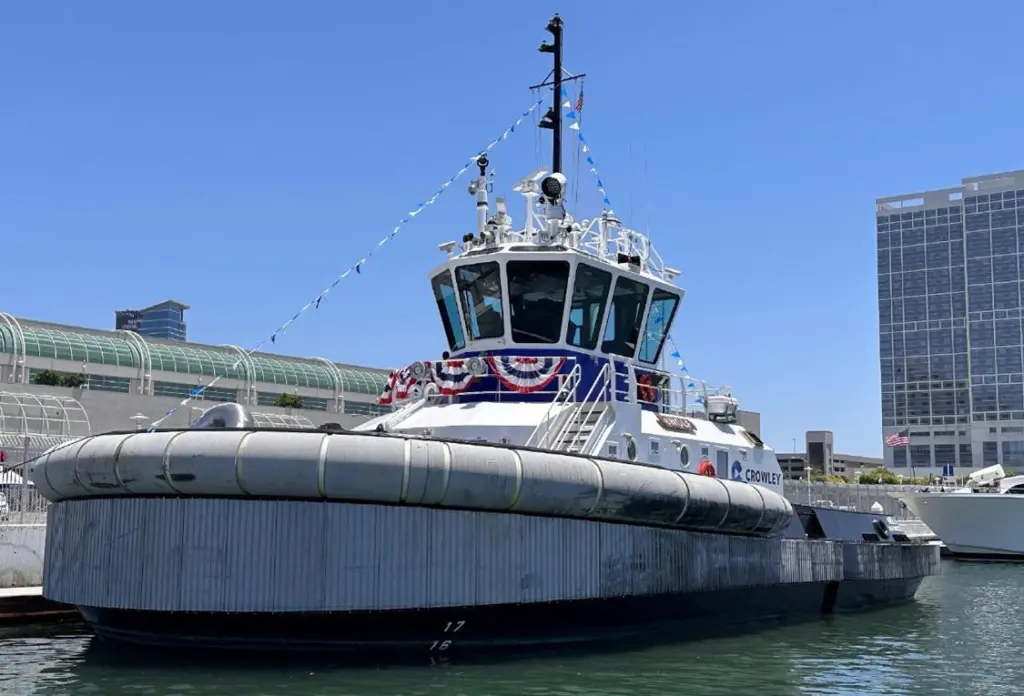
Norway’s Corvus Energy has provided a look under the bonnet of Crowley’s tug eWolf to give an insight into the technology behind what is described as ‘the first fully electric ship-assist tugboat in the United States’.
Shiphandling tug owners, designers and builders are navigating how to move away from fossil fuels, a move driven not only by reducing emissions but also for greater efficiencies from investments in what can be expensive assets operating in an increasingly competitive market.
The tug owner aspiring to upgrade or renew its fleet is faced with options including alternative fuels, hybrid arrangements, mechanical innovation or in this case, battery operation.
Each option has restrictions including fuel availability and operating profile, leading to tailored solutions designed for one particular operation. Where a look under the bonnet of a new tug used to involve the make, type and output of main engines, with electric tugs it is now a case of “what’s in the battery room?”
Designed by Crowley and built by Master Boatbuilders, eWolf is powered by an integrated propulsion system from Swedish/Swiss multinational ABB. It incorporates a Corvus battery arrangement, here its Orca ESS system, the installed energy storage system used on more than 700 vessels worldwide.
eWolf’s system features a 6.2MWh installation capable of operating daily at full capacity using battery power alone, requiring zero fuel and producing zero emissions at point of use. Crowley anticipates the tug will generate 178 tons less nitrogen oxide, 2.5 tons less diesel particulate matter and 3,100 metric tons less carbon dioxide over the first 10 years of its operations – the equivalent of removing 350,000 gallons of gas from use, according to EPA calculations.
Cloud-based monitoring
To optimise battery performance over the system’s lifetime, cloud-based technology is used to continuously monitor energy storage system function and provide critical performance insights through the Corvus Energy Vessel Information Portal.
Online monitoring uses big data, machine learning and algorithms to support predictive maintenance, optimised system use and proactive troubleshooting through a DNV Cyber Security Type Approval secure digital system.
Two sources of further information are provided by eWolf’s owner Crowley and Corvus Energy, the former describing the ASD tug as a vessel 24.9m in length on a beam of 12.1m and design draught of 5m.
The batteries operate through DC grid and AC switchboards, powering two 2,100kW electric motors in turn driving two azimuthing thrusters. Two 300kW generators are provided for long transits and performance figures include an estimated 70 short-tons bollard pull and speed 12kn.
Seattle-based Markey Machine provides identical electric render/recovery winches forward and aft and with the absence of exhaust stacks the wheelhouse offers 360o visibility for the vessel’s four-person crew.
Corvus Orca ESS
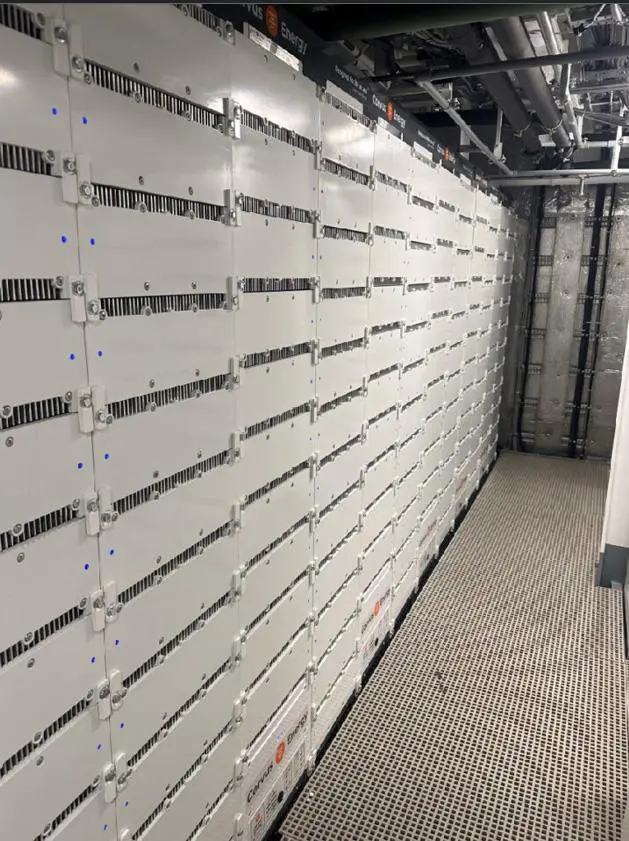
The Orca ESS system was launched in 2016 and is in use in vessels from yachts to cruise ships – and everything in between. Features include it being designed for up to 1,200VDC with “low installation and commissioning time and low life cycle costs”.
The modular design has passive single-cell Thermal Runaway protection and scalable capacity and voltage depending on requirements. The battery cells are of lithium-ion NMC/graphite chemistry with single module capacity 128aH.
Fire suppression meets SOLAS, class and Corvus recommendations and a ‘disconnect circuit’ feature is hardware-based and fail-safe for over-temperature and over-voltage situations. The system cooling is forced air.
Class Compliance and/or Type Approval includes from DNV, LR, BV, ABS and RINA as well as the previously mentioned Cyber Security Approval from DNV.
The US shiphandling tug sector has a proud history of getting every cent of value from its investments but with the sustainability pressures mentioned above, fleet renewals could become common. Corvus says that along with San Diego (where eWolf will operate), several other ports are perusing federal funding to invest in fully electric tugs under the “US Green Ports Programme”.
It can perhaps be argued that early developer advantage will provide a bonus for European industries with Corvus Energy SVP Americas.
“Corvus Energy is well positioned to support, by offering proven technology, operational expertise and US-based manufacturing capacity,” said senior vice-president Sales Tor-Gunnar Hovig. “Corvus has a production facility in the United States in Bellingham, Washington that produces the Corvus Orca ESS and is fully Buy America and BABA compliant, a key qualifier for US federally funded initiatives.”
Related Articles
 OTHER NEWS
 MARINE CIVILS
 AUTONOMOUS VESSELS & TECHNOLOGY