

Equinor and Moss Maritime are joining in a unique test to explore the potential of floating offshore solar panels writes Dag Pike.
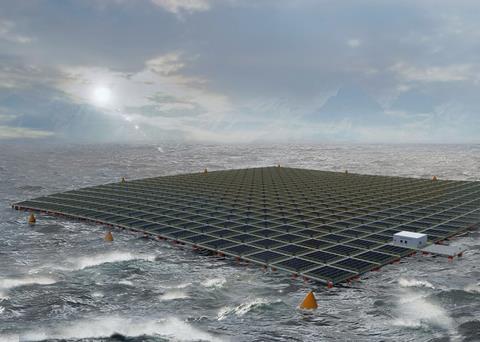
Norwegian energy company Equinor, which is a major operator in offshore wind, will be working with Moss Maritime to test the solar technology in the exposed waters offshore off the Norwegian coast. “We have been working on this concept for the past three years, most recently through our partnership with Equinor,” says Alexander Thøgersen, vice president of engineering at Moss Maritime. “The concept has been substantially matured, both technically and economically. The floating pilot plant will be an important step on the road towards technology commercialisation and an important arena for further development and optimization of the concept.”
The planned test which is expected to be launched later this year will be the world’s first pilot plant for floating solar power in rough waters. The plan is to build a floating plant about 80 metres square with the solar panels about 3 metres above the sea surface on floats which will be established in the waters off the coast at Trondheim. The purpose of this experimental unit is test how durable the system is rather than to see how much power it can produce because Norwegian waters are not noted for their sunshine. “If can we succeed here, we can succeed anywhere,” says Hanne Wigum who is the head of the Equinor technology unit focusing on wind and solar power. Equinor has filed an application for the test to last a minimum of one year.
Equinor is already involved in the production of floating solar power. One test unit is in Sri Lanka where the panels are located in a calm water area and another is on a lake in Holland where alternative types of technology are being tested. Combined with the proposed testing in rough seas, these tests will give Equinor a clearer picture of the possibilities of generating energy from floating solar power. “We choose to perform several research projects in parallel because of the rapid growth within renewable energy,” says Wigum. “This enables us to acquire optimal knowledge about this as early as possible.”