




World-first propulsion for ‘Trearddur Bay’
“It’s completely different to anything already out there, it’s not a prop boat, it’s not a jet boat – and, given what we need, it drives better than either,” said Antony Robson, captain of the very new Turbine Transfers’ ‘Trearddur Bay’.
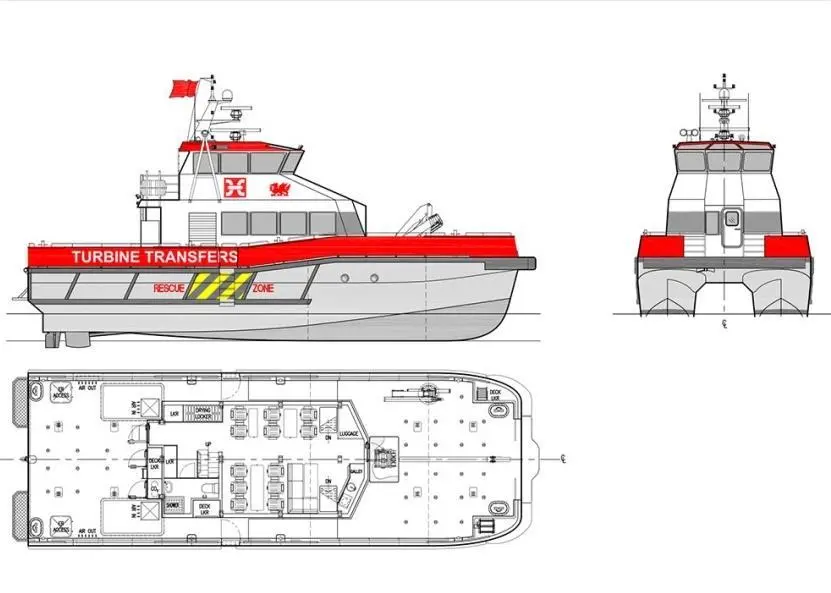
This new 21m long, 7m beam support catamaran is, says Rob Stewart of Aluminium Marine Consultants, “a world first” but most surprisingly instead of it being built by some huge European yard, it was constructed from start to finish by a small – though experienced – boat building company on the Isle of Wight.
However, what gives the Trearddur Bay the edge is that it’s found a very novel answer to a propulsion conundrum: this size of windfarm service vessel often wants to keep a pace somewhere between 25 to 30 knots.
However, Trearddur Bay is the first boat to be fitted with the Voith Linear Jet, a new form of propulsion that provides an efficient answer to both high speed and zero speed power. “Basically it’s a propeller in a shaped nozzle, with stators in the back so that the water flow comes out as a jet rather than having a circular motion,” explains marine superintendent Alistair Knowles of Turbine Transfers.
In fact, the pair of very stiff, 750kg double-walled stainless steel nozzles, which sit in front of a pair of Clements’ rudders, are tailored to the vessel in a way that delays the cavitation point. This gives the vessel extremely low noise and vibration levels, a feature enhanced by the resiliently mounted superstructure – Mr Knowles said that measured noise levels were down to around 62db, “and we could chat comfortably without raising our voices even at high speeds”, giving an extraordinarily smooth ride.
But it also yields huge efficiency advantages.
The trial results speak for themselves. Firstly, Mr Knowles told MJ “It’s phenomenal… extremely fuel efficient for a vessel of the size, so able to run at 25 knots under reduced power and with consumption comparable to smaller and less capable boat”.
Of course, it not just efficiency that’s benefited: “Voith originally calculated that it would do about 27 knots – but we got up to 32 knots out of it on tests,” said Rob Stewart, AMC’s commercial director. Further, because the vessel will be used to carry a certain amount of equipment, it was loaded up with 7 tonnes, half on the foredeck, half behind “and we still got a 30 knot speed with no loss of handling”, added Mr Knowles.
But there’s the matter of sheer grunt for size. “We’ve measured bollard pull of 12.4 tonnes whereas most jets of a similar size would only give you 6 tonnes. That’s almost double,” said Mr Robson.
This element is particularly important. Mr Stewart said that although there have been attempts at more sophistication, the simplest and most cost effective access method remains simply pushing the vessel hard against the boat landings. He described it as a matter of generating the maximum ‘stick’ between the boat fender and the landing tubes, damping out vessel motion as much as possible and allowing easy transfer for the technicians to the wind turbine. Mr Robson added: “It’s simply a case of rubber on metal. If we can do it at lower revs, and I am hoping I can push on at 50% power with this boat, then it gives us a lot of extra in reserve.”
Mr Stewart explained that the build has meant close cooperation between AMC, Turbine Transfers, BMT and Voith: although the BMT Nigel Gee design had been tailored specifically to take the new linear jets, putting it all together was a challenge: “With anything new, especially with an innovative build like this, you are always going to have some tweaks between paper and cutting metal.”
“The engineering, for example, has been demanding just because the tolerances required by Voith were down to a few thousandth of an inch,” he explained “so we used the latest laser equipment to align the pieces.” The extra care should bode well for the service life of Trearddur Bay. “The more accurate you are in alignment the better it is for longevity on stern seals, gearbox, bearings and so on. In fact it’s as near to perfection as we can get.” Voith is also remotely monitoring the installation in real time, “and will know at any moment how much load is being put on, and how fast they are running” said Mr Stewart.
Down in the bowels of the catamaran is the tank area with 500 litres of fresh water and 5,800 litres of fuel to supply the vessel and windfarm substations. Aft of this, each hull holds an MTU 10V M72 engine that yields 1,250 bhp through ZF3000 gearboxes. A pair of Cummins Onan gensets provide the onboard electrical power, and both engines and auxiliaries are supported by battery packs: although there are ‘service’ and ‘starter’ banks, these can be cross linked to get the engines going if necessary.
It has to be said, the whole thing looks a little like Santa’s Grotto as the engines are bright white, surrounded by shiny fittings and a lot of silver insulation which swathes the flame retardant wall coverings: “Along with the sensors and alarms there’s a camera here so the crew can see what’s happening below,” explained Mr Robson.
However, the best safety device is probably the Turbine Transfer crew’s familiarity with these engines: the mature, compact technology is well suited to support boats and has been used on a number of the operator’s vessels – and they are well versed in getting the most out of them.
Above on the bridge there’s Class A AIS, autopilot, SART, EPIRB and MOB location system, plus other bits and pieces such as magnetic and GPS compasses and radios that have been put together as a package by Boat Electrics and Electronics. Two radar display units and a thermal camera assist in reduced visibility and alongside this sits the electronic chart display, all standard enough on this class of vessel. However, some elements took some optimisation: for example the Kwant controls had to be specifically calibrated for the vessel because the characteristics of the VLJ’s are rather different to anything that’s gone before.
In the clean and comfortable deck saloon there is space for 12 technicians to be seated on Cleeman Nautic Star leather chairs arranged around four tables, so there’s a chance to review operations and chat – a lot more sociable than simply lining people up in rows and better for team building. Aft of this is a neat galley, shower, washing and laundry space; the whole crew and passenger area being kept comfortable by Krueger’s aircon and heating combination: a necessity with a dozen men involved in this kind of physical activity.
Outside the 21m2 forward deck space is fitted with a pressure washing system from Hercules, to be used for cleaning down the tower’s T-pieces, preparation for a hydraulic deck crane, a fuel transfer system and a Hercules hydraulic windlass. Aft there’s another 20m2 space, and each deck has sockets to lock in a 10ft container.
But back to Mr Robson for one last, surprising point: “Trearddur Bay does a 360 degree circle around a 250 metres radius, but it does it without much loss of speed,” he said. “If you did this kind of hard lock turn with a conventional waterjet, you’d usually find the jet gets deflected onto the nozzles with a resulting loss of thrust and momentum: the boat then just drops off the plane and will probably stop. This boat just keeps going.”
By Stevie Knight
Related Articles
 ELECTRICAL SYSTEMS
 VESSELS
 INDUSTRY NEWS