


An international consortium has been formed to fund and develop a commercial floating wind farm in the Atlantic waters off the coast of Portugal near Porto. This development follows the successful trials of a prototype floating generator unit developed by WindFloat which has been operating for the past four years.
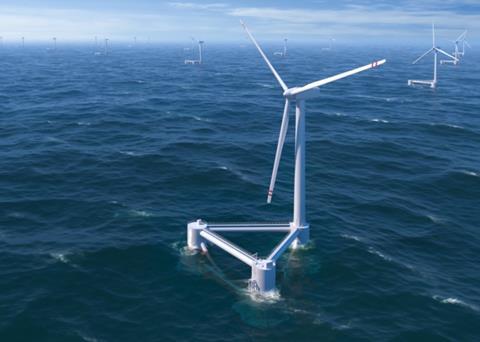
In October, 2011, Principle Power Inc, the lead partner in the consortium, deployed a full-scale 2 MW WindFloat prototype 5km off the coast of Portugal. To date the system has produced in excess of 16 GWh of electricity, delivered by sub-sea cable to the local grid. The structure was completely assembled and commissioned onshore before being towed some 400km along the Portuguese coast from the construction site near Setubal, Portugal.
WindFloat is a floating foundation for offshore wind turbines with what is claimed to be a simple, economic and patented design. The innovative features of the WindFloat dampen wave and turbine induced motions enabling wind turbines to be sited in previously inaccessible locations where water depth exceeds 40 metres - where wind resources are often superior. The semi-submersible base structure comprises a tubular triangle connected by cross members that can be towed to site in completed form to avoid the requirement for expensive heavy lifting equipment offshore.
EDP Renewables, a Portuguese renewable energy company has teamed up with the Mitsubishi Corporation through its subsidiary Diamond Generating Europe and the Chinese Chiyoda Corporation through its subsidiary Chiyoda Generating Europe as the main partners in the project. The French company Engie and the Spanish oil company Repsol are also involved in this offshore wind project which has financial support from the EC and the Portuguese government. The project will be known as the WindFloat Atlantic project.
The project, located 20 km off the Portuguese coast at Viana do Castelo, is planned to be operational in 2018 and will consist of 3 or 4 wind turbines on floating foundations, with a total capacity of 25 MW.
The next generation WindFloat systems will make use of all the information gleaned from the WF1 prototype deployment as well as integrate other innovations developed by Principle Power's design team throughout the WindFloat technology development process. These WindFloat designs will be optimized, both with respect to size and performance, for today's 5-8 MW units and tomorrow's larger 8+ MW offshore wind turbines. Principle Power anticipates decreased annual operational costs and significantly less risk in the operations of a WindFloat equipped wind farm.
The WindFloat base is fitted with patented water entrapment plates at the base of each column and a patented hull-trim system that distributes water ballast between the three columns to compensate for variable turbine thrust due to low frequency. The mooring system uses conventional proven offshore oil technology in a three or four point mooring system.
By Dag Pike