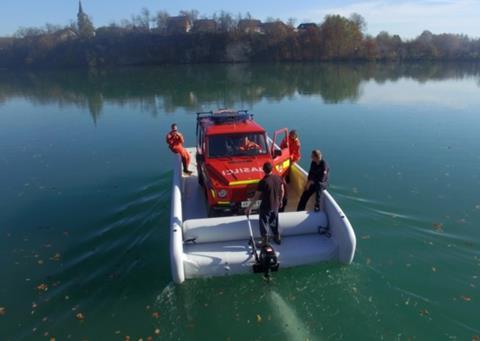
Due to its small volume when deflated, this light-weight inflatable boat is easy to store. The Ferryboat, which is 8 metres in length, has a 3.2 metre beam and is just 300kg in weight, has a maximum load capacity of 5000kg. It is easily launched and can be inflated within minutes using an electric air pump or an air cylinder. The company aims to offer two sizes, the 8 metre and a 6 metre version.
The vessel has a 50-passenger capacity when used on rescue or evacuation duties and it is extremely safe, stable and practically unsinkable. The hull is divided into five air chambers each of which has a maximum load capacity of 1000kg. The design and construction are claimed to ensure that the vessel cannot be overturned, even if all the passengers are located on one of the side railings.
The secret of the Ferryboat lies in the high quality construction material which is composed of two layers of tough fabric linked with thin fibers in a form called 'drop-stitch' which is supplied by the Belgian company Penel. When the edges are sealed and the material is inflated, it becomes as firm and flat as a board which allows it to be used as a panel construction material.
The base fabric that is used for the construction can be either Hypalon or PVC, the Hypalon being more expensive but longer lasting. With the flat panel construction the bottom of the vessel is completely flat, and the narrow sides and railings help to stabilise it which dramatically improves the performance of the material in relation to its own weight.
At one end of the boat a flat inflatable panel is fitted on a hinge and this allows it to be lowered so it can form a boarding ramp. For vehicle access aluminium ramps would be laid across this ramp and on the flat floor to help spread the local loadings of a vehicle’s wheels but otherwise the craft is fully self-contained.
It can operate with a very shallow draft equivalent to just 5cm per 1000kg of load so that it can navigate through areas where ordinary boats would normally get stranded. Because of its low weight, it uses minimum fuel and a fully loaded vessel can operate with a 5hp outboard motor to give a speed of 4 knots in calm water. If an electrical supply is required on board a solar cell system can be installed.
By Dag Pike