

Do dredgers divine the rainbows return?
The credit crunch may be having an adverse effect on almost every industry, including investment in ports and marine infrastructure, but recent investments by some of the biggest and best known names in the business suggest that companies believe they can ride out the seeming slump in demand and that the good times will return, albeit perhaps at a somewhat slower pace than in recent years.
Typical of the effects of the credit crunch on demand for marine civils expertise was the decision late last year by the authorities in Monaco to shelve a multi-billion dollar scheme to expand the small state into the sea by reclaiming land.Speaking in December, Prince Albert II said Monaco had been forced to drop plans to build a huge artificial peninsula, which had been compared to Dubai’s many and much publicized land reclamation projects because, ‘in the current climate it would be irresponsible to launch a project of this scale.’
Monaco’s ambitious land reclamation project had, it seemed, been much more difficult to fund in the current economic situation than it might have been 12 to 18 months ago, and the project has reportedly fallen short of both its funding and some environmental protection goals.
The economic climate is of course, much tougher than it used to be, even for Nakheel, one of the major developers in Dubai, where so much land reclamation has taken place in the last 4 to 5 years. Nakheel recently reached important milestones with its waterfront development, which it describes as ‘the world’s largest coastal development’. Nakheel says it ‘will transform 1.4bn square feet of empty desert and sea into an international community for an estimated population of 1.5m people’, but on The World, another Nakheel development, where the company has created 254 artificial islands, so far only 175 have been sold and some buyers reportedly cannot keep up with payments. Nakheel still plans to develop more islands in 2009, however, although it is not yet clear how quickly that will happen.
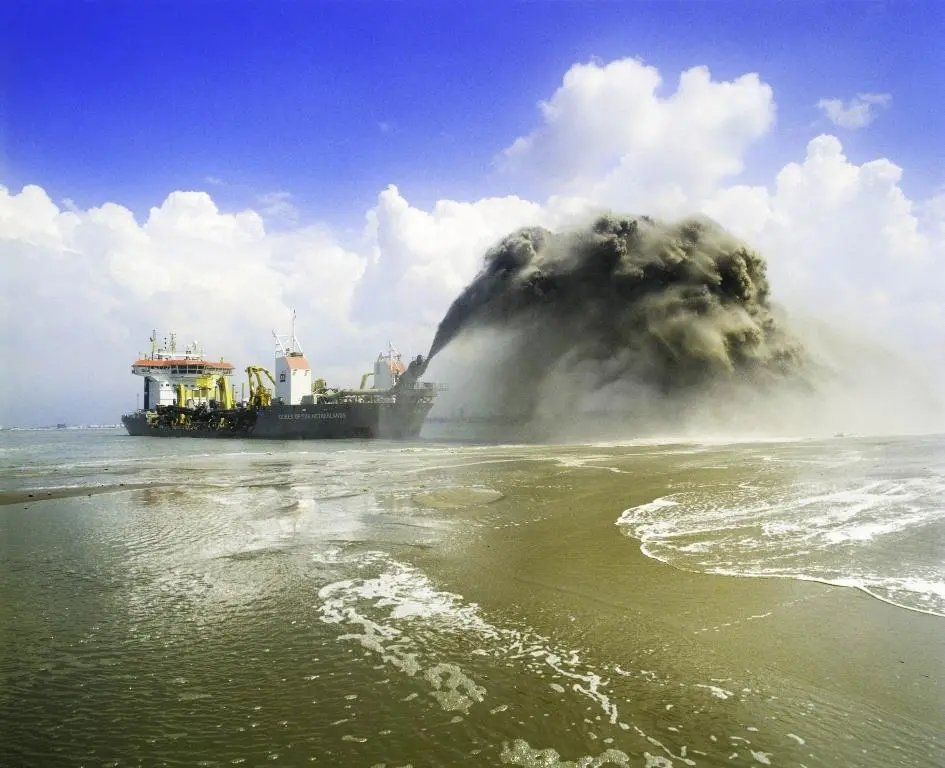
Dredging companies have, of course, been the main beneficiaries of the massive boom in land reclamation in the past decade, and show little sign of retrenchment themselves, despite the economic picture. In fact, finding a dredger to carry out the kind of work that used to be dredging companies’ bread and butter, dredging ports to keep ships moving, has become more and more difficult in recent years as more and more vessels are committed to land reclamation.
As Maritime Journal’s sister journal Port Strategy reported recently, the problem seems to be that the glut of reclamation work and relative scarcity of dredgers has meant that the dredging companies can pick and choose which projects they wish to do, leaving others on the shelf.
Where a port has an ongoing relationship with a contractor for maintenance dredging, such as the UK port of Harwich, which has Westminster Dredging on call, the situation is easier. But ports with a requirement for a capital works programme can be left kicking their heels unless of course the port has friends in high places, like the London Gateway project, which is backed by DP World.
As Port Strategy noted, which projects get picked can be swung by factors like repositioning costs. This can tilt a decision, given the huge size of the recent builds (like Jan de Nul’s massive 46,000m3 capacity Cristóbal Colón, due to start work later this year) and the still relatively high price of fuel, because companies have to absorb the expenses themselves once the dredger has finished a job, although mobilisation may be factored into costs.
Moreover, despite the global downturn, the major dredging companies continue to invest in new vessels and equipment. At the end of 2008, IHC Merwede Group secured an order for the construction of a 30,000m³ jumbo trailing suction hopper dredger for Belgian contractor DEME, a vessel that is not due for delivery until mid-2011. The same dredger builder announced that in recent weeks it had also received orders for the construction of two other large trailing suction hopper dredgers and eight medium sized stationary cutter suction dredgers. This follows hard on the heels of an order from Van Oord announced in September for construction of a large self-propelled cutter suction dredger which will be one of the largest cutter suction dredgers in the world when delivered in the autumn of 2011.
The delivery dates for these huge vessels may offer a clue to the way that companies such as Van Oord and DEME see the market. Building a new mega-trailer any more quickly is out of the question, but by 2011 the markets in which the two companies operate could be booming again, a supposition supported by recent statements by some of their competitors. Although dredging’s big four of Jan De Nul, Van Oord, DEME and Royal Boskalis Westminster may not anticipate new orders flowing in the next 12 to 18 months at the same rate as in the last 12 to18 months, particularly if developers are strapped for cash and finding access to finance much more difficult, they already have full order books for the short to medium term in any case.
Announcing details of three oil and gas related contracts for projects in Europe and the Middle East, Royal Boskalis Westminster noted that energy related offshore activity at Boskalis had shown strong growth over the last few years. ‘Going forward, said the company earlier this month, ‘Boskalis sees numerous opportunities for further growth.’
Related Articles
 MARINE CONSTRUCTION
 POWER & PROPULSION
 ENVIRONMENT