


Peterhead builds future on a bed of granite
A quay is being built at Peterhead Harbour in Scotland which has been especially designed to take the sting out of the waves hitting it.
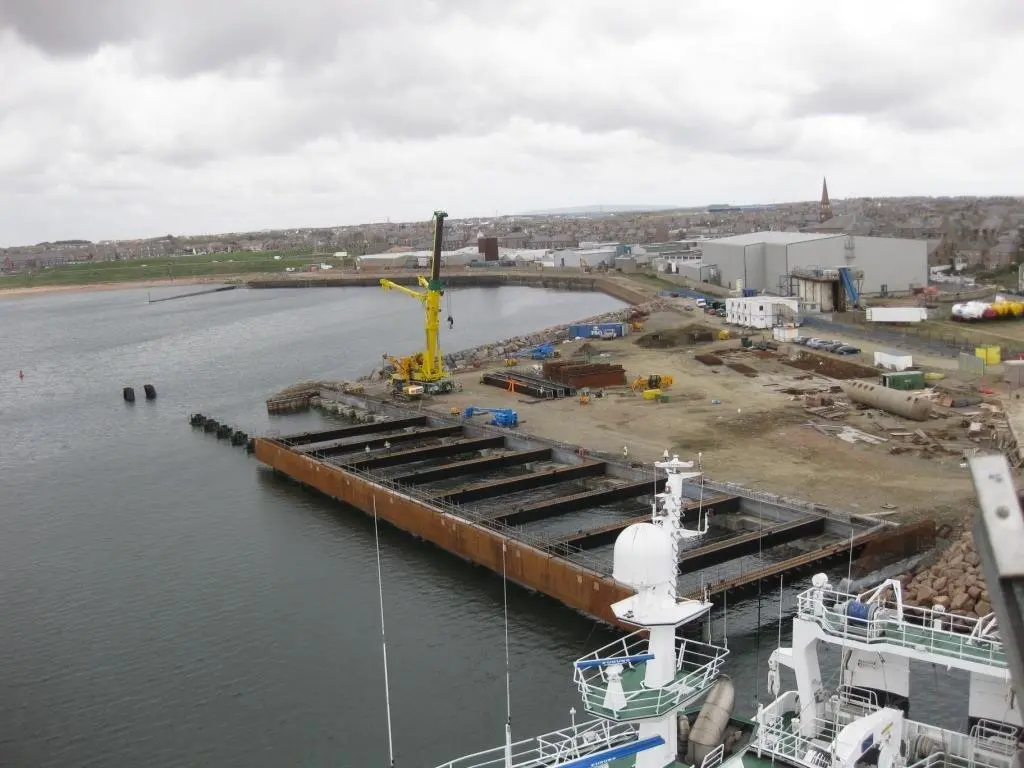
Construction of the 650ft quay and a 328ft breakwater at the disused embankment is due to be finished in September. The expansion is expected to create more than 200 jobs and pump around £11million into the local economy. The project has been around six years in the making, but the plans have moved forward swiftly since the merger between Peterhead Bay Authority and the Peterhead Harbour Trust in 2006.
Stephan Dickenson of engineering company Peter Fraenkel and Partners, which is overseeing the project, gave MJ an update on the Peterhead Harbour expansion, saying the project is coming in both on time, and on budget.
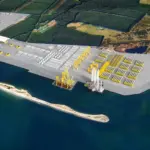
The works include an extension of the existing Smith Embankment with an additional 120 m long quay, plus a dolphin that gives a further 40 m of berthing space. There is another 80m of rubble based breakwater, covered in 16 ton armour blocks which will give the development protection from the southeast. The development will allow a 200m long vessel to be happily serviced alongside.
However, the local waters are demanding, and Mr Dickenson explained that the construction of the quay has meant a different design tactic to the more usual infill quay wall. The quay is of a steel box girder construction which spans the area like a bridge. It is some 25m in depth, with the body resting on open steel tubular piles on the seaward side and with a reinforced concrete seat along the shoreside at the back. Underneath the piles, a revetted structure rises back toward the bank.
‘Box girders are a standard design for bridges, but innovative for a quay, said Mr Dickenson. ‘However, we needed to limit the reflections from waves coming into the harbour and setting up a resonance pattern which would make it difficult to berth. The revetted slope, which is located under the quay itself, reduces wave energy, lowers the wave heights and stops a difficult resonance pattern forming.’
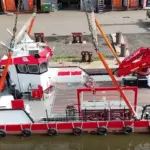
Ian Laidlaw, also of Fraenkel, said that further challenges were caused by the granite seabed. He explained that the fifteen 26m long tubular steel piles had to be fitted into 10m deep by 1,600mm diameter sockets bored into the granite seabed before they could be grouted in and filled with concrete. This difficult phase was undertaken by Fugro Seacore’s barge Deepdiver-2, which quite literally ground away the granite and pumped it out in small 50ml pieces. The operation, not surprisingly, took some four months.
The seabed caused more challenges for the dredging works also because it consisted of a mixture of sand, silts and weathered granite. Dredging works are bringing the depth to a general 9m, with a 10m berthing pocket alongside the quay. One of the largest backhoe dredgers in the world, Manu Pekka from Westminster Dredging, was on site for over four months, joined by split hopper barges, Cork Sand, Long Sand and Nab, likewise from Westminster. Mr Laidlaw explained that the operations, which went on 24/7 for quite some while, proved to be something of a logistical conundrum. ‘It is quite a narrow channel we were all working in and all works had to be coordinated with harbour operations while minimising noise disruption to local residents’, he explained.
The dredged material was used in the 9,000 sq/m of reclaimed land behind the new quay. In all, the development gives Peterhead another 13,000 sq/m of work area. While most of this will increase the berth facilities for fishing boats, the quay is also designed with 30m of heavy lift area, which in the future might become viable for North Sea related decommissioning activities.
Decommissioning is a good industry to get into at ground level and, as some sources point out, it is a useful bet against a further decline in the fishing industry. Oil and gas sector decommissioning activities look like coming into their own over the next 20 years, and are expected to be worth possibly between £15bn to £20bn to the UK economy.
Related Articles
 MARINE CONSTRUCTION
 EQUIPMENT
 MARINE CONSTRUCTION