![MaritimeJournal[Seawork]](https://www.maritimejournal.com/wp-content/uploads/2026/09/MaritimeJournalSeawork.svg)






Developing floating turbines for deeper waters
The Energy Technologies Institute (ETI) have chosen The Glosten Associates to design a demonstrator for its floating wind turbine, to be installed at the UK Wave Hub offshore energy test site.
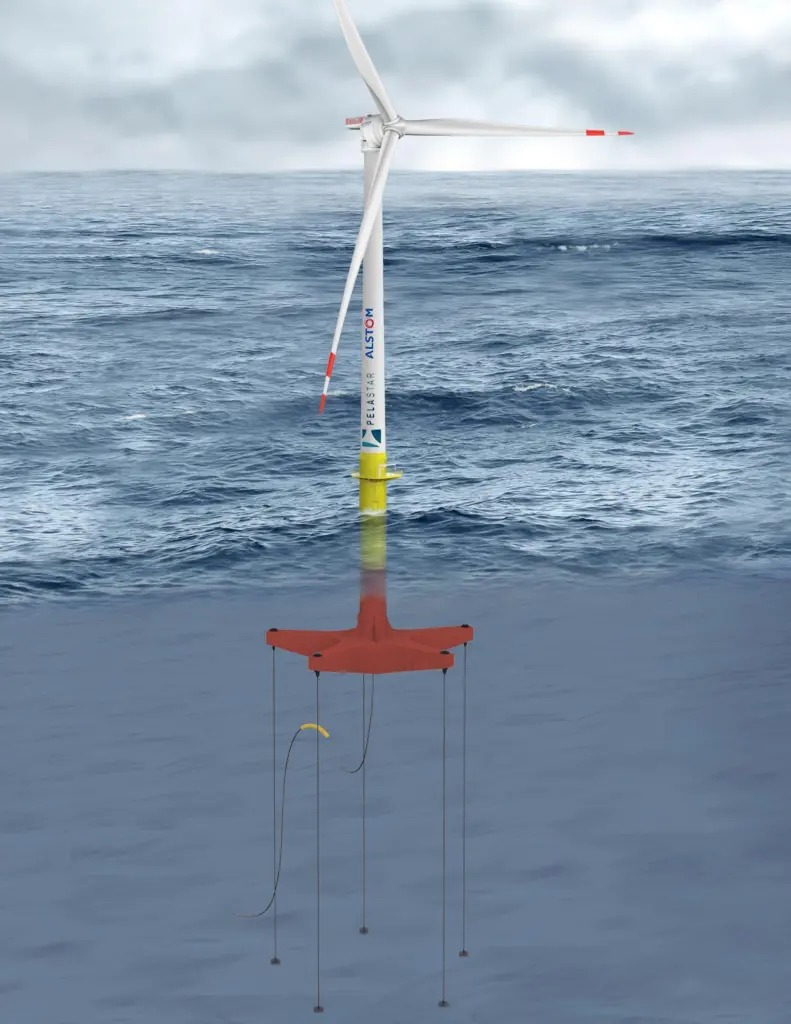
ETI studies have found that wind speeds off the coast of south-west England, along with north-west and north-east Scotland are higher than some of the current and proposed sites further offshore. These areas closer inshore, are however in deeper water, typically between 60m and 100m, beyond the current norm of up to around 45m and the depth where monopile or jacket type foundations are typically adopted, hence the interest in floating turbines. ETI state that these locations have the potential to “… play a significant part in helping to reduce the cost of energy in the UK in the medium to longer term, perhaps bringing offshore wind down to a level where it competes with other forms of low carbon generation without the need for subsidy”.
US based naval architecture and marine engineering company Glosten Associates will now design a PelaStar tension leg platform (TLP) by developing a Front End Engineering Design Study (FEED). The prototype will be developed in partnership with Alstom using their Haliade 150-6MW offshore turbine. The FEED study will take around 12 months to complete at a cost of GB£4m. Harland and Wolff in Belfast have been chosen by Glosten as builders of the demonstrator.
Following the study ETI will decide whether or not to commission the construction and installation of the TLP, an investment estimated at up to GB£21m. The prototype would be deployed at ETI’s preferred test site, Wave Hub in Cornwall as early as 2015. The intention is then for the demonstrator to be operated for eight to 10 years allowing further design modifications and refinements to take place.
The development of floating wind turbines holds important potential for countries that have good offshore wind resources but deep waters off their coastline. The world’s first deep-water full-scale floating wind turbine was the 2.3MW Hywind turbine, installed in 200m water depth by a three point mooring spread off the south-west coast of Norway in 2009.
Another floating turbine of note is 5km off the coast of Portugal at Aguҫadoura. Installed in June 2012, a Vestas v80 2MW turbine is mounted on Principle Power Inc’s WindFloat, a three column structure fabricated into a triangular form, the turbine mounted on top of one of the columns. The mooring system is made up of conventional components including chain and polyester lines, connected to pre-laid drag embedded anchors.
For Alstom, the 150-6MW turbine offers significant promise for the future. First inaugurated at Carnet in the Loire-Atlantique in March 2012, the turbine was developed in response to the French government’s call for tenders to install 3GW of offshore wind power off the French coast by 2015. Described as simple, robust and efficient, a feature of the 150-6MW is the use of direct drive and fitted with a permanent magnet generator rather than the more traditional gearbox. Alstom claim reduced operating and maintenance costs with this approach.
The selection of Cornwall based Wave Hub as preferred location for the demonstrator is an important milestone in their establishment as an offshore energy test site. The facility comprise an electrical hub on the seabed 16km off the north Cornwall coast with four separate ‘berths’ available for lease, each with a capacity of 4-5MW linked to the UK grid via a 25km long subsea cable. Preparatory work is already underway with geophysical work already completed and available metocean data being analysed to assist the platform’s design. The onshore substation is being upgraded to accommodate the 6MW prototype in a single berth.
By Peter Barker
Related Articles
 OTHER NEWS
 ACCESSORIES & EQUIPMENT
 ACCESSORIES & EQUIPMENT