![MaritimeJournal[Seawork]](https://www.maritimejournal.com/wp-content/uploads/2026/09/MaritimeJournalSeawork.svg)



Maasvlakte 2 opened to shipping
Port of Rotterdam Authority has celebrated the opening of their Maasvlakte 2 port expansion project to shipping, on time and significantly below budget.
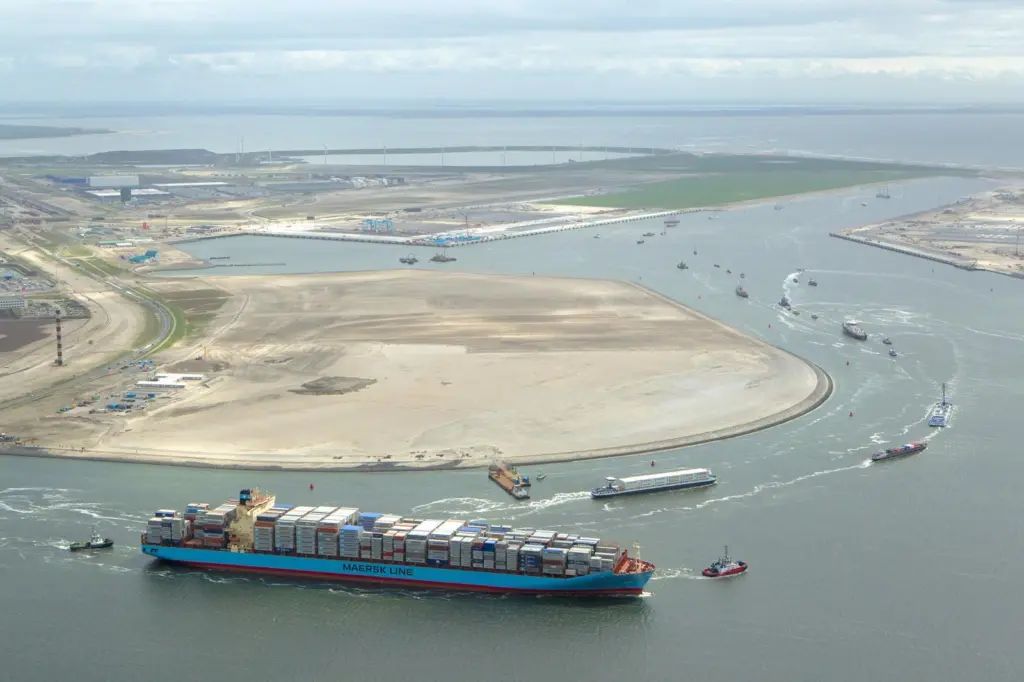
Maritime Journal has been following construction of Europe’s largest port development project since the very start. The story is far from over but this important occasion, which witnessed the first sea-going container ship sailing into Maasvlakte 2, (if only for a ceremonial guest appearance), allowed those involved to take a step back and reflect on the financial picture and also unveil plans to make further use of the huge area of new land now available for expansion. In effect, the Port Authority is now saying: the groundwork and infrastructure is complete, now where would you like your business or terminal to be?
The go-ahead for construction of Maasvlakte 2 was given in September 2008 following which PUMA construction consortium (Boskalis and Van Oord) set to work delivering 240 million m3 of sand for the development, extending the Netherlands coastline around 3km further seawards. The 3.5km new hard seawall comprises 7 million tonnes of stone and 20,000 concrete blocks, recycled from the old seawall. In 2012 the coastal leisure facilities were opened, the opening in the seawall was closed allowing road and rail infrastructure to be completed and the Yangtzekanaal sea access route opened. Several kilometres of new quay have been completed for the APMT and RWG container terminals which are on schedule to commence operations in 2014. Seven hundred hectares of extra land are now available for business use, another 300 hectares due to be added in phase two.
The opening of Maasvlakte 2 to shipping was carried out by Melanie Schultz van Haegen, Minister of Infrastructure and the Environment who said: “Today we are clearing the way for international shipping and trade. That’s typical of the Netherlands. That’s how we became big. With Maasvlakte 2, the Netherlands is throwing the door wide open to the newest generation of container ships… The port is growing 20% larger, and the container capacity has doubled”
Work vessels including dredgers have had access throughout construction, but just a week before the event SAL Heavy Lift’s cargo vessel Paula delivered the first barge/feeder crane components for APMT’s terminal. The main gantry cranes for both APMT and RWG are due later this year. On the day, there was a sail past by classic three-masters along with other port service vessels. A highly symbolic appearance was made by one of Maersk’s container ships, the 8,112TEU Maersk Tukang.
CONTROLLING COSTS
Development of Maasvlakte 2 is now at the stage where a picture of the actual costs can be reported. Meticulous attention to detail in planning, along with careful allocation of responsibilities and the structure of construction contracts have resulted in savings to the tune of €150 million. In 2006 it was estimated that €1.7 billion would be spent on phase one of Maasvlakte 2. It is usual for projects of such scale and complexity to include a contingency sum to cover setbacks and deviations from original plans, so called scope expansions, and an additional €200 million was set aside here, making a total budget figure of €1.9 billion. Indications are that the cost of phase one has come in at €1.55 billion, some €150 million less than estimated with the contingency sum of €200 million remaining untouched.
There were various reasons for construction proceeding according to plan and costs remaining under control without sacrificing quality. The project was thoroughly prepared such that during execution hardly any unexpected matters arose. Partly due to this there were also no delays from legal proceedings. Appropriate forms of contracts were sought with contractors, including enabling optimisation on completion. Design of the hard seawall was an example of this optimisation where a solid dike was originally planned but subsequently a block dam and cobble beach design was adopted allowing construction and maintenance savings without sacrificing safety. Similarly a relatively expensive structure envisaged for temporary cooling water discharge from the E.ON power station was replaced by a narrow canal to the Yangtzehaven. Risk distribution between client and contractors was also included. For example sand washed away by storms was the risk of the contractor whereas any loss of sand from storm waves higher than 6.75m for more than 3 hours was the responsibility of the Port Authority, a 10 year average event which fortunately did not occur.
Sticking to the original scope of the project also avoided over-expenditure. The largest extension was increasing the security level of the railway so it could be put to better use. Calls for tender for the infrastructure to connect Maasvlakte 2 to the existing port area started in 2010. The market situation at that time allowed projects to be awarded more favourably than had been estimated in 2006. The meeting of important milestones in the project avoided the domino effect in the planning, costs associated with supervising construction also being kept under control. This was attributed to in part by good cooperation between PUMA, other contractors and the Port Authority.
There were no setbacks that required the reserved €200 million contingency fund to be used. There were no postponements or delays, for instance due to long legal proceedings, and costs did not rise due to extremely high inflation or substantial changes in the project size: in summary Maasvlakte 2 has been constructed almost exactly as conceived in 2006-2007. The largest outstanding risk is with possible extra maintenance costs for the seawall from unforeseen changes to the current, a cost that will be borne by the Port Authority for the first ten years.
NEW ACTIVITIES
Large ports are constantly evolving and Rotterdam is no different. The two new container terminals are located at Prinses Amaliahaven, next to which is the large inland lake, Prinses Alexiahaven, which will remain as such for the next five to ten years. The 300 hectares of business sites that can be created here will only be developed once there is demand for them. The area will not be left unused however: piles will be placed in the lake allowing ship-to-ship transfer operations to take place. A particular beneficiary of this facility will be the port’s liquid bulk sector which is growing, mainly from Russian oil shipped to Asia via Rotterdam. Dry bulk, particularly grain is also a growing market sector. The Netherlands has a particularly strong offshore industry cluster and the piles will also be available for offshore activities. Around €10 million is being invested in this facility which is due to be ready for use in 2014.
The Port Authority also have some interesting plans for a ‘plug-and-play’ industry park for the (bio-based) chemical industry on a site near the Lyondell Bayer plant on Maasvlakte. The project involves construction of infrastructure including jetties along with gas, water and electricity mains services. The facility will allow businesses to concentrate on their core activity of making products and agreements have already been made with local utility companies, discussions now also underway with international businesses that may want to establish a presence on the site. Port of Rotterdam Authority also reports an increased interest in distribution activities due to the imminent arrival of the new container terminals.
Considerable simulation research was carried out for the waterways on Maasvlakte 2. Allowances had to be made for the larger dimensions of the likes of Maersk’s Triple-E class, particularly as the Yangtzekanaal is also home to Euromax Terminal. The waterway’s width of 600m will allow two of these giants to pass each other with a third moored on the quay. The south-west orientation of the Amaliahaven was intentionally planned such that vessels moored there will catch less of the prevailing south-westerly winds. The shape of Maasvlakte 2 has also reduced the cross current in the mouth of the Nieuwe Waterweg, something of particular value to deep-draught vessels entering the port.
Related Articles
 OTHER NEWS
 OTHER NEWS
 FEATURES & VIDEOS