![MaritimeJournal[Seawork]](https://www.maritimejournal.com/wp-content/uploads/2026/09/MaritimeJournalSeawork.svg)





Kiel on target after terminal work
The German port of Kiel has completed work on the expansion of one cruise terminal and won a race against time to finalise remedial work at another.
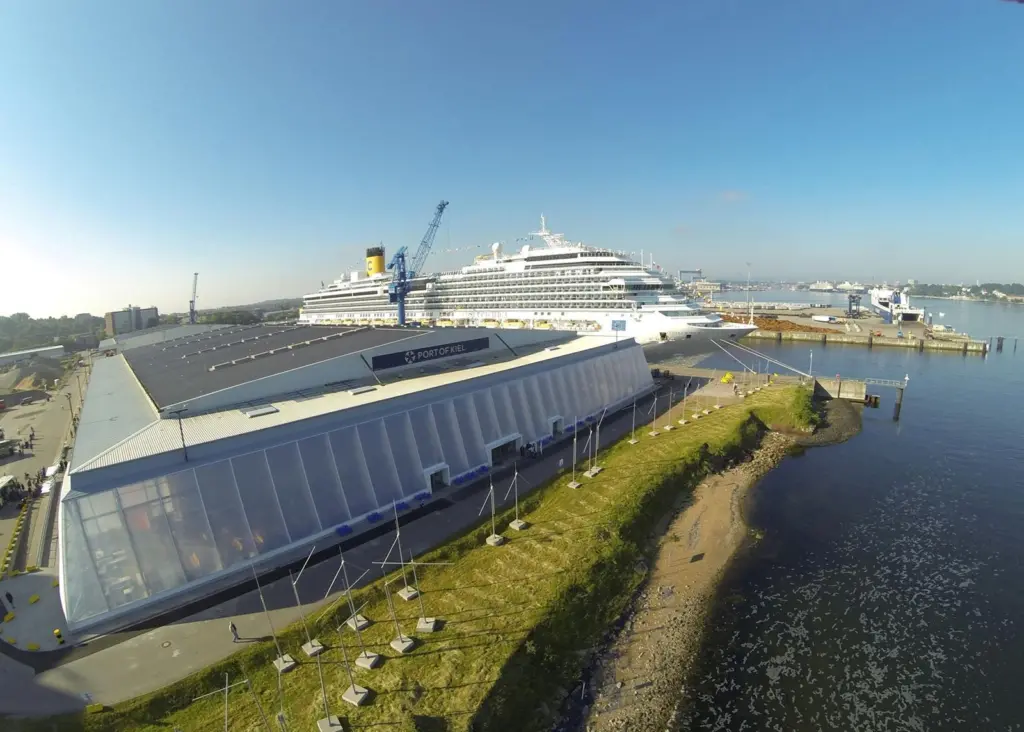
The inauguration of a 110m long, 14m wide and 10m high passenger pavilion at the new Berth I Terminal in the Ostuferhafen is the latest step in handling expansion. It means Kiel now has three big berths for complete passenger exchanges on ships of 300m plus with up to 4,000 passengers.
Berth 1 boasts a 400m long quay on 10m of water. Last year a quay fender system suitable for passenger ships was added along with a new gangway. The pavilion is made of steel with an ETFE transparent plastic façade. Officials said the cladding had so far only been used for sports facilities like Munich football stadium and Sochi Olympic Stadium.
The new pavilion boasts a passenger check-in and waiting area covering 1,560 m² directly linked to a 3,000 m² luggage and processing hall. It is also capable of further extension.
Helbig Bau built the facility foundations and Foiltec tackled the steel construction and cladding. Fender Team handled quay and ramp fendering work on Berth 1.
Kiel and the state of Schleswig-Holstein have invested about €4.5m in the Ostuferhafen facilities and have now created the capacity for Kiel to handle 150 calls by cruise ships in a single season. This year 22 ships will call 125 times, cementing the port’s position as one of the busiest in Germany.
Kiel’s other two berths for big cruise ships are at the €28.5 Ostseekai Terminal, built in 2007, where pile re-anchoring work has been successfully ended in time for this year’s cruise season.
The work, which a spokesman said earlier was costing up to €2m, involved re-anchoring some of the 40m long quay pilings on the southern 360m Berth 27. Additional 20m pilings were driven on land 40m behind the quay wall and linked horizontally to the existing pilings to provide extra strength. A new surface covering was laid between the terminal and the quayside.
The operation was completed without major disruption although officials said it was more complicated than expected. It also took longer than originally thought to make good the site.
The 38,557gt AIDAcara had to be diverted several times to the Sartorikai, immediately to the south and directly linked to the Ostseekai but normal terminal processing was possible so “this was a good solution to the problem”, said Port of Kiel managing director, Dirk Claus.
The work was organised by Boeger & Jaeckle Engineering and the technical department of the Seehafen Kiel while construction was carried out by Fankie Grundbau and Szupryczynski Tiefbau.
By Tom Todd
Related Articles
 OTHER NEWS
 ACCESSORIES & EQUIPMENT
 ACCESSORIES & EQUIPMENT