![MaritimeJournal[Seawork]](https://www.maritimejournal.com/wp-content/uploads/2026/09/MaritimeJournalSeawork.svg)





Durability – and budget
Single cranes installed on a workboat are a very different proposition to the huge numbers of cranes required for installation on windfarms.
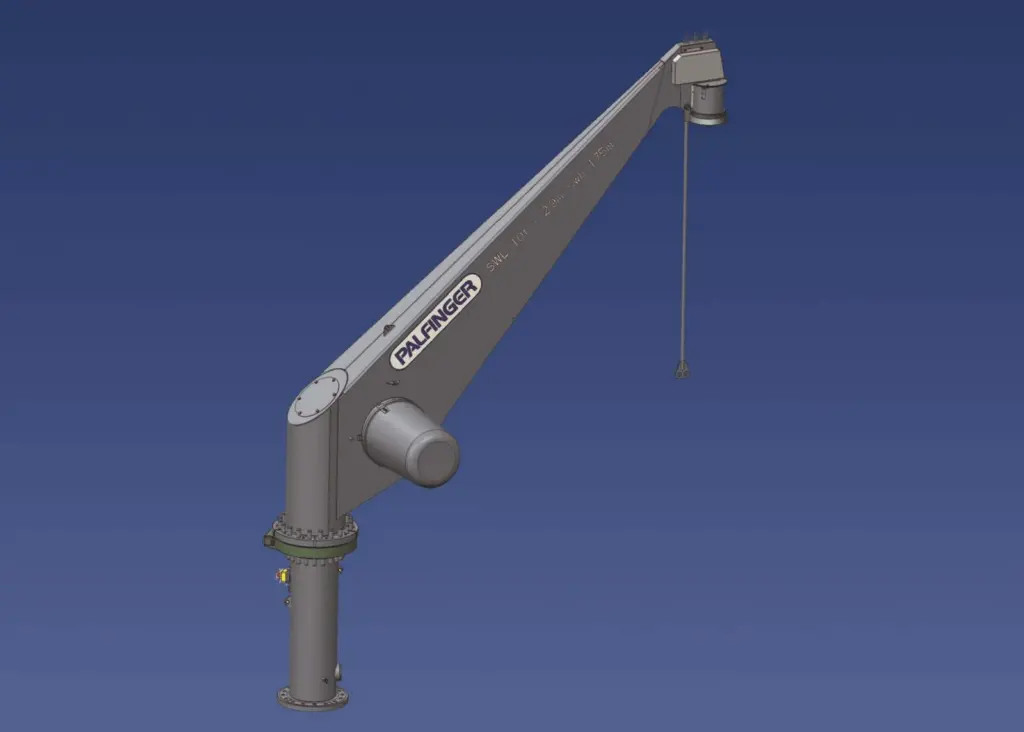
In fact, the two Gode Wind projects presently being built 45km from the German coast need nearly a hundred service cranes that will see the worst of weathers.
However, the challenge for Austrian company Palfinger Marine in developing this new range of windfarm-specific cranes was to combine durability with cost effectiveness, says designer Kim Andersen.
“We set our main focus on keeping the design user- and maintenance friendly,” explained Mr Andersen’s colleague Dionys Ebner. These PF 8000 cranes, which will mainly be used for lifting spare parts and tools from support vessels to the transition platform, are of a fixed-boom design equipped with an electric winch and a manual slewing system, and as all drive control and safety features are placed inside the main structure of the crane there is a high level of protection.
Because these cranes are expected to cope with high winds, they feature hook parking and a slack wire avoidance function as well as emergency devices that will work even if there is a loss of power.
Further, to help give the cranes the necessary protection, the entire structure has been galvanised as well as being coated with high quality marine paint, and accessory items such as cover plates, brackets etc have been made out of corrosion proof materials.
Start of construction will be first half of 2015 at Gode Wind 2, followed by Gode Wind 1: the wind farms are expected to be fully commissioned in the second half of 2016.
By Stevie Knight
Related Articles
 OTHER NEWS
 ACCESSORIES & EQUIPMENT
 ACCESSORIES & EQUIPMENT