![MaritimeJournal[Seawork]](https://www.maritimejournal.com/wp-content/uploads/2026/09/MaritimeJournalSeawork.svg)






Robert Allan introduces LNG tug
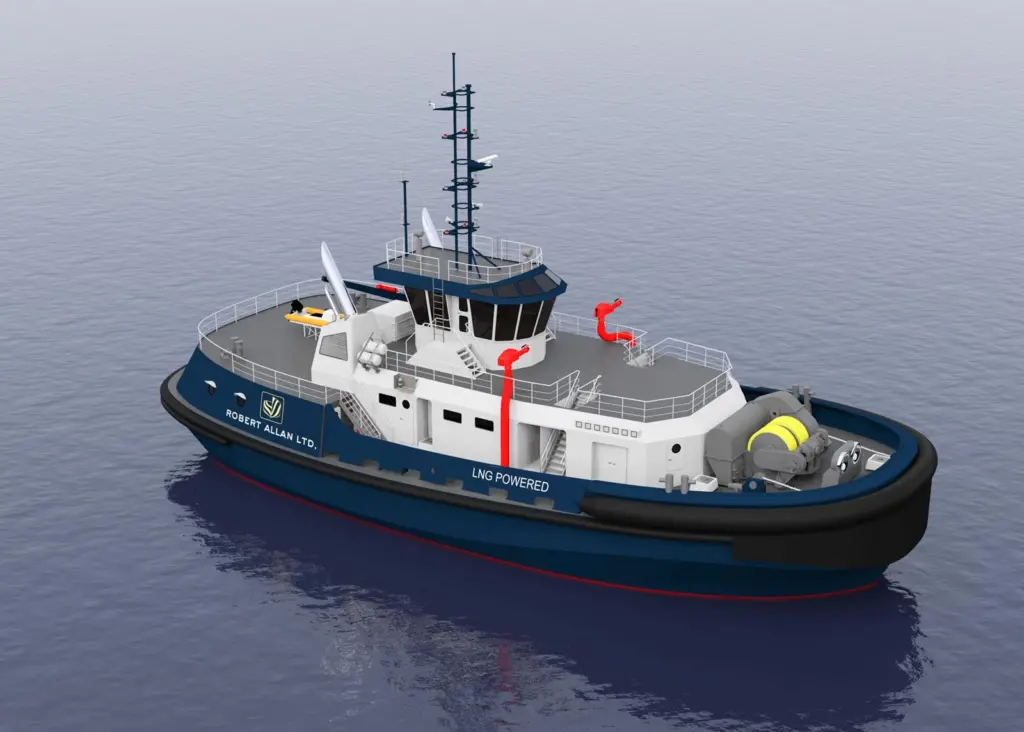
Vancouver based naval architect Robert Allan Ltd has presented the towing industry with its latest tug design headlined, RANGLer – A fresh approach to LNG fuelled tugs.
The world of towing is witnessing almost continuous technical development of late and one strand exercising the minds of designers and builders alike is the linked requirement to reduce emissions and improve efficiency. Hybrid and dual fuel tugs are examples of innovation gaining ground in the industry.
Adopting LNG as an alternative fuel for shipping in general is another area attracting attention, offering reduced emissions compared with conventional fuels. While a lack of LNG bunkering stations has been a barrier, Norway in particular has seen growth with LNG powered vessels including the world’s first two LNG powered tugs (Borgoy and Bokn), fjord ferries operating fixed routes and offshore support vessels on long-term charters operating from ports with LNG bunkering facilities.
Some LNG import terminals are developing export capabilities, opening the door ro bunkering facilities: Europe’s inland waterway sector a particular area where LNG is seen as an attractive alternative, trading patterns often involving operation close to residential areas.
A FRESH APPROACH
In introducing their new LNG powered tug, Robert Allan points out that the principal attraction is the ability to achieve low emissions without the costly and bulky after-treatment components required with diesel engines. This can involve much larger casings and exhaust trunks, impeding wheelhouse visibility. In such a small vessel however, a downside is the large volume required for LNG storage tanks and associated control systems.
They state that LNG tug concepts to date take the traditional vessel configuration and squeeze in the storage tanks, impacting the space available for storage and crew accommodation. After studying various options they decided to take a completely fresh approach and not be constrained by conventional tug layouts. Starting with the basics they ensured that the primary working deck was not compromised. Next they looked at the LNG storage and distribution requirements to determine where, along with the engines of course they could be most efficiently located.
They concluded that on many tugs, particularly those for terminal and escort duties, the aft deck is essentially redundant, their manoeuvrability and ability to tow in any direction removing the requirement for an aft winch. They consider this area as “prime real estate” for accommodating facilities displaced by the LNG tanks.
After extensive concept studies a completely fresh design, known as the RANGLer was born, departing from traditional designs. The deckhouse is biased aft providing good visibility and an efficient working deck forward. The main visual impact comes from a stern ‘castle’ replacing the usual below deck crew accommodation. The space forward of the engine room is used for the LNG storage tank allowing easy installation and removal of what is called the LNG Fuel Module.
The module includes: an IMO Type C storage tank, gas processing equipment, bunkering station, regulation units, controls, ventilation fans, enclosures and access ways. Integration of these elements allows testing and approval ahead of time making installation of the entire LNG system a more time-efficient and less risky process.
The example presented is in the configuration of a twin Z-drive terminal support and escort tug based on the sponson-shaped hull form of the RAstar series from Robert Allan. Approval in Principal from both BV and ABS has been achieved for either single gas or dual fuel engines. Basic statistics for the RANGLer design include: 36.5m LOA, 15.4m beam, 5.8m draft with provision for two 2,4320kW main engines and a gross LNG capacity of 80m3. A bollard pull figure of 80 tonnes and vessel speed of 14 knots is quoted.
By Peter Barker
Related Articles
 SPECIAL REPORTS
 TUGS & SALVAGE
 EQUIPMENT