![MaritimeJournal[Seawork]](https://www.maritimejournal.com/wp-content/uploads/2026/09/MaritimeJournalSeawork.svg)




Multiple salvage vessel order for Nevsky Shipyard
Located on the Volga-Baltic Waterway at Schliesselburg, Nevsky Shipyard has boasted a full order book from Russian clients since 2009 and recently announced an order for four salvage vessels.
The contract was signed in October between Nevsky Shipyard and the Direction of State Contractor of Marine Transport Development Program and covers the construction of four multipurpose shallow draught salvage vessels of the MPSV12 project. The order was the consequence of a competitive tender process.
The list of roles for the vessels indicates the depth of the project and includes: standby and rescue duties in areas of shipping, fishing, oil and gas fields; search and assistance for vessels in distress; rescue, ship-repair and diving operations at depths not more than 60m including underwater welding and cutting; towing of damaged vessels and objects to sheltered areas, also sea towing of vessels, floating objects and constructions in ice conditions; fire-fighting and oil product spill response; underwater search capability; evacuation of people and provision of first aid services; offloading and delivery of cargoes including general cargo, containers and liquid; personnel delivery and finally ROV capability up to 3,000, depth.
The vessels will be built to RS rules with class notation KM*Arc5 [1] AUT2 FF2WS DYNPOS-2 Salvage Ship. General specifications include: LOA 79.8m, LBP 73.3m, maximum breadth (with fenders) 17.3m, depth at midships 6.7m, draught at DWL 3.2m, scantling draught 4.5m, deadweight approximately 1,820t, main machinery 2×2,600kW producing a sailing speed at 85% MCR of 14 knots.
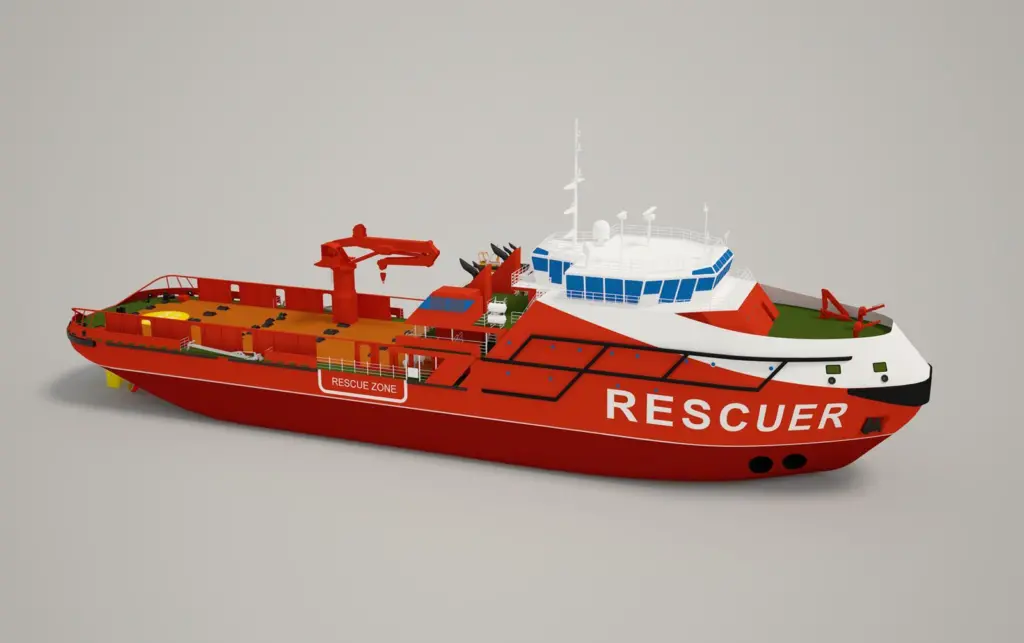
A computer generated impression reveals a profile similar to an offshore support vessel with raked stem and cruiser stern. A two-level wheelhouse/accommodation block is located on the forecastle deck, further crew spaces below, above main deck level. The engine room is located amidships. The spacious aft deck has a cut-away stern with towing pins aft. The ability to offload and transport cargo including containers is evident from the clear deck space, lashing points and a knuckleboom crane offset to port. Two fire monitors are positioned on the foredeck. The hull is reinforced to ice category Arc5 and propulsion is from twin propellers with the vessel’s manoeuvrability enhanced by inclusion of two bow and one stern thrusters.
Nevsky Shipyard’s origins date back to construction of Russia’s Old Ladoga Canal in 1719, at the time Europe’s largest hydraulic structure. Increasing traffic led to establishment of the Schliesselburg ship repair workshops in 1913, later becoming the modern Nevsky Shipyard. Over 300 vessels of all type have been built by the yard and while shipbuilding is their main activity, ship repair remains an important activity for the yard which employs over 1,000 people. The yard’s slipway can accommodate vessels up to 150m length with a docking weight of 3,000t.
By Peter Barker
Related Articles
 SPECIAL REPORTS
 TUGS & SALVAGE
 EQUIPMENT