![MaritimeJournal[Seawork]](https://www.maritimejournal.com/wp-content/uploads/2026/09/MaritimeJournalSeawork.svg)



Three more green tugs for Norway
The gradual introduction of ‘green’ tugs is continuing with an order for three dual-fuel escort tugs for Norwegian ship owner Østensjø Rederi to operate for Statoil.
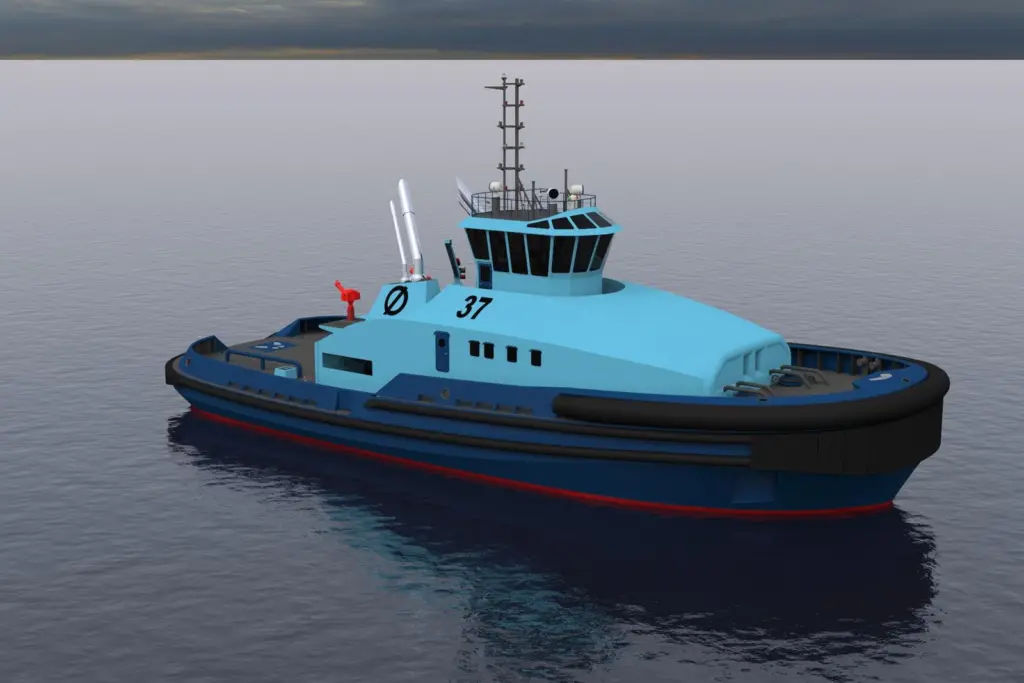
In 2013 fellow Norwegian tug owner Buksér og Berging entered the history books when they took delivery of the world’s first pure LNG-fuelled tugs Borgøy and Bokn from Sanmar Shipyard in Turkey. Østensjø Rederi have now followed the trend with their order for a trio of powerful dual-fuel (LNG and marine gas oil) tugs from Spanish shipbuilder Astilleros Gondán SA.
These latest deliveries and orders are on the back of contracts with Norwegian oil company Statoil and are examples of the trend for high-specification, high quality towage services at onshore and offshore terminals. Østensjø’s vessels will operate at Statoil’s Melkøya terminal near Hammerfest Norway with Buksér og Berging’s pair now in operation at Statoil’s Kårstø gas terminal.
Østensjø Rederi have returned to Canadian naval architect Robert Allan Ltd, selecting their RAL 4000 DF (ASD) design with basic specifications including length 40.2m, beam 16m, moulded depth 6.1m, draught (at escort waterline) 6.7m, bollard pull 100t and a steering force of 155t. The tugs will be required to operate in icy environments of up to -20’C and wave heights to 5m (Hs). This called for a demanding design along with quality construction to provide protection from the weather for crew and equipment. As well as shiphandling and tanker escort duties they will also be capable of coastal and ocean towing work and delivery is expected during the first half of 2017.
The machinery package will be supplied by Wärtsilä Corporation and includes two six cylinder Wärtsilä 34DF dual-fuel main engines. The tugs are designed to operate primarily on LNG fuel, the dual-fuel capability providing the flexibility to select the most suitable fuel according to availability, price and local environmental restrictions.
The LNG system will incorporate Wärtsilä’s unique fully integrated LNGPac gas handling system and Gas Valve Unit (GVU): the latter has been particularly designed to accommodate the need for a compact solution. The contract for the machinery package was signed in December 2014 with delivery scheduled for the first half of 2016.
The hull-form will be optimised to provide best possible sea-keeping performance sailing in each direction with a high top speed of 15 knots (free running) with main machinery at 100% MCR and fuel and stores at approximately 50% capacity. The hull, deckhouse and wheelhouse will be of all-welded steel construction with the mast constructed of galvanised steel. The vessels will be fitted with fire-fighting equipment (water and foam) to fifi1 class requirements along with oil recovery equipment.
Approximate tank capacities for the ASD trio include: fuel oil 236.7m3, LNG 30m3 (at 90%), fresh water 32m3, foam 19.2m3, dispersant 14.1m3, recovered oil 255.5m3 and ballast water 123.9m3. The accommodation will be outfitted to the usual high standards seen now in such vessels with space for five crew members, each accommodated in single cabins, three of which will also have one spare Pullman type bunk.
Gondán Shipyard is located in the Province of Asturias, Northern Spain with three facilities in the region at Figueras, Barres and Vegadeo. They produce a broad portfolio of vessels ranging from cargo carriers to fishing vessels to military vessels and their reference list includes high specification tonnage such as offshore support vessels and in this respect Østensjø Rederi are no strangers to Gondán’s products. Between 2007 and 2013 they took delivery of three innovative diesel-electric platform supply vessels from Gondán, each powered by two Voith propulsion units.
Østensø themselves state that they never purchase vessels ‘off the shelf’, instead opting for specialised and advanced bespoke vessels (they pioneered the use of Voith Schneider propellers in offshore vessels with the three mentioned above). The three platform supply vessels are not the only vessels they have taken delivery of from Gondán however.
There are two main strands to Østensjø’s business, offshore and tug services and with the latter they have been regular customers for Gondán. Between 2005 and 2010 they took delivery of five tractor tugs: Velox, Tenax, Phenix, Apex and Vortex. All five are of the Robert Allan Ltd AVT 3700 design, once again adopting Voith propulsion units with bollard pull figures quoted as between 65t and 73t. Østensjø have one other Robert Allan designed Voith tractor Ajax (93tbp) built by another Spanish builder, Astilleros Zamakona SA.
Mr Carl Johan Amundsen, Project Manager at Østensjø Rederi said: “These are trend setting tugs in that they provide environmental sustainability through the use of LNG fuel. Wärtsilä is the technology leader in making this trend possible. At the same time, the flexibility of the dual-fuel engine technology also ensures a high level of operational security since the switch from gas to diesel can be made at any time without loss of speed or power.”
By Peter Barker
Related Articles
 SPECIAL REPORTS
 TUGS & SALVAGE
 EQUIPMENT