![MaritimeJournal[Seawork]](https://www.maritimejournal.com/wp-content/uploads/2026/09/MaritimeJournalSeawork.svg)


Change is in the air… and in the water
The wind installation market is being driven by rising scale, depth and not least, competition. so some operators are responding by making significant changes.
“The challenge we face now is future-proofing our fleet,” Peter Robinson, MPI Offshore’s managing director, told MJ: however, the dilemma is that future’s lack of clarity.
So, despite the looming shadow cast by the upcoming 10MW-plus turbines, the details, including those of the necessary investment pipeline, remain shrouded in uncertainty.
Mr Robinson is blunt about the issue: “We stopped attempting five-year plans about two years ago because it’s nonsense. At the moment you just can’t see that far ahead.” He added that while MPI is looking toward a productive 2017 and 18,“it’s still a very tentative market and you need to step your way through it carefully, gathering intelligence and information to firm up your opinion for what will happen after that”.
So, it’s with a robust outline for the next two or three years “and an eye on where things might go afterwards” that MPI has decided to adapt some of its vessels. Although the six-legged MPI Resolution recently went in for an upgrade that helped capture maintenance work at Amrumbank, the 60-day operation, was “a no-brainer” as it came down to installing the additional leg lengths that came with the original vessel delivery back in 2003.
But Resolution won’t be the last of MPI’s fleet to undergo surgery and the rest are going to be a little trickier. MPI Discovery has been the subject of detailed discussions – 15m leg additions “just begin to give you some stability issues” when raised in transit while 5m just isn’t long enough. “But at 10m you get enough benefit to be worthwhile, and stability isn’t a big deal,” he added.
However, Mr Robinson is clear, he’s not just a ‘leg man’ and the lifting capacity is as much to the point. However, there’s a change in the air.
“It used to be that one way or another, you’d design a single vessel to take on everything. But now, we are looking at the XXL size of monopiles, and probably eventually moving into jackets at some point,” he said. At the same time, “the demand is for one piece towers, so you are lifting components of potentially 100m-plus and maybe even 130m in length, which means going forward you’ll need hook heights of 150m off the deck”.
So, MPI is now looking at dividing the fleet’s focus.
“In my view, although there will be some crossover we will begin to see a split in crane duties. While you need a longer, slimmer boom to achieve the hook heights for the turbines, these don’t necessarily need the massive lift capacity required for the foundations – those would best be served by shorter, sturdier cranes.” Therefore Discovery is aiming at specialising in this latter type of operation: a new 1,500 tonne crane “will allow work at a reasonable radius with a 1,300 tonne monopile”.
The returns are another issue – interestingly, this also plays into greater role differentiation.
Mr Robinson reckons that “day rates are about 20% lower than they were two years or even 18 months ago”. It’s still viable for MPI and similarly established operations, if only because the older vessels have had a good run for their money and paid off most of their original investment. However, he added: “It’s approaching those margins where it becomes more painful, and you have got to be a little more commercially aware than in the past.”
He explained that a few years ago a vessel might have entered a job where “you might have been more relaxed and taken on a little extra weather or other risks… now these contracts need a known and defined scope.” It’s a “lean and mean” game these days, compounded by the rise in scale “and you need to be more specific and definitive than before” he concluded.
BOSKALIS
MPI is not alone in its response. One of Boskalis’ biggest semi-submersible heavy lift vessels is also under the knife: the current slowdown in the oil and gas market has resulted in the company giving this 216m long SSHTV a new lease of life as the F3000.
While not steady enough for turbine fitting, a floating vessel that can hold station on DP is quite literally going to be one step ahead when it comes to tower and foundation installation as it doesn’t have to spend hours putting its feet down.
Further, being a large vessel to start with, this SSHTV is ahead of the curve for the new component sizes. But the modification is no superficial job, the changes go right down to the bone, explained Boskalis’ renewables commercial manager Bart van Schooten.
It helps that the big ship already has certain characteristics that can be capitalised on. Stability is one element, plus, of course, there’s available space on top: “No other crane vessel has an empty deck of 165m by 43m,” he pointed out.
Next, the existing design provides a transit speed between 11 and 12 knots. Combine this with that massive deck space, a big 3,000 tonne crane and the result is fewer pick-up runs and more time on site. Therefore while certainly larger and therefore higher on the day rate as well as fuel, the increased efficiency will condense installation programs and lower costs, creating, according to Mr van Schooten, “a double winner”.
However, unlike its original remit, the SSHTV’s new incarnation is going to need a DP2 positioning system. It means, he explained, going the whole hog and committing a relatively recent vessel to the process and not trying to re-purpose an older one, not least because “a fully redundant modern diesel-electric layout…. is less complex to reconfigure compared to a shaft drive”.
However, a semisubmersible, even a large one, is substantially different in nature to a crane ship and Mr van Schooten admitted that generally speaking it’s no easy job to convert a vessel designed for a particular purpose. “The challenge is to make use of the specific strengths of the SSHTV and have these work to your benefit,” he explained.
So, for example, redrawing it into a DP vessel means no less than four, 3.5MW Rolls-Royce retractable thrusters and two 1MW-plus bow thrusters to pick up the demand from the dynamic positioning – and to feed it all, over 10MWs of additional genset power.
This lands the redesign with something of a problem: where’s the space for all this extra equipment going to come from? In fact, it becomes available from relinquishing the original’s central feature; many of the submersible’s huge ballasting tanks are being reshaped to provide engine space and internal thruster rooms; those that remain are being adapted to give the F3000 a fast trim, rather than depth capability.
Last but not least, the accommodation block will be enlarged from 50 to 150 personnel and the addition of a helideck will allow offshore crew changes.
It has to be admitted that the F3000 isn’t only looking toward the inauguration of new wind parks, it’s also focusing on the decommissioning of existing oil and gas installations to support its new remit. However, both have one thing in common: price constraints. This overriding feature has underscored the need for modifications to be both “smart and efficient” said Mr van Schooten.
NEWBUILDS
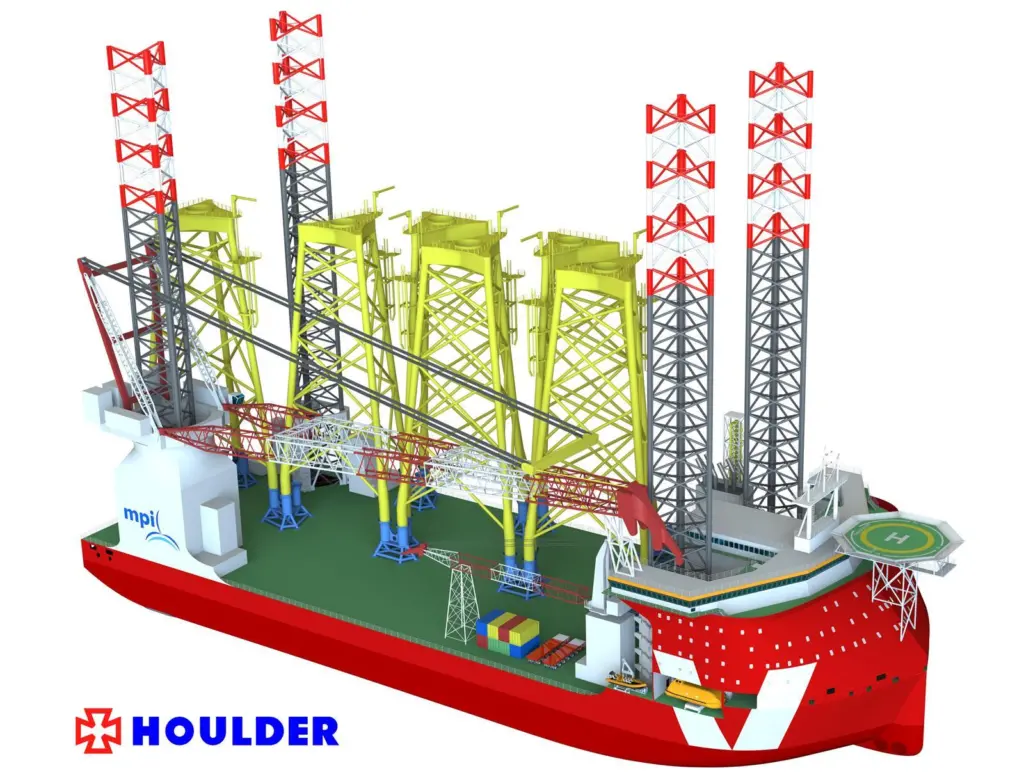
While adapting existing vessels yields cost efficiencies, a solid investment pipeline means companies will once again be looking at new builds. Certainly, MPI has an advanced jack-up on the burner – and has invested £3m on the design alone.
The 180m MPI Endeavour will be able to work in water depths of 65m and will be equipped with a capable, 2,600 tonne capacity crane. Scaled to carry six, vertically stacked jackets, “it might take even more if we are working with items that allow for nesting”, he said. “Similarly you will need to be able to get six or eight of the new turbines on the deck. These are the kind of numbers you need to be looking at to make it viable.”
It’s just waiting “for a couple of two-year-plus charters” to enable MPI to push the button on construction. Why two years? Mr Robinson explained that a couple of windfarm developers got burned by the failure of their charter agreements to keep pace with the exponential rise in scale of components. “So now they are very reluctant to get into a long-term relationship with an owner because maybe in two or three years time, the components will be out of that vessel’s capacity,” he explained. “The longer, continuous hire periods are gone. We have to get used to stringing one or two charters together.”
On top of this, there’s the end of ‘pay-as-you-go’ contracts in favour of fixed price, lump-sum agreements which leaves operators responsible for the overruns. All of which leaves businesses such as MPI needing “a very sharp pencil for the calculations”, said Mr Robinson.
Finally when it comes to predicting what kind of vessels will prove most suitable for this new generation of wind components, Mr van Schooten pointed out that efficiency is the big issue.
Certainly, the industry has noted the sudden plunge in strike price and most assume the associated squeeze will be passed on, one way or another. Therefore Mr van Schooten believes operations need a rethink simply because these developments “don’t give much room for manoeuvre”. He said despite the many changes “there are two items which remain constant… the need for cost-efficient solutions and quick turnaround times”, and added this newly tailored ship will be “the appropriate answer”.
Needless to say, Mr Robinson has his own view. He admitted that “when the weather is right, floating vessels become very competitive” but said, “taken over a full 365 days a year, the jack-up wins hands down”.
The future is shaping up to be particularly demanding – but given the breadth of operations, there will still probably be room for both.
By Stevie Knight

Related Articles
 OFFSHORE RENEWABLES
 OFFSHORE RENEWABLES
 ENVIRONMENT