

When a Marine Hydraulic System Needs More Pressure in One Place
 Marine and offshore equipment often relies upon a central hydraulic supply serving several different functions. Most may operate satisfactorily at the available system pressure, while one tool or operation occasionally requires considerably more.
That creates an important design question. Does the complete hydraulic system need to be designed or upgraded for one demanding function, or can the additional pressure be generated locally, where and when it is required?
Where the high-pressure demand is intermittent and requires a comparatively small volume of fluid, a hydraulic pressure intensifier may provide a compact alternative.
Making better use of an existing hydraulic supply
A hydraulic pressure intensifier, sometimes called a hydraulic booster, uses an existing low-pressure hydraulic supply to produce a higher pressure at its outlet. A larger piston area driven by the host supply acts upon a smaller piston area on the high-pressure side. The difference between those areas determines the theoretical intensification ratio.
The intensifier does not produce additional energy. It exchanges flow for pressure. The available high-pressure flow is therefore lower than the inlet flow, and actual performance must also allow for efficiency losses.
This makes pressure intensification particularly relevant where an existing vessel, offshore installation or remotely operated vehicle has sufficient hydraulic flow but cannot provide the pressure required by one attached tool. The alternative could involve a separate high-pressure power unit or extensive changes to the host hydraulic system.
Where might higher local pressure be useful?
Documented marine and offshore uses include subsea cutting and gripping tools. An ROV may provide the flow needed to position and operate a tool, while a local intensifier produces the greater pressure required for the final cut or grip. Similar arrangements can be used with linear override tools and other intervention equipment.
Local intensification may also be considered for hydrostatic testing of valves, pipework, hoses, pressure housings and other marine or offshore components. The test requires high pressure, but the wider installation does not necessarily require a permanent high-pressure hydraulic supply.
Other possible duties include high-force clamping, locking, pressing and maintenance tools. In every case, suitability depends upon the pressure, flow, fluid volume and duty cycle required rather than the application name alone.
Fast approach followed by high force
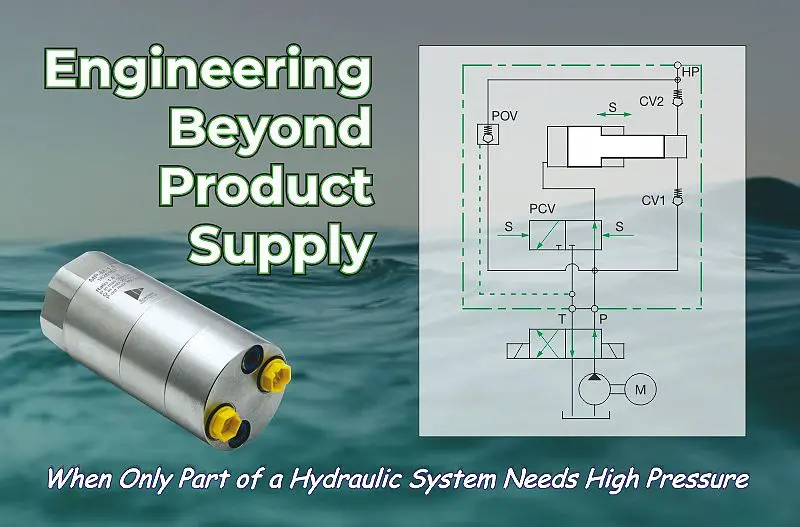
Some pressure intensifiers incorporate a low-pressure bypass. This can be useful where a tool initially requires relatively high flow at normal system pressure, followed by lower flow at a much higher pressure.
Consider a hydraulic cutter. The host supply can pass through the intensifier to move the blades rapidly towards the material. As resistance increases and the pressure reaches the changeover point, the bypass closes and the intensifier begins operating automatically. The final cutting force is then produced at the higher pressure.
This can shorten the operating cycle while limiting active pressure intensification to the part of the cycle in which it is needed. Pressure may nevertheless remain trapped in the high-pressure section after operation, so controlled decompression remains essential.
Why not increase the pressure of the complete system?
Designing the complete hydraulic installation around one exceptional pressure requirement may affect the power unit, valves, hoses, pipework, filters, seals, fittings and control equipment. It may also extend very-high-pressure pipework through areas where it is not otherwise needed.
In a suitable application, local pressure intensification may help to:
• Retain an existing host hydraulic supply
• Avoid a separate high-pressure power unit
• Reduce the number of components requiring the highest pressure rating
• Limit the length and extent of the very-high-pressure circuit
• Reduce installation space and weight
• Provide high pressure only for the function that requires it
These are potential system benefits, not automatic consequences of fitting an intensifier. Where continuous high pressure and high flow are required together, a dedicated power unit may remain the more appropriate solution.
Safety remains a system responsibility
Hydraulic systems contain stored energy, and released fluid can cause severe injury. The risks become still more serious at very high pressures. Restricting the intensified pressure to a smaller, clearly defined part of the circuit can assist safe system design, but it does not make that section inherently safe.
Every component on the high-pressure side must be suitable for the maximum pressure it could experience. The design must consider pressure relief, guarding, isolation, hose and fitting ratings, controlled depressurisation and the possibility of pressure remaining trapped after the host supply has been switched off.
Subsea operation makes these considerations more demanding. A leak or component failure may be difficult to observe directly, while inspection and intervention are remote. The complete tooling package, not merely the intensifier, must be designed and tested for its intended duty.
Subsea equipment requires more than high-pressure capability
An intensifier suitable for protected installation aboard a vessel is not automatically suitable for direct immersion. Subsea selection may additionally require consideration of:
• Operating depth and external hydrostatic pressure
• Corrosion-resistant materials and protective finishes
• Seal and hydraulic-fluid compatibility
• Use of hydraulic oil, glycol or water-glycol fluids
• Pressure compensation and prevention of seawater ingress
• Subsea-rated hoses, fittings and electrical or hydraulic interfaces
• Environmental consequences of leakage
• Recovery, inspection and maintenance arrangements
• Applicable certification and classification requirements
Pressure intensification can form part of a subsea solution, but only when the intensifier and every connected component have been selected for that environment.
Start with the duty, not the pressure ratio
Correct selection begins by establishing the available inlet pressure and flow, required outlet pressure, high-pressure fluid volume, operating frequency, permitted pressure build-up time and duty cycle. Fluid type, temperature, installation space, pressure losses and safe isolation arrangements must also be understood.
A cutter requiring a small volume of oil at high pressure for the final part of its stroke presents a very different duty from equipment expected to move continuously at high pressure. A pressure ratio alone cannot establish whether an intensifier is suitable.
Consider the complete marine hydraulic system
A pressure intensifier can allow an existing marine or offshore hydraulic supply to operate a tool with a higher local pressure requirement. In the right application, it may avoid unnecessary changes to the host system, reduce the extent of the high-pressure zone and make better use of the hydraulic power already available.
Its value does not come simply from producing a larger pressure figure. The real engineering question is where the higher pressure is needed, how much high-pressure flow is required and how the intensified section can be controlled, isolated and maintained safely.
jbj Techniques can supply hydraulic pressure intensifiers and assist with evaluating their suitability as part of the wider hydraulic system.
Sometimes the answer is not to make the entire system operate at a higher pressure, but to apply higher pressure only where it is required.
Find out more about Pressure Intensifiers at jbj.co.uk