




Analysis highlights drop in Scottish offshore wind investments
Scottish Renewables has drawn attention to positive developments in Scotland’s offshore wind industry but also pointed out challenges that have impacted the pace of investment.
The analysis ‘Offshore Wind: Investing in Scotland 2013’ was produced ahead of the Offshore Wind & Supply Chain Conference in Aberdeen recently, and highlights figures from offshore wind deployment and investment in 2013 showing a dip in investment. This is against the backdrop of ambitious renewable targets set for Scotland. Scottish Renewables represents over 300 renewable energy sector companies and figures show major developers more than halved their spending in Scotland in 2013, the industry potentially threatened by an investment hiatus. The findings report that £28.9m was spent in 2013 compared with £63.6m in 2012. Total investment to date now stands at £193.4m.
Lindsay Leask, senior policy manager for Scottish Renewables said: “Uncertainty throughout the industry is growing as none of the major projects planned for Scottish waters have had their planning applications determined yet, and the details around accessing market incentives are still unclear.” She went on to say that offshore wind developers can’t afford to be “left in limbo”. As a result, the supply chain serving offshore developments is also restricted in its ability to grow.
Scotland is seen as having all the right ingredients to build a world class offshore wind industry, with estimates of 25% of Europe’s offshore wind resources, and benefitting from world class oil and gas industry expertise and an active research sector.
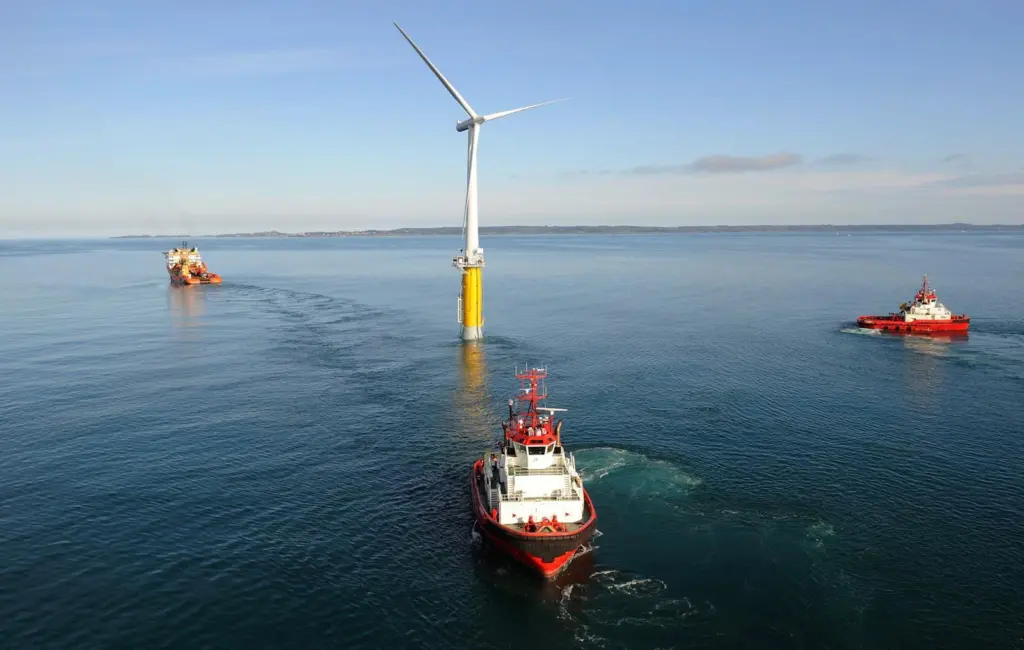
There was positive news however for 2013 including the installation of Samsung Heavy Industries’ 7MW turbine off the Fife coast, the launch of the £15m Scottish Innovative Foundation Technologies Fund and progress on Statoil’s Hywind development off Peterhead, the UK’s first floating offshore wind project.
The slow-down referred to extends to other parts of the UK, with several projects either cancelled or reduced in size. Analysing recent trends and events in the UK makes for a complex exercise. The industry has clearly been caught up to some extent in the politicisation of the domestic energy market, mixed messages being sent to developers contemplating investments over timescales considerably more distant than politicians horizons.
When the nine Round 3 UK zones were identified in 2009 the figures surrounding potential capacity and turbine numbers were eye-watering. Potential is moving to reality however and The Crown Estate describes the industry as maturing, with continuation of a “healthy attrition” as the UK pipeline moves from a potential 40GW towards a figure more in line with the government’s current thinking. Recent events are seen as far from implying the industry is running out of steam however, rather signs of a healthy sector, firming up a clear, sustainable pathway towards future growth.
By Peter Barker
Related Articles
 OTHER NEWS
 MARINE CIVILS NEWS
 OTHER NEWS