![MaritimeJournal[Seawork]](https://www.maritimejournal.com/wp-content/uploads/2026/09/MaritimeJournalSeawork.svg)


Barge innovation helps build Bordeaux bridge
Bringing in the 6,600 tonne steel sections of the recently opened Bacalan-Bastide elevating bridge from Italy to Bordeaux in France required the kind of innovative approach that is becoming common with the rise in large-scale structures.
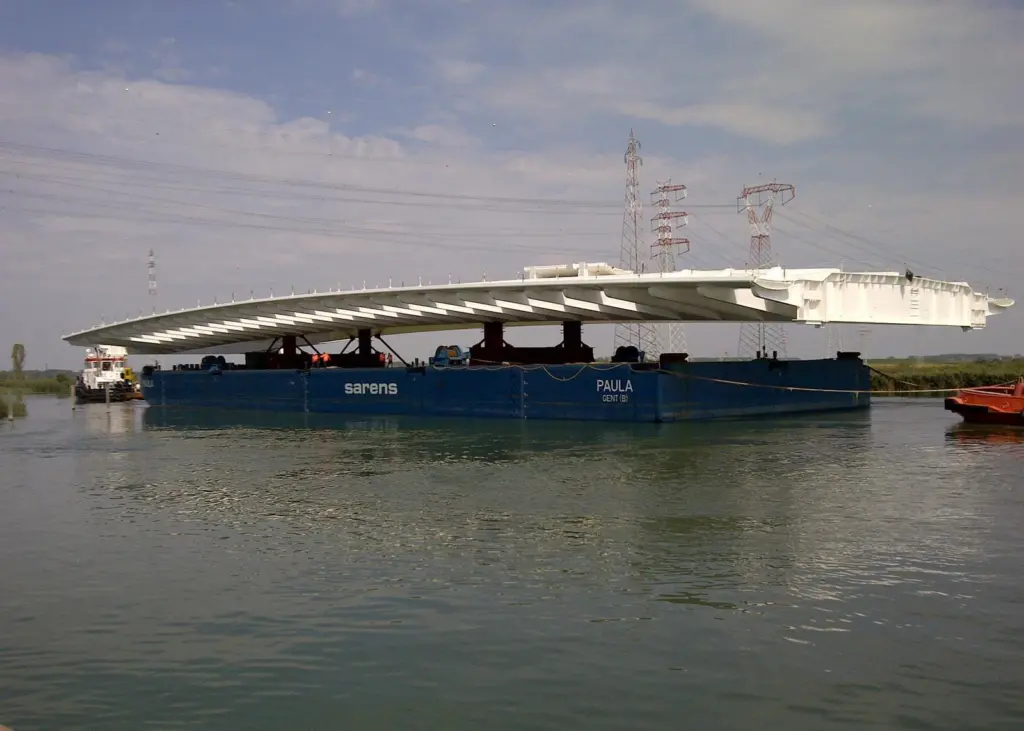
The bridge (now renamed Pont Jacques Chaban-Delmas) spans the Garonne and provides a 110m sailing channel. With the mid-section lifted, the 77m pylons allow an air draught of 53m and, as you’d expect from the winner of an international design competition, it also provides a truly magnificent spectacle.
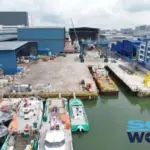
However, the build logistics are in themselves quite spectacular. The first point, explains Peter Libert of the Germany based Sarens Group, is that the construction area at the French site of the 117m steel bridge was limited and certainly not up to providing the necessary 4,000m2 of free space for a build on site.
As you can imagine, the engineering on a vertical-lift bridge has an extremely heavy duty cycle with stresses to match. And, as is increasingly the case with many of these mammoth sized civil works, there are a number of challenges that the scaled-up engineering has to meet, resulting in a growing need to both build and test out the designs under controlled conditions. There is also the issue that with such a novel design, a manufacturer wants to keep the core competency of a skilled workforce close to hand, much more difficult to do if you are taking a build out to a remote site or even to another country.
And in this case, adds Mr Libert, if you tried to bring this particular build onto the site at Bordeaux you’d be responsible for putting something like 400 additional trucks on the road, many of them for a long haul.
All of this meant the most efficient and cost effective option was putting it together in the Italian Cimolai manufacturing site, testing it out and then transporting it in five large, pre-assembled pieces to its final application in Bordeaux. However, the biggest section weighs in at a huge 2,500 tonnes.
While the Garonne in Bordeaux certainly isn’t open for heavy lift ships, it can take big pontoon barges and Sarens’ largest twins, the 100m barges Louis and Paula, were prepared for two separate load outs in San Giorgio, Italy. These are both very spacious, strong craft with a 33m beam, a 6.7m draught and an overall deck strength of 25 tonnes per metre. The water ballasting tanks are laid out so that there are five transverse bulkheads and three longitudinal ones holding 21,616m3, with a pair of pumps that can shift 1,000m3 per hour between them.
However, this still leaves the issue of getting the sections onto the barges. Sarens’ approach was to use no fewer than 18 Kamag self-propelled platform trailers (SPMTs). These indicates the number of SPMT ‘modules’ that can be linked together and remotely driven, in this case in four rows, to wheel the sections onto a receiving cradle on the vessel. This use of SPMTs and ro-ro able barges is gaining ground as it is generally more cost effective than the big crane lifts and is also a more stable option. However, the general effect can be like seeing a giant roller skating onto the waiting pontoon.
The other approach that Sarens uses concerns the cradle itself. This is fitted with a ‘climbing’ mechanism and has two layers, the top of which is fitted with four, 600 tonne jacks. So when it came to loading the side sections, after the larger piece had been slid into place these hydraulic jacks got to work to elevate the section above the deck, giving room for the other slightly smaller section to be rolled on below it.
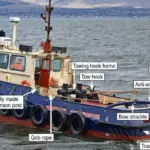
The newly constructed Paula, carrying the large central section, was towed by Sea Bravo from Porto Nogaro round Italy, through the Mediterranean, past Spain and into Bordeaux, a month’s journey covering 2,650 nautical miles. Bart Peeters of Seacontractors says that considering the “exceptional value and nature of the load” and a week’s delay to avoid forecasted 3.3m wave heights near Gibraltar, “it was a very smooth operation”.
However, the trickiest parts of the process took place on arrival at the site in Bordeaux as the barges and cargo were drawn precisely into position using a number of tensioned lines. In the case of the side sections, the SPMTs had to turn the whole section around to slot it into the tight gap at the side of the river, then tilt it with the hydraulic jacks to the necessary four degrees. Mating it up relied on both the tide and Louis’ powerful ballasting mechanism to lower both barge and bridge section downward, slotting it into the receiving structures either side.
Bringing the central section into position was done by turning the whole barge athwart the river, a twitchy job considering the action of the current and tide on Paula’s long hull, and once again both tide and the ballasting mechanism were used to settle the big section into place on its pins, ready to be linked up to the counterweights that run up and down inside the pairs of towers at either end.
By Stevie Knight
Related Articles
 FEATURES & VIDEOS
 MARINE CIVILS
 OTHER NEWS